
While the Lebanese state presses ahead with implementing recent understandings aimed at extending its authority over southern Lebanon and consolidating weapons under its control, Israel appears determined to cement its military presence inside Lebanese territory — commencing construction of permanent positions and officially declaring that it will not withdraw from the "security zones". These developments place the Rome framework understandings before their first real field test.
In the most significant new development, the Israeli newspaper Maariv reported yesterday that the Israeli army has begun constructing a line of permanent military positions inside the security zone it controls in southern Lebanon, a move that suggests the military presence is shifting from a temporary deployment to a more enduring structure.
This came simultaneously with Israeli Defence Minister Israel Katz confirming, during a phone call with his American counterpart Pete Hegseth, that Israel intends to keep its forces in the "security zones" in Lebanon, Syria, and the Gaza Strip, describing this as necessary to protect Israel's borders.
A statement issued by Katz's office added: "We have never asked the United States to act on our behalf along our borders." It continued: "We are determined to defend the citizens of Israel against any threat, and that is precisely what we intend to do."
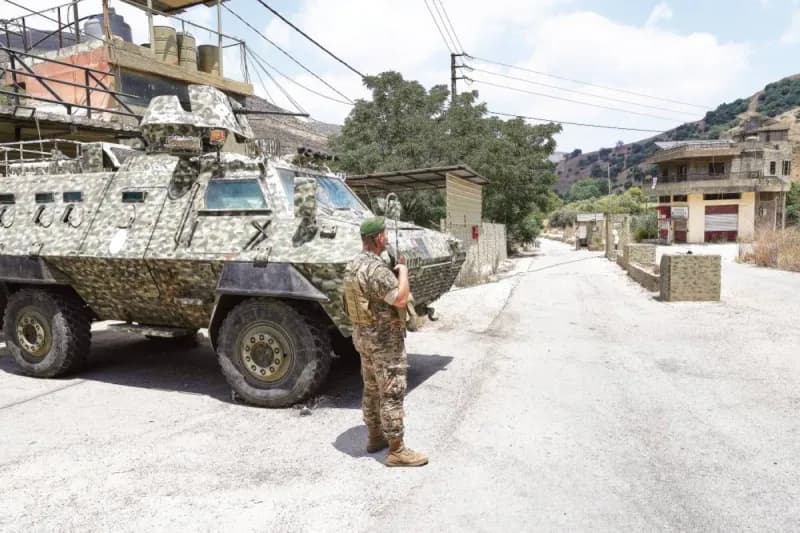
In parallel, the Lebanese army began conducting intensive patrols in the Ghandouriyeh sector adjacent to the town of Farun, as part of implementing the latest procedural understandings stemming from the framework agreement, with the aim of demonstrating its readiness to deploy in pilot areas — despite ongoing security tensions and widespread destruction that continue to limit the return of residents.
On the ground, the Israeli army continued its operations in southern Lebanon, carrying out strikes on the outskirts of the towns of Baraachit and Beit Yahoun. The Lebanese National News Agency reported that Israeli forces set fire to a number of homes and areas of land on the outskirts of Beit Yahoun, while warplanes and drones continued to fly over several Lebanese areas.
On the political front, Lebanese Foreign Minister Youssef Raji confirmed that the government has taken a decision to end Hezbollah's military presence and to restrict weapons to the hands of the state, stressing that decisions on war, peace, and foreign policy are now exclusively the prerogative of legitimate institutions. However, he linked the completion of army deployment and the extension of state authority over all Lebanese territory to a full Israeli withdrawal from the south.
These developments indicate that implementation of the new understandings faces a dual test: while Beirut seeks to strengthen the state's and army's presence in the south, Israel is taking field-level steps that suggest it is prepared for a longer-term presence inside the areas it controls — something that could complicate the gradual withdrawal process on which the recent understandings are premised.