
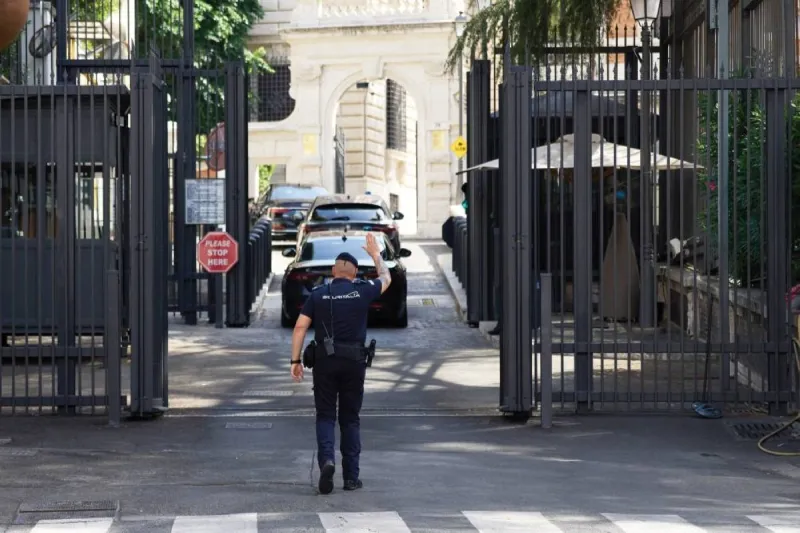
Amid US President Donald Trump's call on Israel to withdraw from Lebanon and Syria, the sixth round of direct negotiations between Lebanon and Israel kicked off in Rome on Tuesday under American auspices, in an effort to translate the framework agreement signed in Washington in late June into concrete field steps.
The most prominent of these steps is the establishment of 'pilot zones' in southern Lebanon, from which Israeli forces would gradually withdraw in exchange for the deployment of the Lebanese army under American supervision. However, Israel expressed its readiness to proceed with only 'two pilot zones', even as it escalated military activity in southern Lebanon.
The Lebanese delegation in the Rome round included Ambassador to Washington Nada Maaouad, former Ambassador Simon Karam, and Brigadier General Ziad Haykal, adviser to Lebanese President Joseph Aoun, while a source close to the negotiations confirmed that the US Ambassador in Beirut was absent from the talks.
The meeting, which lasted 5 hours and is set to continue on Wednesday, carries exceptional significance as it represents the mandatory executive channel for translating the 'framework formula' into reality on the ground in the south — specifically by finalising the operational details of an Israeli forces withdrawal timetable concurrent with the deployment and positioning of Lebanese army units in the 'pilot zone'.
An American official told Axios that Trump made clear to Israeli Prime Minister Benjamin Netanyahu, in a phone call, the necessity of withdrawing from Syria and Lebanon, and that the Israeli military presence on Syrian soil is causing tensions that could lead to regional escalation.
The official added that the same assessment applies to the Israeli presence in Lebanon. The site reported that Netanyahu told Trump that Israel needs border security zones.
Meanwhile, Israeli Foreign Minister Gideon Sa'ar said he expects the talks to help achieve progress on the withdrawal of Israeli forces from 'two pilot zones' in the south.
Sa'ar told journalists at a press conference: "We are ready to move forward on these two pilot zones. I hope, and I believe, that this round of discussions in Rome will push towards accomplishing that."
Lebanese sources on the negotiations track stress that the real bet must be placed on the pilot zones, as they will be the true measure of the parties' credibility.
If the pilot phase succeeds, the agreement will have taken a fundamental step towards implementation. If it falters, all political meetings will remain on hold pending the implementation of this point, with the possibility of transferring talks to Washington should the current round face obstacles.
According to available information, the areas proposed for the first phase of implementation include Zoutar Al-Sharqiyeh, Zoutar Al-Gharbiyeh, Yohmor, the environs of Beaufort Castle (Qala'at Al-Shaqif), Froun, and Al-Ghandouriyeh — strategic areas overlooking the Litani River and a number of Israeli settlements.
There is no doubt that the measure of success in this new round is American pressure on Israel to take practical steps on the ground and allow the Lebanese army to deploy in the agreed-upon areas, as Lebanon enters a political phase centred on themes that form the basis of the international approach to Lebanon: entrenching the Lebanese state's authority over sovereign decisions, completing the negotiations track, and ensuring the success of Joseph Aoun's visit to Washington.
The Rome round comes one week before the anticipated meeting between the Lebanese president and the US president in Washington on 21 July, which is expected to address the future of the framework agreement and the next phase of security arrangements on the southern border.
Lebanon appears unwilling this time to accept any Israeli manoeuvring, as parallel coordination meetings are taking place in Beirut with a US military delegation that arrived days ago, following a series of meetings with Israeli military officials, to discuss the mechanisms for implementing the first phase of the agreement.
In this way, Lebanese authorities are raising their bets on an American role that presses Israel to convert the framework memorandum into field action — yet this approach is constantly met with Israeli intransigence, as Israel escalated its attacks in southern Lebanon concurrently with the negotiations round.
The past few hours saw systematic demolition and blasting of homes and buildings, as well as a drone strike. Israeli forces carried out demolition operations in the towns of Al-Nabatyeh Al-Fawqa and Kfar Tibnit in the south. An Israeli drone struck the town of Al-Nabatyeh Al-Fawqa, with 2 injuries reported.
Movement of Israeli military vehicles was also recorded in the vicinity of Zoutar Al-Gharbiyeh and Zoutar Al-Sharqiyeh, accompanied by heavy machine-gun fire in the area, according to Lebanon's official National News Agency.