
Lebanon is living through a decisive phase as a US delegation arrived in Beirut to establish mechanisms for an anticipated Israeli withdrawal within days from a pilot zone in the south and its handover to the Lebanese army, paving the way for a new round of negotiations in Rome next Thursday and Friday.
A US military delegation arrived in Lebanon and began meetings with Lebanese army leadership to discuss the mechanisms for implementing an Israeli military withdrawal from a pilot zone — one of two such zones in southern Lebanon — according to a Lebanese military source who spoke yesterday.
A Lebanese military source told Agence France-Presse, on condition of anonymity: "The American military delegation has arrived and begun meetings with Lebanese army leadership to discuss establishing the mechanisms to begin implementing the first pilot zone from which the Israeli army will withdraw so that the Lebanese army can deploy." He added: "This is the main item the American military delegation is bringing to Lebanon — the translation and application of the framework paper."
In Washington, a US official stated: "We are now in the implementation phase of the framework," adding: "The first pilot zone will be launched within days, and additional pilot zones are currently being mapped and planned."
He explained that US Central Command (CENTCOM) would handle coordination with both countries, saying: "We will soon begin engaging with international partners to effectively help the Lebanese government restore its sovereignty in these areas and across the country more broadly."
Lebanon had conditioned its acceptance of participation in a new round of negotiations — scheduled for next week in Rome — on Israel withdrawing from 2 pilot zones in the south, according to a diplomatic source close to the negotiations who spoke several days ago.
The agreement does not set a timetable for withdrawal from southern Lebanon, while Israel has repeatedly stated through its officials that its forces will not withdraw from a security zone extending 10 kilometres from its border until Hezbollah is disarmed — a step Israel doubts the Lebanese state is capable of carrying out.
Meanwhile, a Lebanese official source said yesterday that Lebanon will participate in the talks scheduled for next week with Israel in Rome. The source confirmed Lebanon's participation, after a diplomatic source close to the negotiations had said on Wednesday that Lebanon was conditioning its acceptance on Israel withdrawing from 2 pilot zones in the south.
The next round of negotiations is scheduled to be held in Rome on 15 and 16 of this month at Washington's request, having hosted the first five rounds. The upcoming round will take place days before an anticipated visit by Lebanese President Joseph Aoun to Washington at the invitation of his American counterpart Donald Trump.
Separately, German Foreign Minister Johann Wadephul announced a German-French initiative regarding Lebanon. The minister told the German newspaper Tagesspiegel ahead of the German-French Council of Ministers meeting next week: "We want, together with France, to formulate a common policy towards Lebanon in order to increase the chances of achieving peace in the Near and Middle East."
The minister did not reveal further details. At the same time, Wadephul announced other joint initiatives with France, explaining that the two countries want to strengthen Europe's capacity to act in foreign policy, including by ending the "overlapping of competences" in EU foreign policy, among other things.
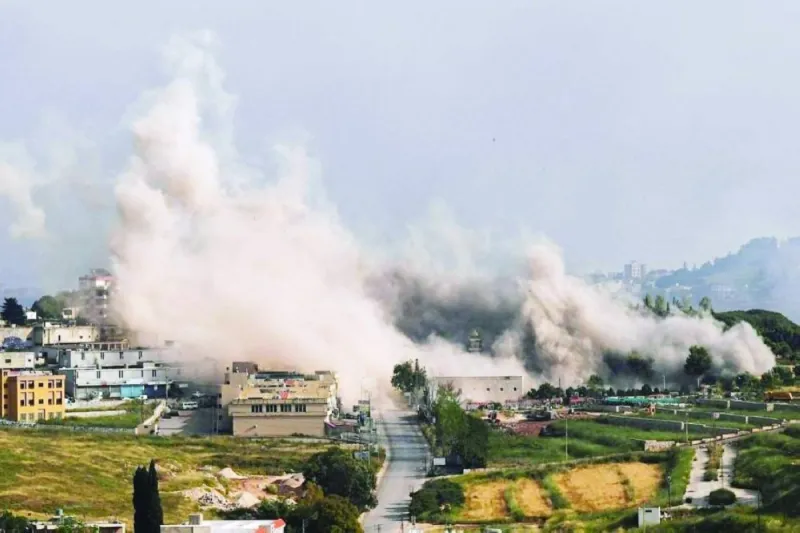
On the ground, the Israeli army continued yesterday to carry out air strikes, artillery shelling, and house demolitions in scattered areas of southern Lebanon.
The National News Agency reported that 3 enemy air strikes targeted the Al-Masha' neighbourhood in the town of Al-Mansouri in the Tyre district, noting that enemy drones also struck the town of Majdal Zoun in the same district.
It added that the Israeli army is continuing its attacks by demolishing houses in the town of Houla in the Marjayoun district, while an enemy drone carried out a strike in 2 waves on the town of Kfar Tibnit.
From Friday night through yesterday morning, the Israeli army carried out a series of attacks including a warplane strike and 2 drone strikes targeting the town of Al-Nabatiyeh Al-Fawqa, simultaneously with artillery shelling that hit the towns of Kunin and Beit Yahoun.