
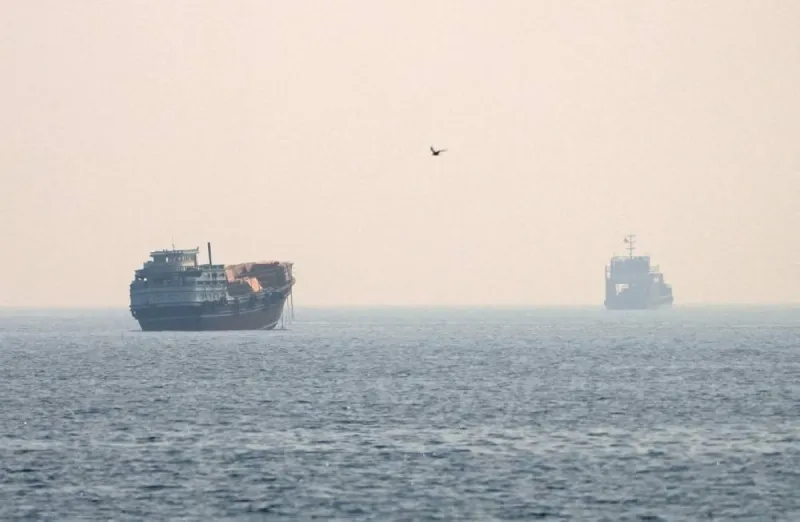
The world is holding its breath today, awaiting the expiry of US President Donald Trump's deadline for Iran to reopen the Strait of Hormuz, and watching for Tehran's response — specifically whether it will issue an official statement confirming that all lanes through the strait are open and that it has ceased firing on vessels, returning the situation to its pre-war footing.
Leaks indicate that delegations from Tehran and Muscat, meeting in the Omani capital, are discussing the issuance of a statement on reopening the central passage through Hormuz in a manner that guarantees freedom of navigation and the transit of ships. Iran's options are narrowing rapidly, under mounting military pressure and an American determination — stronger than at any previous point — to resolve Tehran's threats to shipping lanes in the Strait of Hormuz.
Tehran's negotiators moved toward Muscat today under the weight of President Donald Trump's latest unequivocal warning, issued on his Truth Social platform: "Iran has asked us to continue talks. We have agreed to that, but the United States has informed them, in no uncertain terms, that the ceasefire is over!" Tehran now recognises that it may be facing a "last chance", given Washington's insistence on a definitive resolution. It is confronted with two options: full compliance — ending what Washington calls its extortion — or facing direct military escalation. The United States is pressing firmly to terminate Tehran's attempts to assert control over the Strait of Hormuz through a combination of direct military pressure and hard-nosed diplomacy.
Washington continues its diplomatic efforts to reduce tensions with Iran, while simultaneously maintaining readiness to carry out military action if necessary, keeping a list of potential targets as a pressure card — this following the collapse of the temporary truce between the two countries.
US officials told Axios that the message was conveyed to Tehran directly and through regional intermediaries, noting that Washington is awaiting a statement following today's Saturday meeting in Oman. Washington considers any failure to deliver this commitment as undermining confidence in Iran's readiness to implement any future nuclear deal. The coming hours will therefore witness an acceleration of efforts and a resumption of negotiating channels, whether directly or through regional and international intermediaries. Past experience has shown that the Washington–Tehran relationship typically moves from escalation to negotiation in order to avoid an all-out war.
There are moves underway regarding the reopening of the central passage through Hormuz to guarantee freedom of navigation and the transit of ships — moves that could help the active parties convert the current temporary understanding into a sustained and institutionalised negotiating track. In the medium term, this could produce a comprehensive agreement ending the dispute over Hormuz by establishing firm security arrangements for regional navigation, while opening the door to discussions on the nuclear file and the lifting of economic sanctions.
The memorandum of understanding — particularly that relating to the US–Iran tensions in the Strait of Hormuz — cannot, according to a number of analysts, be considered an agreement. It is, at most, a "conflict-management document" rather than a final peace agreement. This framework ensures that negotiating channels remain open to avoid an all-out war that no party wants, for the following reasons: the memorandum of understanding concluded with Tehran raises more questions than it answers.
The memorandum is vague in its essential details, as well as regarding the sequencing of steps and implementation mechanisms, making it susceptible to misinterpretation by both sides — to the point where the memorandum itself now appears to require a new memorandum of understanding.
Regardless of its content, the mere existence of the memorandum of understanding — even if it guarantees nothing — at least provides an opportunity to reduce escalation and reach a diplomatic solution.