
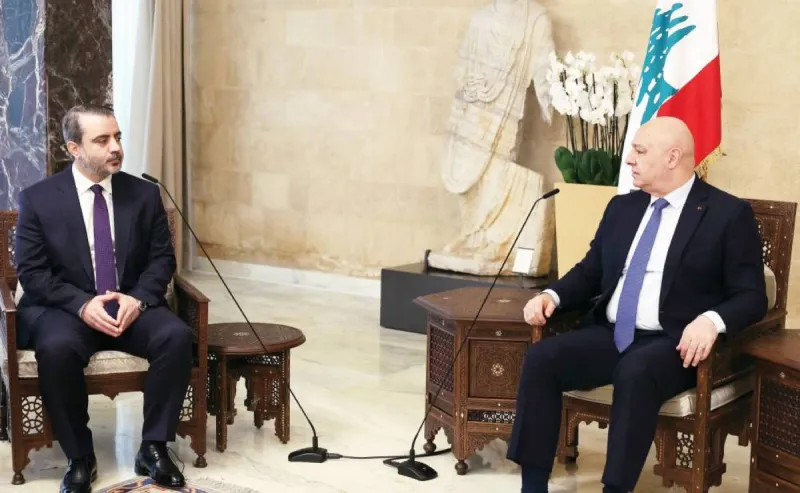
Lebanon has drawn its red lines regarding its negotiations with Israel, stressing that it will not relinquish any part of its territory and that the goal of the framework agreement is full Israeli withdrawal, while maintaining its position that weapons must be held exclusively by the state.
Lebanese President Joseph Aoun affirmed that he will not give up any part of Lebanese territory, following statements by Israeli officials confirming that their army will remain in the south for as long as Hezbollah poses a threat, without specifying a timetable for withdrawal.
Aoun said, according to the presidency, that the direct negotiations Lebanon is conducting with Israel are not a betrayal but rather a diplomatic war without bloodshed.
He explained that the state decided to enter negotiations to secure its rights and guarantee Israeli withdrawal from its territory.
Aoun described this as the safest and least costly option for Lebanon after all the losses it has endured, adding: "We will not concede an inch of Lebanese soil — judge us by the results on the ground."
On another front, Aoun affirmed Lebanon's commitment to establishing brotherly relations with Syria based on cooperation, coordination, and non-interference in the internal affairs of both countries.
A Lebanese presidency statement quoted Aoun as saying, during his reception of Syrian Foreign Minister Asaad Al-Shaibani, that he was comfortable with the coordination between the two countries, particularly in the areas of border control and preventing the smuggling of persons and weapons and anything that threatens the security of both nations. He stressed his full commitment to Syria's stability, just as Syria is committed to Lebanon's stability.
He added: "President Ahmad Al-Sharaa assured me in more than one meeting and phone call that Syria's role will not be as it was in the past, and that a new page has been opened between the two countries — one in which Syria will not side with one party against another but will stand alongside all Lebanese."
Aoun welcomed the formation of the joint higher committee between the two countries to preserve the mutual interests of Lebanon and Syria.
Al-Shaibani, for his part, assured President Joseph Aoun that Syria has no intention of military intervention in Lebanon, and conveyed a formal invitation from his Syrian counterpart to visit Damascus, according to a statement from the Lebanese presidency. Al-Shaibani noted that his country supports any political process that serves Lebanon's interest and stability.
Lebanon's official National News Agency quoted Al-Shaibani as saying at a joint press conference with Lebanese Prime Minister Nawaf Salam: "My visit to Lebanon comes to translate the supportive stance toward Lebanon — its government and its people."
Joseph Aoun also called on the international community to pressure Israel to implement the provisions of the framework formula agreed upon in the Lebanese-American-Israeli negotiations in Washington and not to obstruct its implementation.
Aoun added, during his meeting with Jean Arnault, the Personal Envoy of the UN Secretary-General for the Middle East conflict and its repercussions: "Remove any cause that could lead to the continuation of the current situation in the south," stressing the need to support the army so it can carry out the tasks required of it in the coming period.
Arnault, for his part, affirmed the United Nations' support for the steps Lebanon is taking to preserve its sovereignty, independence, and the extension of state authority over all Lebanese territory, particularly the south, as well as support for the army and the continuation of humanitarian assistance to civilians.
Prime Minister Nawaf Salam stressed that the goal of the framework agreement is clear: full Israeli withdrawal, and he underscored that there will be no clash with Hezbollah and no retreat from the demand that weapons be held exclusively by the state.
Salam said in an interview with LBCI television that the government is working to provide ready-made homes to be placed in villages from which Israel withdraws, in order to anchor residents to their land pending reconstruction, noting that work is also under way to restore the communications network in the south to approximately 90% of its pre-war capacity within 10 days.
He added that the state has been working for weeks on a plan for the return of people to their homes and lands in the south and across all infrastructure sectors, with detailed plans for each area, noting that there is no time to waste further opportunities.
On the political front, he affirmed that he does not seek a confrontation with Hezbollah, but that neither he nor the government will submit to any form of blackmail, stressing the demand for adherence to the Taif Agreement, UN Resolution 1701, the cessation of hostilities declaration, and the ministerial statement.
The prime minister noted that the government had joined France, Saudi Arabia, Qatar and others in calling for a conference in Paris to support the Lebanese army, saying what is needed is to strengthen the military institution's capabilities, while at the same time rejecting any slide into internal conflict or civil war.
He added that the government had asked the army to draw up an implementation plan to confine weapons to the state's hands; that plan was prepared and presented to the Council of Ministers, which welcomed it, and the first phase of its implementation had begun before conditions on the ground changed, necessitating an update.
On the negotiations file, Salam clarified that any process must remain within established principles and the ministerial statement, and that the purpose of the framework is to define a path leading to Israeli withdrawal, the return of residents, and reconstruction, with the possibility of setting a timetable in subsequent rounds.
He indicated that the anticipated withdrawal covers villages including Zoutar Al-Gharbiyeh and Zoutar Al-Sharqiyeh, with the Lebanese army to deploy and extend its authority over areas from which the Israeli army withdraws.
On the issue of the south, Salam affirmed that the goal is for every weapon on Lebanese soil to be under the command of the Lebanese army, stressing that the extension of state authority covers all of Lebanese territory.