
Dubai – Al Bayan and agencies
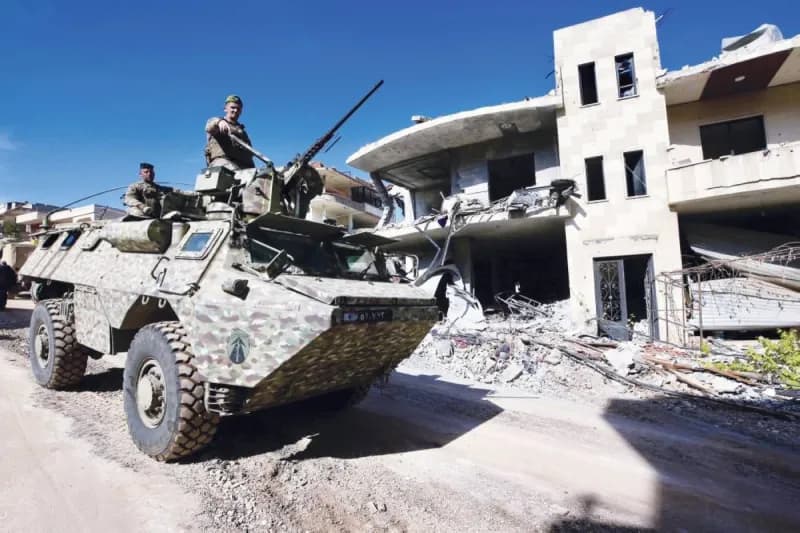
Four days after the framework agreement was signed in Washington, the Lebanese file has moved from the negotiating table to the implementation phase. In this shift, the Lebanese Army has emerged as the party against which the agreement's ability to transition from text to the field will be measured.
This was reflected in the meeting between Lebanese President Joseph Aoun and Army Commander General Rodolph Haykal to discuss the anticipated security tasks during the coming phase.
The Lebanese presidency said Aoun was briefed by the army commander on the results of his recent talks in Turkey and the United Kingdom within the framework of military cooperation, and that the two also discussed the security situation in the country and preparations related to the next phase of the framework agreement signed in Washington under US sponsorship between Lebanon and Israel.
The Lebanese president, according to the presidency's statement, affirmed that the army continues to fulfil its role in "extending state authority, preserving security and stability, controlling borders, and protecting civil peace," stressing that campaigns of doubt targeting the military institution and its leadership "will not affect its national performance nor the Lebanese people's trust in it."
The meeting comes as Lebanon began preparing for the implementation phase of the agreement, which stipulates the launch of two pilot zones in the south of the country, encompassing a limited Israeli withdrawal, the deployment of the Lebanese Army, and the disarmament of the Hezbollah militia, under US-led supervision and a follow-up mechanism.
US Central Command (CENTCOM) Commander Admiral Brad Cooper visited Beirut the day before yesterday, where he met President Aoun and the army commander, in the first visit by a US official of this level to Lebanon since the agreement was signed.
The Lebanese presidency said Aoun affirmed during the meeting the state's determination to extend its authority through its armed forces up to the southern international border, while the US Embassy in Beirut indicated that the meeting addressed "the formal launch of implementation of the framework agreement" and building on the momentum the agreement has generated.
The embassy stated that "this agreement sets a realistic path out of the ongoing conflict and establishes a clear, organised process aimed at restoring Lebanon's sovereignty and disarming Hezbollah."
US Central Command also announced that Cooper discussed with Lebanese officials ways to proceed with implementing the agreement, while the Lebanese Army Command said the talks addressed the importance of ensuring the success of the mechanism for implementing the security annex and strengthening military cooperation between the two countries.
The Washington Post quoted an American official — who requested anonymity — as saying that the United States will play a direct role in monitoring the movements of both the Lebanese and Israeli armies, including the use of American forces on the ground in Lebanon and Israel.
The official clarified that the United States has had forces in Lebanon performing a monitoring role since the 2024 agreement, and that it will now oversee both parties to detect any violations of the agreement.
Alongside the official movements, indicators emerged of growing international support for the Lebanese military institution. President Aoun announced that the army commander had briefed him on the results of his talks in Turkey and the United Kingdom within the framework of strengthening military cooperation, at a time when consultations with international partners are also continuing regarding logistical and technical support for the army during the coming phase.
This role carries particular importance because the agreement makes the Lebanese Army the party responsible for deploying in the areas from which Israeli forces are expected to withdraw, following verification that the security arrangements stipulated in the agreement have been implemented.
These developments coincide with continuing international efforts to support Lebanon's stability. President Aoun earlier welcomed the French-Italian initiative aimed at exploring an international mechanism for the period following the end of the mandate of the United Nations Interim Force in Lebanon (UNIFIL), considering it a reflection of continued international commitment to supporting Lebanon's sovereignty and security institutions.
On the humanitarian front, the UN Humanitarian Coordinator for Lebanon, Imran Riza, said that approximately 1 million people remain displaced due to the war, while around 1.4 million people are in need of humanitarian assistance.
In contrast, Minister of Social Affairs Hanin Al Sayed, citing data from the International Organization for Migration, announced that approximately 400,000 displaced persons had returned to their areas, representing around 40% of the total number of displaced, as the numbers residing in shelters continue to decline.
Alongside Lebanon's preparations to implement the agreement, Israel affirmed its insistence on maintaining a military presence in southern Lebanon. Israeli Prime Minister Benjamin Netanyahu, during a tour he conducted yesterday in southern Lebanon accompanied by Defence Minister Israel Katz, said — according to a statement from his office — that Israeli forces "will not leave southern Lebanon until the threat is eliminated," in reference to Hezbollah.
Netanyahu added that Israel has established "buffer zones" inside Lebanese territory, describing them as one of the most prominent objectives of military operations. He also told Israeli soldiers that "Lebanon and Israel are two sovereign states that want to live in peace," calling on Iran and Hezbollah to leave the Lebanese arena.
In parallel, the United States continued to tighten financial pressure on Hezbollah. The US Treasury Department, through the Office of Foreign Assets Control (OFAC), announced an expansion of its sanctions list to include 5 institutions and 16 individuals, among them the Bayt al-Mal and Al-Qard al-Hassan institutions.
The Treasury Department said these institutions form part of the financial infrastructure Hezbollah uses to manage its assets and fund its activities, adding that the party relies on financial institutions, front companies, and money exchange agents to circumvent sanctions and transfer funds outside official banking channels.
It stated that the new measures aim to disrupt these networks and isolate them from the international financial system, as part of the continuation of US pressure on the party's funding sources.
As Lebanese institutions transition from the negotiation phase to the implementation phase, American and Israeli moves indicate that the new track is not limited to field security arrangements, but also runs in parallel with continued political and financial pressure related to the Hezbollah file, at a time when the Lebanese Army's performance is expected to constitute the first test of the framework agreement's provisions on the ground.