
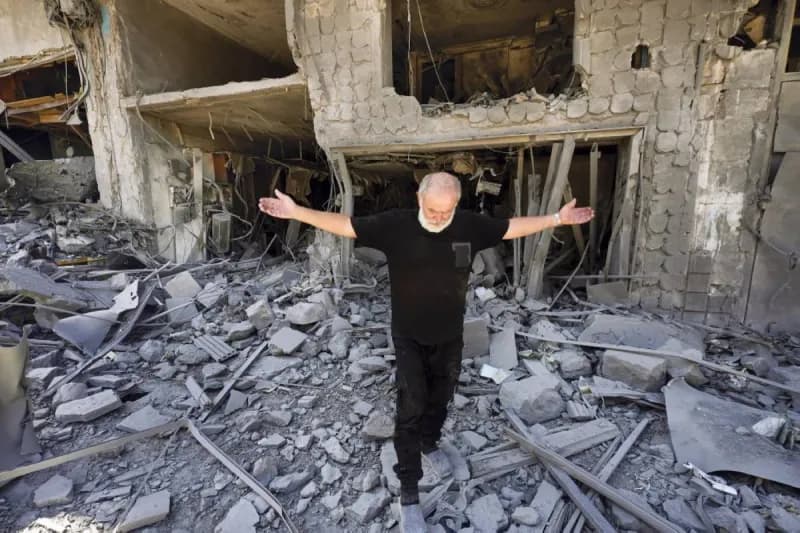
Residents of southern Lebanon made their way back to their towns on Monday, taking advantage of the halt in fighting between Israel and Hezbollah since Saturday evening, even as the Lebanese army warned them against rushing their return.
In the city of Nabatieh, which suffered intense strikes in recent days and was surrounded by heavy combat, correspondents observed a number of residents returning to inspect their homes and shops. Among them was Mohammed Salloum, who was checking on his store, and who confirmed he would leave again for the city of Sidon, north of Nabatieh, where he had taken refuge during the war.
He told Agence France-Presse: "Nabatieh is a devastated city," before adding: "God willing, the city will return to life within two or three months."
For his part, Nabatieh municipal president Abbas Badr Al-Din said that "the scale of destruction in the city over the past 48 hours is equivalent to roughly half of what occurred" during the rest of the war.
Israeli military operations had recently been concentrated in the Nabatieh area. Banque du Liban said on Saturday that an Israeli strike had targeted its branch in the city, one of the largest in the south of the country.
The Lebanese army stressed on Monday "the necessity for residents to exercise patience before returning to the southern border villages and towns, and to comply with the directives of deployed military units, in order to preserve their safety from the danger of Israeli violations and aggressions."
In the coastal city of Tyre, many residents inspected their properties, but a large number confirmed they had no intention of returning for now, preferring to wait until the outcome of talks in Switzerland between Iran and the United States on a final agreement to end the war in the Middle East becomes clear.
The latest ceasefire between Israel and Hezbollah was announced on Friday, but Lebanese authorities said Israeli strikes on the south and east of the country on Saturday killed at least 30 people before the fighting stopped.
Earlier this month, Israel agreed to a ceasefire that allowed its forces to remain in southern Lebanon and, crucially, permitted them to continue operations against Hezbollah. That agreement was supposed to establish "pilot zones" for Lebanese forces to begin taking control of certain territory in southern Lebanon — an effort that has yet to materialise.
However, the newly signed ceasefire between the United States and Iran calls for a permanent end to the fighting, including in Lebanon. CNN previously reported that Israeli Prime Minister Benjamin Netanyahu told US President Donald Trump that he does not view Israel as bound by the new agreement. What remains in Lebanon is therefore a ceasefire that has collapsed repeatedly, but the consequences of its collapse are now far more severe.