
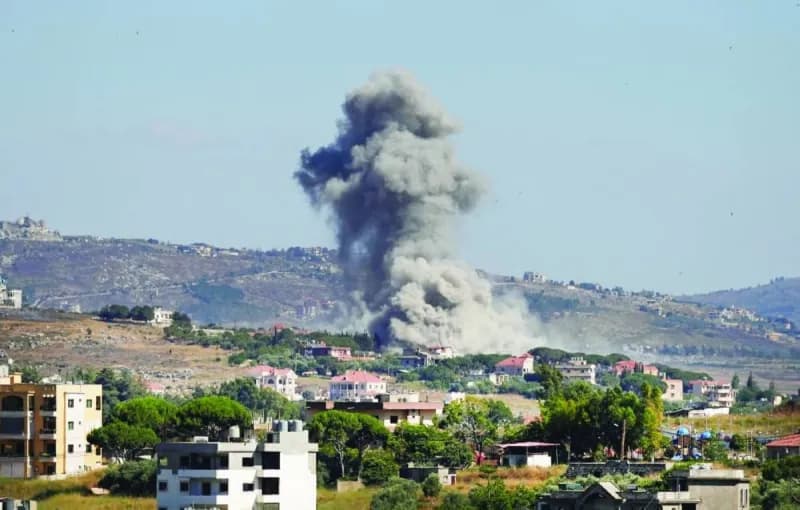
The agreement between the United States and Iran brought relief and calm to Lebanon through the announcement of a ceasefire deal, despite preceding airstrikes that killed dozens across various areas. While Washington revealed it would host a new round of talks between Beirut and Tel Aviv on Tuesday, Paris urged Tel Aviv to abide by the Washington-Tehran accord and its provisions calling for a halt to escalation in Lebanon.
A US official said Israel and Lebanon had agreed to a ceasefire, noting that it came into effect just before 4:00 p.m. Beirut time.
The official, who requested anonymity, said: "Our understanding is that after the exchange of fire, Israel and Hezbollah have now entered into a ceasefire," adding that US and Qatari negotiators reached the agreement with assistance from Iran.
The US Ministry of Foreign Affairs also announced that the next round of Lebanese-Israeli talks would be held in Washington from Tuesday through Thursday, following a phone call between US Secretary of State Marco Rubio and Lebanese President Joseph Aoun.
State Department spokesperson Tommy Pigott said in a statement that Rubio again stressed the necessity of disarming Hezbollah and reaffirmed US support for the Lebanese government's efforts to establish a fully sovereign Lebanese state that lives in peace with all its neighbours.
For his part, Aoun emphasised that a comprehensive ceasefire is a fundamental pillar for the advancement of direct negotiations with Israel, and stressed the need for Israeli aggression to cease through the achievement of a comprehensive ceasefire.
Prior to that, Israeli airstrikes killed 47 people and wounded 79 others in southern and eastern Lebanon, according to the Ministry of Health.
Dozens were killed in strikes launched by Israel, mostly in southern Lebanon, where its military announced the deaths of 4 soldiers — in an escalation described as the most severe since Tehran and Washington reached an agreement to halt the war in the Middle East, including Lebanon.
The Israeli air force, according to Lebanon's official National News Agency, carried out a series of overnight strikes on several towns in the Nabatieh region, some of which hit inhabited residential buildings.
The Israeli military said in a statement that overnight it struck more than 80 command centres, launch sites, and militant infrastructure in the Nabatieh area and other areas of southern Lebanon, resulting in the deaths of dozens of Hezbollah militants who were operating in the command centres. The Israeli strikes also reached the Baalbek area in the Bekaa Valley.
The Ministry of Health recorded 3 deaths. The 4 soldiers, including a battalion commander, were killed — according to an Israeli military official — by a suspected projectile that struck an Israeli army tank in the Kfar Tibnit area after midnight, before the army responded by striking several Hezbollah positions.
Israeli Prime Minister Benjamin Netanyahu reiterated that his forces would remain in Lebanon for as long as necessary, threatening — following the announcement of the deaths of 4 soldiers — that Israel would make Hezbollah pay a very heavy price.
Netanyahu said in a statement that the Israeli army would remain in the security zone in southern Lebanon for as long as necessary to protect towns in northern Israel, adding: "Israel will not accept any attack on our soldiers or on our territory." Defence Minister Israel Katz warned that Israel would respond with great force to any attack.
Lebanese Foreign Minister Youssef Raji affirmed that Lebanon would continue to pursue negotiations with Israel on a track independent of the Iranian-American track.
Raji, during a phone call he received from his Canadian counterpart Anita Anand, stressed that Lebanon is continuing with the negotiation option, but on a track independent of the Iranian-American track, with the aim of reaching a comprehensive solution that preserves Lebanon's sovereignty and stability.
Raji indicated that the highest priority remains a ceasefire, welcoming any agreement that serves stability. For her part, the Canadian minister affirmed her country's solidarity with Lebanon and its continued provision of assistance during this critical phase.
In this context, French Foreign Minister Jean-Noël Barrot urged Israel to abide by the protocol of the agreement signed between the United States and Iran, which calls for a halt to the war in the region, including Lebanon.
Barrot said in remarks on France Info radio that the agreement provides for a cessation of hostilities and the Israeli government must comply with it, adding that the United States in particular should exert all necessary pressure on the Israeli government to do so.
Barrot also revealed that France is still working to convene an international conference to mobilise support for the Lebanese army.