
Beirut, Dubai – Al Bayan, agencies
Despite the United States and Iran announcing an understanding aimed at ending the war in the Middle East — including on the Lebanese front — continued Israeli strikes in southern Lebanon are testing the seriousness of this political path on the ground.
The strikes raise questions about translating the agreement into reality, as Lebanese President Joseph Aoun stressed that Lebanon's negotiating track with Israel is "independent" of the US-Iran understanding, while expressing Beirut's welcome for any effort to consolidate the ceasefire, including from Iran.
"The assurances we have received, and what we insist upon, is that Lebanon's track in the negotiations is independent. We are certainly in favour of a ceasefire and in favour of any state that helps us, including Iran," Aoun said in remarks yesterday.
He added, according to a statement from the Lebanese presidency: "The Lebanese state is sovereign in its decisions. For the first time, it is the one conducting the negotiations — no one is negotiating on its behalf." He sought to reassure Lebanese citizens, saying: "I want to assure the Lebanese that no one is tying us to any other state, and any settlement will be reached through us, not at our expense."
In remarks carried by Reuters, Aoun expressed Lebanon's welcome for support from any country in reaching a ceasefire, including Iran. This came days after he had criticised Tehran for using Lebanon as a "bargaining chip" in its negotiations with the United States.
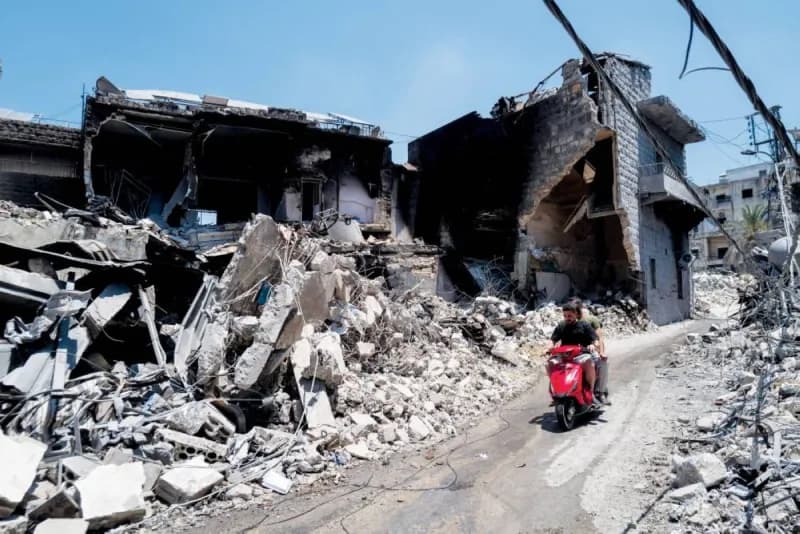
On the ground, the Israeli army continued its operations in southern Lebanon. The National News Agency reported that Israeli warplanes struck the town of Nabatieh Al Fawqa, the outskirts of Kfartebnit, and the town of Ansariyeh in the Zahrani district. Artillery also shelled the area around Dar Al Muallimin at the Nabatieh junction, while intensive drone activity was recorded over Beirut's southern suburbs.
At least 5 people have been killed in southern Lebanon since the US-Iran understanding was announced. 4 of them were killed the day before yesterday in strikes on Mayfadoun and Shawkeen. The Israeli army announced it had carried out a strike on a "suspicious vehicle" and intercepted rockets fired towards its forces.
While Israeli Prime Minister Benjamin Netanyahu had affirmed that his forces would remain in Gaza, Lebanon, and Syria "for as long as necessary", Tehran demanded a full Israeli withdrawal from occupied Lebanese territory, stating that any continued operations constituted a violation of the memorandum of understanding due to be signed on Friday in Switzerland.
Tehran also threatened to respond to any ongoing Israeli operations. Despite a relative reduction in the pace of operations, the Lebanese army urged residents to exercise caution before returning to their villages and towns in the south, citing the continuing threat of strikes and violations.
This comes as Washington and Tehran are scheduled to sign a memorandum of understanding on Friday in Switzerland, forming a framework for negotiations to last two months, with the aim of ending the war and opening the Strait of Hormuz fully to navigation.