
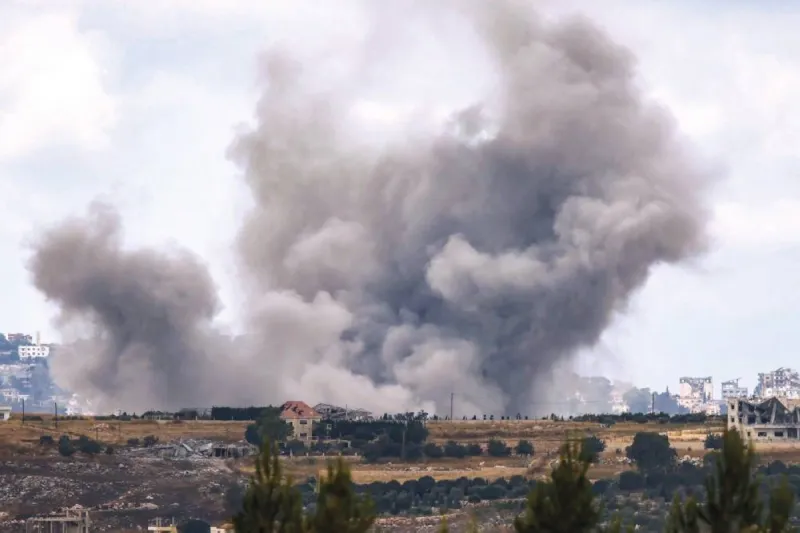
Israel's bombing of Beirut's southern suburb, Dahiyeh, came at a sensitive moment for US President Donald Trump, who has repeatedly, over recent hours, been heralding an imminent deal with Iran.
Trump was sharp in his criticism of the strike, writing on Truth Social: "This attack on Beirut this morning should not have happened."
He continued: "We are very close to a deal that will bring peace to the region, including Lebanon, and all parties should stand down." He concluded: "This could be the beginning of a long and beautiful peace — don't ruin it!"
What was striking, therefore, was not the strike itself, but the fact that the objection came from Trump personally, who saw the operation as threatening a peace opportunity that had never been closer.
Typically, American-Israeli disagreements over Iran have revolved around the details and conditions of agreements. Today, however, the dispute appears to go beyond that, extending to the very vision for the region itself.
Trump is speaking of a comprehensive settlement that links the various arenas, making a deal with Tehran a gateway to de-escalation in Lebanon and perhaps elsewhere. Netanyahu, by contrast, has long viewed such approaches with suspicion, uncomfortable with the linking of files on the grounds that it grants Iran an opportunity to leverage its regional influence as a bargaining chip.
Where Washington sees de-escalation in Lebanon as part of the broader negotiating track with Iran, Israel appears determined to assert that the Lebanese front will remain governed by its own direct security considerations, regardless of any political understandings reached elsewhere.
Netanyahu has on more than one occasion expressed his discomfort with attempts to link different files. He believes that no settlement with Iran should be allowed to become a constraint on Israeli freedom of action in Lebanon or Syria.
In this context, it is difficult to dismiss the hypothesis that the timing of the strike was connected to a desire to test Iran's reaction, or even to complicate the political environment surrounding the negotiations — placing Tehran before a delicate equation: either respond in a way that threatens the deal and returns the region to the brink of confrontation, or let the strike pass, which would be interpreted as a costless concession at a sensitive moment.
Yet the paradox is that the strike may have revealed something else more significant than Iran's response itself: the limits of the understanding between Trump and Netanyahu. The American president, who only days ago spoke of a tough conversation with the Israeli prime minister, publicly rebuked the strike — a signal that the disagreement between them is no longer merely about tactics, but about the direction the region should take in this cooling-down phase.
The closer the American-Iranian deal comes, the greater the likelihood that every military strike and every security incident will be drawn into a broader political contest over the shape of the coming settlement.
In this landscape, Dahiyeh may be more than just an arena of confrontation between Israel and Hezbollah — it may be one of the stages on which the growing divergence between Trump and Netanyahu over the future of the Middle East itself is playing out.