
Baghdad — Al Bayan, agencies
Iraq's anti-corruption efforts have registered a significant development with the recovery of 375 kilograms of gold in two corruption cases, alongside the seizure of properties, factories, and trucks worth tens of millions of dollars in the case of Adnan Al-Jumaili, the arrested undersecretary of the Ministry of Oil for refining affairs.
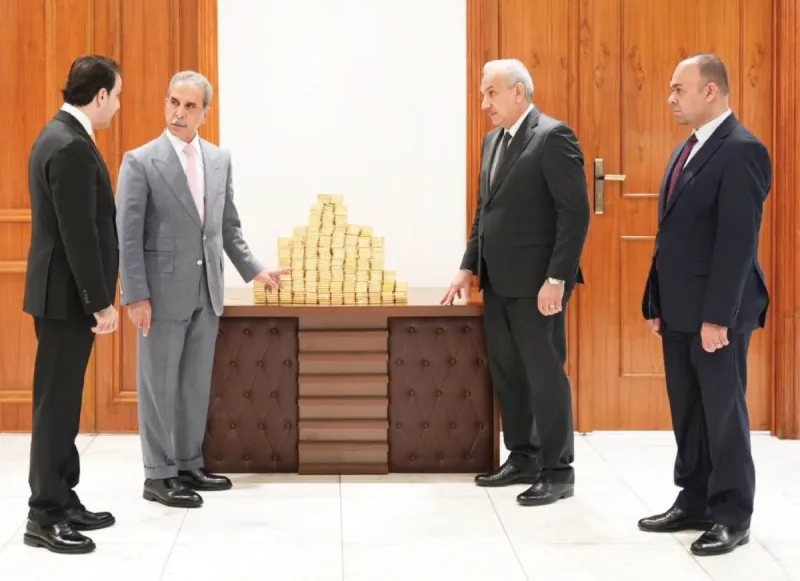
Investigative judge at the Central Anti-Corruption Criminal Court, Diaa Jaafar, said in a statement carried by the Iraqi News Agency that the authorities recovered, in coordination with the Kurdistan Region and under the supervision of Supreme Judicial Council President Judge Faiq Zidan, 358 kilograms of gold.
He added that competent authorities seized an additional 17 kilograms in a separate investigation, bringing the total amount held in custody to 375 kilograms.
Jaafar explained that the recovered gold was handed over to the director-general of the Issuance and Treasury Department at the Central Bank of Iraq and his deputy, as part of efforts to complete the investigation into the Al-Jumaili case, recover movable and immovable assets derived from the crimes, and hold those involved accountable under the law.
Iraq's Supreme Judicial Council had announced last Thursday the seizure of 14 billion Iraqi dinars (approximately $10.6 million) hidden inside a rainwater drainage pit, as part of the ongoing investigations into Al-Jumaili.
In a separate statement, the judiciary media office announced that the Nineveh Investigative Court specialising in integrity cases decided to seize 9 commercial properties and 3 flour production factories in the city of Mosul in connection with the Al-Jumaili investigation.
According to the statement, the total value of the properties and factories amounts to approximately 69 billion Iraqi dinars (around $52.6 million), in addition to 7 modern trucks each estimated to be worth $200,000.
The statement noted that the market value of the commercial properties in central Mosul amounts to approximately 45 billion Iraqi dinars (around $34.3 million), while the flour factories are valued at 24 billion dinars (approximately $18.3 million). The judiciary media office said that fugitive defendants had registered the properties in the names of their workers in order to disguise and conceal their illicit origin.
The court decided to appoint judicial custodians to manage the seized properties and factories, given that they are productive assets generating revenue, in order to ensure their preservation and collect their profits on behalf of the state.
The Supreme Judicial Council affirmed that it will continue to pursue fugitive defendants, recover movable and immovable assets derived from corruption crimes, and hold those involved accountable under the law.
These measures come within the framework of the investigation into Al-Jumaili, who was dismissed from his post on 2 June following suspicions of squandering public funds, concluding illegal contracts, and money laundering.
Iraq's judiciary announced in recent days the arrest of dozens of suspects in financial and administrative corruption cases linked to the file, including members of parliament and executive officials whose immunity was lifted to allow investigations to proceed.
Authorities had previously arrested a number of defendants in corruption cases, among them members of parliament whose immunity was lifted, and officials whose names were mentioned in confessions related to the case.
Iraq's Integrity Commission had earlier announced the preparation of files to extradite hundreds of defendants residing abroad, and the submission of legal assistance requests aimed at tracing funds suspected of having been smuggled out of the country.
On a separate front, Iraqi competent authorities continue their efforts to recover smuggled Iraqi antiquities through negotiations with a number of countries and by monitoring international auctions and exhibitions displaying pieces suspected of having left the country illegally.
Ali Obaid Shalgham, head of the State Board of Antiquities and Heritage under the Ministry of Culture, told the Iraqi News Agency that Iraq is negotiating with several countries to recover more of its smuggled antiquities. He revealed that files for their recovery from the United States have been largely completed, and he hopes that artefacts will arrive soon through the Iraqi embassy in Washington, similar to those from the United Kingdom, from which he expected several comparable pieces to be returned to the country in the coming period.