
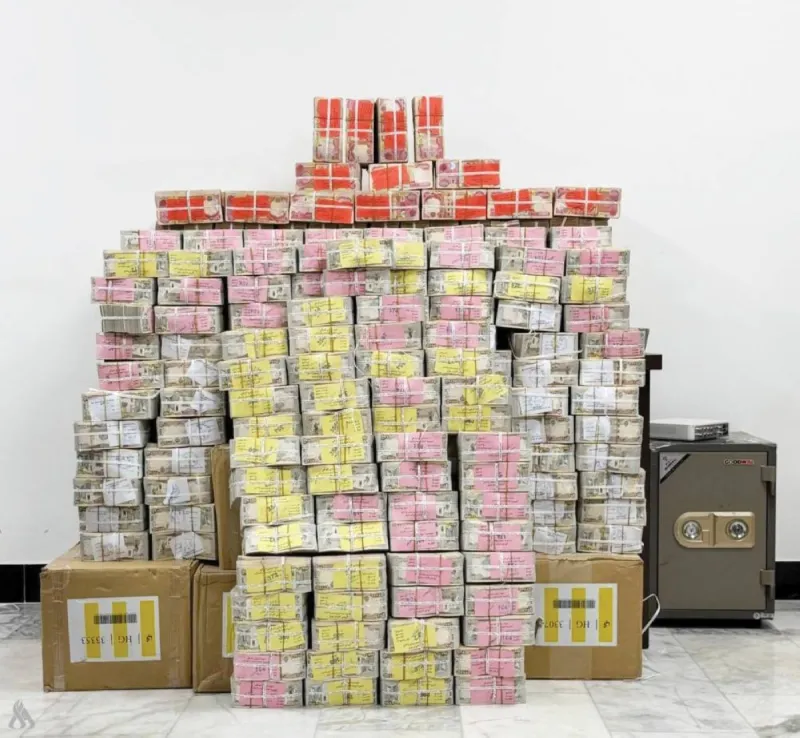
Iraq's judiciary delivered a major surprise on Wednesday in the course of its ongoing investigation into one of the largest organised financial corruption cases in the oil sector, announcing that it had foiled attempts to conceal vast wealth and seized billions of newly discovered dinars hidden in a primitive manner inside plastic water bottles — coming just one day after Prime Minister Ali Al Zaidi announced generous financial rewards for whistleblowers in accordance with the law.
The Supreme Judicial Council of Iraq announced in an official statement that an investigative judge at the Central Anti-Corruption Criminal Court oversaw the seizure of an additional 25 billion Iraqi dinars, as well as 1 million US dollars in cash, along with gold jewellery and items estimated at approximately 5 kilograms. These substantial seizures come within the framework of the open case against the detained accused, Adnan Al Jumaili, Deputy Minister of Oil for Refining Affairs, and the parties and networks implicated alongside him.
The Iraqi News Agency (INA) quoted the presiding judge as saying that precise intelligence surveillance tracking the financial proceeds resulting from the astronomical waste in projects executed by the accused led to the seizure of these sums, which had been placed in an unusual manner inside plastic water bottles and carefully concealed within the walls of the accused's home in Tikrit, the capital of Salah al-Din Governorate.
The total amount of liquid funds seized in cash in this case has thus surged to a record figure of 127 billion Iraqi dinars and 24 million US dollars, in addition to the impoundment of fleets of luxury vehicles, strategic real estate properties, and gold.
The Prime Minister had called on citizens the day before yesterday to report cases of corruption and public funds obtained through financial crimes, within the framework of a government campaign aimed at recovering looted funds and pursuing those involved both inside and outside Iraq, announcing the allocation of generous financial rewards for whistleblowers in accordance with the law.
In a related development, informed government sources revealed that the second phase of the "Sawlat Al Fajr" (Dawn Assault) campaign targeting individuals implicated in corruption cases has been launched, with its scope expanded to include tracking assets, real estate, and residential compounds in the United States and Europe suspected of belonging to Iraqi officials or investment fronts linked to them.
According to the sources, the campaign targets files within the Ministries of Health, Oil, and Electricity, following the completion of a legal and administrative review of a number of contracts and files, amid indications of the existence of loopholes that were exploited to push through deals and investments that caused waste of public funds.
The sources also clarified that investigations are ongoing and encompass administrative and political figures as well as influential employees within state institutions, while a new list of names suspected of involvement in corruption files is being prepared, with the scope of scrutiny expanding to include various contracts and projects in sensitive service sectors.
These developments come at a time of growing popular and official calls to strengthen oversight of public funds, amid government assurances that the coming phase will see an expansion of monitoring and prosecution tools, with greater citizen participation in reporting corruption cases.