
Abu Dhabi – WAM, world capitals – Al Bayan, agencies
The United States expanded its military operations on Tuesday against the capabilities Iran uses to threaten navigation in the Strait of Hormuz, as sources revealed Iranian moves to prepare a new front in the Red Sea through the Houthis — a step that could widen pressure on trade and energy flows in the region — while Kuwait, Bahrain, and Jordan intercepted new Iranian missile and drone attacks.
Simultaneously, US Vice President JD Vance said that an internal struggle within Iran was behind the resumption of hostilities, and that the Trump administration is handling the file as a "delicate diplomatic dance."
Official media reported that US airstrikes shook the Iranian capital, Tehran.
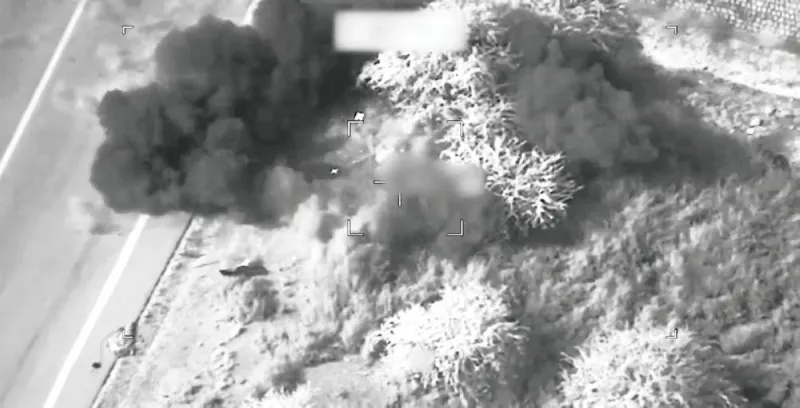
The US military announced on Tuesday evening that its forces had launched new strikes against Iran for the fifth consecutive night. US Central Command (CENTCOM) said in a post on X that the strikes, which began at 18:00 GMT, were carried out "to further degrade Iran's military capabilities."
Earlier on Tuesday, CENTCOM announced the completion of a new wave of strikes, saying they targeted command centres, air defence sites, missile and drone capabilities, and coastal surveillance facilities, with the aim of undermining Iran's ability to threaten navigation in the Strait of Hormuz.
It added that the strikes included the city of Bandar Abbas, which hosts Iran's largest port and key naval and Islamic Revolutionary Guard Corps installations on the Strait of Hormuz, as well as coastal defence system sites and cruise missile storage and launch facilities.
Iranian media reported strikes also in the vicinity of Qeshm Island, along with explosions in several areas and the activation of air defence systems in Tehran.
Iranian state television also announced that a US projectile struck the village of Masen on Qeshm Island in the south of the country on Tuesday afternoon. Hormozgan Province said US missiles struck areas near the city of Bandar Abbas in the south.
These operations follow a threat by US President Donald Trump on Monday to target Iranian infrastructure, including power stations and bridges, if Tehran did not return to the negotiating track.
In a development reflecting the widening scope of the confrontation, sources said Iran has asked the Houthis to prepare to close the Strait of Bab al-Mandeb if the United States launches an attack on Iran's power grid, adding that the request was conveyed to the group in recent days.
Two senior Iranian sources and one informed source from a regional country said the idea was discussed within Iran's leadership and that the allied Houthis were notified.
A source also said the Houthi movement has completed its preparations to launch attacks on shipping vessels, deploying missiles and drones near the Strait of Bab al-Mandeb on the Red Sea in Yemeni highlands overlooking Hudaydah and the Gulf of Aden, and is awaiting the order to begin.
A source close to the Houthis said that Islamic Revolutionary Guard Corps representatives currently present in Yemen will control the decision on when to close the Strait of Bab al-Mandeb.
This development carries particular significance as it comes at a time when the Strait of Hormuz is still subject to Iranian coercion of shipping, raising the prospect of simultaneous pressure on the two most important maritime corridors for Middle East energy exports if the confrontation widens.
Meanwhile, the Kuwaiti Armed Forces General Command announced that its air defences had intercepted, for the second time since dawn on Tuesday, attacks by hostile drones, confirming that the sounds of explosions heard were the result of air defence system interceptions.
Kuwait's Ministry of Foreign Affairs said the continuation of Iranian aggressions constitutes a flagrant violation of the country's sovereignty, a grave breach of international law, the UN Charter, and Security Council Resolution 2817, and held Iran fully responsible for these aggressions and their consequences.
In Bahrain, the General Command of the Bahrain Defence Force announced that air defence systems intercepted and destroyed a number of Iranian aerial attacks, confirming that Tehran continues to target civilians and private property with missiles and drones, as explosions were heard in Manama simultaneously with the sounding of air raid sirens.
Jordan's armed forces also announced the interception of 8 Iranian missiles targeting the Kingdom's territory early Tuesday morning, confirming that the interception operations resulted in no casualties or material damage.
The United Arab Emirates on Tuesday condemned in the strongest terms the renewed Iranian aggressive attacks targeting the Kingdom of Bahrain, the State of Kuwait, and the Hashemite Kingdom of Jordan with missiles and drones.
The Ministry of Foreign Affairs stated in a communiqué that these aggressive attacks constitute a flagrant violation of the sovereignty of the sisterly states and a threat to their security and stability. The Ministry renewed the UAE's full solidarity with the Kingdom of Bahrain, the State of Kuwait, and the Hashemite Kingdom of Jordan, and its support for all measures to preserve their security and stability.
Qatar also strongly condemned the repeated Iranian attacks, describing them as a blatant violation of the sovereignty of these states and a flagrant breach of the rules of international law. Qatar's Ministry of Foreign Affairs stressed in a statement the necessity of sparing the region the repercussions of unjustified attacks, and of continuing on the path of dialogue and diplomacy and de-escalation, in a way that contributes to consolidating security and stability at both the regional and international levels.
The Arab Republic of Egypt also condemned in the strongest terms the continuation of Iranian aggressions, affirming that these aggressions represent an extremely dangerous escalation that threatens the security and stability of the region.
Saudi Arabia also condemned the continuation of Iranian attacks, affirming its solidarity with Kuwait, Bahrain, and Jordan, and calling for an immediate halt to escalation and a return to diplomatic solutions.
Alongside the military operations, the United States tightened its naval blockade measures on Iranian ports. CENTCOM said a US aircraft disabled the empty oil tanker Pelma after it ignored repeated warnings and attempted to sail toward Iran, while two other commercial vessels complied with orders to change course.
Data from the Kpler platform also showed a decline in shipping traffic through the Strait of Hormuz, with only 7 vessels crossing on Monday, compared to 13 the day before, and no very large crude carriers or liquefied natural gas tankers passing through — an indication of continued disruption to navigation in one of the world's most important maritime corridors.
Despite the ongoing confrontation, Pakistan — which brokered the memorandum of understanding between Washington and Tehran last month — confirmed it would continue to encourage both sides to end the violence and resume technical discussions, warning of the growing implications of escalation for global energy security and trade.
Pakistani Foreign Ministry spokesman Tahir Andrabi told reporters: "Although implementation of the memorandum of understanding is facing difficulties, Pakistan will continue to encourage all parties to end the violence and resume technical discussions in accordance with the provisions of the memorandum."
He added: "We express our hope that the situation in the Strait of Hormuz will return to normal quickly, and affirm the importance of ensuring the safety, security, and freedom of maritime navigation at all times."
Meanwhile, US Vice President JD Vance said that tensions between "hardline" and "pragmatic" factions within Iran contributed to the resumption of the confrontation between Washington and Tehran, affirming that the US administration still sees an opportunity to pursue a diplomatic track despite the recent military developments.
In remarks made during an interview with broadcaster Joe Rogan, Vance described the Trump administration's handling of the Iranian file as a "delicate diplomatic dance," pointing to diverging positions within the Iranian establishment over how to handle the crisis. He explained that the hardline faction hardened its stance following developments related to the Strait of Hormuz, believing that the continued flow of oil through the waterway reduced Tehran's leverage — which, in his words, pushed it toward more escalatory positions.
In contrast, Vance said what he described as the "pragmatic" faction within Iran believes the escalation was a mistake and prefers to continue dialogue with the United States, adding that Washington is attempting to engage with this faction but responds militarily when subjected to attacks or acts of violence. He also said the memorandum of understanding reached by both sides last month had been "greatly mischaracterised."
He added that much of what had been raised about it did not reflect its true content, and noted that the agreement is no longer being fully implemented after President Donald Trump declared the ceasefire over.
Vance also said that some members of the Israeli government had attempted to influence American public opinion to turn it against an agreement reached by the United States to end the war with Iran. He stated: "I know for a fact that there are people inside the Israeli government who were actually trying to pull us away from this policy because they wanted the military campaign to continue."
He added that he has "good relations" with some members of the Israeli government, but said that "there are people inside its institutions who we know for a fact are trying to manipulate and influence American public opinion with the aim of keeping the war going indefinitely." He added: "What bothers me is that those operations and influence campaigns are actually affecting American policy and decision-making in the United States."