
The confrontation between the United States and Iran widened yesterday, as Iranian aggressive attacks using missiles and drones were renewed against Bahrain, Kuwait and Jordan, while Tehran simultaneously threatened to extend pressure on the region's energy corridors by deploying the Houthi card to close the Bab el-Mandeb strait — stretching Iranian extortion from the Strait of Hormuz to the Red Sea. The United States, meanwhile, intensified its strikes on Iranian military capabilities used to threaten shipping, affirming that military operations would continue in parallel with diplomatic pressure to bring Tehran back to the negotiating table.
The United Arab Emirates condemned in the strongest terms the renewed Iranian aggressive attacks targeting the Kingdom of Bahrain, the State of Kuwait and the Hashemite Kingdom of Jordan with missiles and drones.
The Ministry of Foreign Affairs stated in a communiqué that these aggressive attacks constitute a flagrant violation of the sovereignty of the sisterly states and a threat to their security and stability.
The ministry renewed the UAE's full solidarity with the Kingdom of Bahrain, the State of Kuwait and the Hashemite Kingdom of Jordan, and its support for all measures aimed at preserving their security and stability.
The Secretary-General of the Gulf Cooperation Council, Jasem Mohamed Al-Budaiwi, also condemned the Iranian attacks, stressing that they represent an unprecedented escalation and reflect a clear determination to violate international rules and norms. He emphasised that GCC member states stand as one with Bahrain, Kuwait and Jordan, and support all measures they take to protect their security, sovereignty and territorial integrity.
In Bahrain, the Bahrain Defence Force General Command announced that air defence systems intercepted and destroyed a number of Iranian aerial attacks yesterday morning, affirming that Iran continues its systematic hostile pattern of targeting civilians and that the use of missiles and drones against civilians and private property constitutes a flagrant violation of international humanitarian law.
In Kuwait, the General Staff of the Army announced that air defences intercepted attacks by hostile Iranian drones, explaining that the explosions heard were the result of interception operations by air defence systems.
The General Fire Force also announced it had brought under control a fire that broke out at one of the targeted sites, with support from the Kuwaiti Army and the National Guard, confirming no human casualties and that damage was limited to material losses.
In Jordan, the General Command of the Armed Forces announced the interception and downing of 3 ballistic missiles that entered the Kingdom's airspace from Iranian territory, confirming that the operation resulted in no casualties or material damage, and that the armed forces would respond to any airspace violation in accordance with approved rules of engagement to preserve the Kingdom's sovereignty and security.
In Washington, US Secretary of State Marco Rubio condemned the Iranian attacks on Jordan as "unacceptable" during a meeting with Jordanian Deputy Prime Minister and Foreign Minister Ayman Safadi. The two sides also discussed Iran's ongoing attacks on shipping and regional states, with Rubio praising Jordan's role in bolstering regional security.
Concurrent with the attacks, Tehran raised the level of its threats to shipping and energy supplies. The Islamic Revolutionary Guard Corps announced that the United States and its allies should expect the closure of "other export corridors" in addition to the Strait of Hormuz, asserting that oil and gas exports in the region would be "either for everyone or for no one," and that the Strait of Hormuz would remain closed as long as US attacks continue.
These statements raised fears of pressure spreading to the Red Sea, with analysts, as quoted by Reuters, noting that the Iranian threats could mean resorting to the Houthis to disrupt navigation through the Bab el-Mandeb strait, following a Houthi official's announcement of the group's readiness to close the strait — a development that would place 2 of the world's most vital energy and trade corridors under simultaneous pressure if the threat were to materialise.
The United States, meanwhile, continued its strategy of undermining the military capabilities Iran uses to threaten shipping. US Central Command (CENTCOM) announced a new round of strikes lasting 90 minutes, during which fighters, drones and naval vessels deployed precision munitions to target coastal defence systems and cruise missile storage and launch sites, confirming the operation aimed to reduce Iran's ability to attack commercial vessels in the Strait of Hormuz.
This operation came hours after CENTCOM announced the conclusion of another wave of strikes lasting 7 hours that targeted dozens of military, naval and missile targets in Iranian coastal areas, as part of a sustained campaign which the US command said was aimed at continuing to degrade the capabilities used to target commercial shipping and freedom of navigation.
CENTCOM also announced that its forces had redirected 2 commercial vessels since the resumption of the naval blockade on Iranian ports, in an indication of the continued risks facing shipping traffic in the region.
Commander of US Central Command Admiral Brad Cooper said that Iran had attacked 7 commercial ships over the past 7 days, resulting in the death, disappearance or injury of more than 10 civilian crew members, and had fired dozens of missiles and drones at neighbouring Gulf states. He affirmed that US forces are "holding Iran accountable for its unjustified aggressions" that endanger civilian lives.
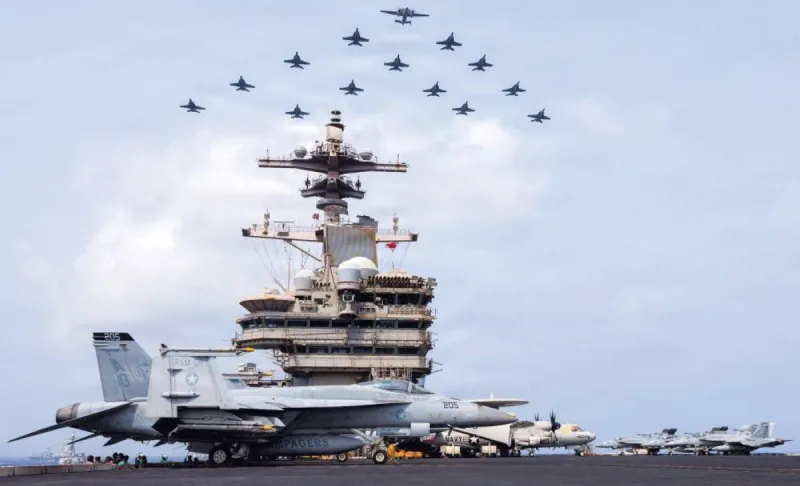
Cooper added that the United States is currently deploying at least 19 warships, including 2 aircraft carriers and an amphibious assault ship carrying more than 1,000 marines, alongside hundreds of military aircraft deployed across the Middle East, reflecting the scale of the US military build-up in the region.
The Iranian military, in turn, announced the deaths of 7 of its personnel in US strikes targeting a military base near the city of Iranshahr in the country's southeast, while the Iranian Ministry of Health said more than 260 people were wounded in the latest round of strikes, and the Iranian government spokeswoman announced that more than 30 people had been killed over the past few days.
US President Donald Trump affirmed that the American strikes would continue "until I say that's enough," noting that the United States had inflicted significant damage on Iran's military capabilities and that rebuilding them could take years if operations were to stop at this point.
Trump warned that the coming week could see strikes expanded to include power stations and bridges if Tehran does not agree to return to the negotiating table, affirming that the American objective is to prevent Iran from obtaining a nuclear weapon, preserve freedom of navigation in the Strait of Hormuz, and degrade the military capabilities used to threaten commercial vessels.
Trump also hinted vaguely at the possibility of launching a ground campaign as tensions in the war with Iran escalate, but provided no specific details.
In an interview with Fox News commenting on the idea of a ground war, Trump said: "I don't want to do that," adding: "Sometimes a ground campaign is necessary, but we have other parties that will carry out the ground campaign on our behalf," without identifying those parties.
US Vice President JD Vance said yesterday, however, that President Donald Trump's administration would not send ground troops to achieve regime change in Iran.
He added that Washington seeks to combine military pressure with negotiation to achieve 2 primary objectives: preventing Tehran from acquiring a nuclear weapon and ensuring the continued flow of oil and gas through the Strait of Hormuz.
At the same time, Trump revealed that US representatives had held talks with Iranian officials, while the Associated Press, citing regional officials, reported that a Pakistan-led mediation effort continues to work toward reviving a ceasefire and reactivating the negotiating track.