
Abu Dhabi — WAM / World capitals — Agencies
Iran continued on Wednesday to use the Strait of Hormuz as a pressure and extortion tool against international shipping, as vessel traffic fell to its lowest level in two months, shots were fired at commercial ships, and Tehran attempted to impose transit routes of its own choosing — all while renewing missile and drone strikes against Bahrain, Kuwait and Jordan.
In response, the United States announced a fresh wave of strikes against dozens of Iranian military sites, while US President Donald Trump said Washington was "in the process of taking control" of the strait and threatened to hit Tehran "with tremendous force."
The United Arab Emirates condemned in the strongest terms Iran's aggressive attacks on Arab sisterly nations, affirming that they constitute a flagrant violation of their sovereignty and a threat to their security and stability.
Shipping data and analysis by Kpler showed that oil and gas tanker traffic through the Strait of Hormuz fell to its lowest level since 25 May, while the US Navy-led Maritime Security Communications with Industry centre said commercial navigation was continuing, though at reduced levels reflecting the caution of shipping companies following recent attacks. Brokerage firm Gibson also warned that continued escalation could lead to a global supply shortage and higher energy prices if disruptions were prolonged.
In the midst of this escalation, President Trump said in an interview with Fox News that the United States was "in the process of taking control" of the Strait of Hormuz, pledging that Washington would take charge of protecting the vital maritime corridor and accusing Iran of reneging on understandings reached during recent talks.
Trump said Tehran had "broken the deal," threatening to strike it "with tremendous force" if it continued targeting international shipping. He also announced the reimposition of a naval blockade on Iranian ports alongside the launch of an American operation to protect the Strait of Hormuz.
Trump wrote on Truth Social that "the United States will once again impose a naval blockade on Iran," adding that his country "will collect a 20% fee on all goods shipped through the Strait of Hormuz." He said the operation "will begin immediately," without providing further details.
Trump also told Fox News: "They have no navy and no air force. All of their leaders have been killed. Their best leaders have been killed. Khamenei has been taken out, and his son has been taken out 90%."
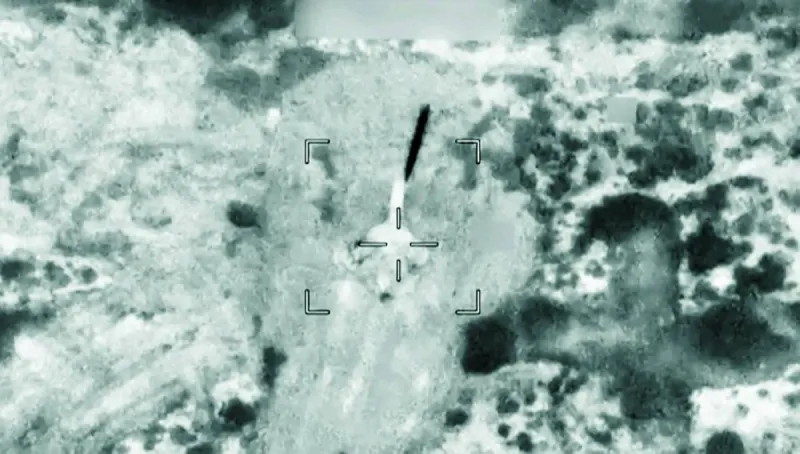
US Central Command (CENTCOM) announced the completion of a new wave of strikes against dozens of Iranian military sites, including air defence systems, coastal radar installations, missile capabilities, drones and fast boats, affirming that the operations aimed to degrade Iran's ability to attack commercial vessels and to ensure freedom of navigation in the Strait of Hormuz. CENTCOM also announced the use of one-way attack drones to strike a submarine and a ship-maintenance facility in Iran.
Iranian media, meanwhile, reported that 2 people were killed and 3 others wounded in strikes targeting sites in Khuzestan Province, while local reports spoke of explosions near Bandar Abbas and Qeshm Island, both overlooking the strait.
Bahrain's General Command of the Defence Force announced that its air defence systems had successfully intercepted and destroyed a number of Iranian missiles and drones, affirming that its forces were at the highest state of readiness and that targeting civilians and property constituted a flagrant violation of international humanitarian law.
In Kuwait, the General Staff of the Armed Forces announced that the armed forces had intercepted hostile aerial targets within the country's airspace, while the Jordanian Armed Forces announced the interception and downing of 4 missiles that had entered the kingdom's airspace from Iranian territory, with no casualties or damage recorded.
The UAE condemned in the strongest terms the renewed Iranian aggressive attacks — carried out with missiles and drones — that targeted the Kingdom of Bahrain, the State of Kuwait and the Hashemite Kingdom of Jordan.
The Ministry of Foreign Affairs stated in a communiqué that these aggressive attacks constitute a flagrant violation of the sovereignty of the sisterly states and a threat to their security and stability. The ministry renewed the UAE's full solidarity with Bahrain, Kuwait and Jordan and its support for all measures that would preserve their security and stability.
Qatar also condemned the Iranian attacks on Jordan, Bahrain and Kuwait, describing them as a breach of international law, and called for de-escalation and a return to the diplomatic track. Germany, France and Britain similarly condemned, in a joint statement, Iran's attacks on commercial ships in the Strait of Hormuz and on countries of the region, calling for a return to the ceasefire and the resumption of negotiations.
In a sign of the breadth of Western pressure on Tehran, the foreign ministers of Germany, France and Britain denounced the attacks Iran launched against commercial shipping in the Strait of Hormuz and against countries in the region.
The three countries said in their joint statement: "We condemn Iran's disgraceful attacks on commercial shipping in the Strait of Hormuz and on countries in the region, including Qatar, Kuwait, Oman and Jordan." The three nations — known as the European Troika — called for a reimposition of the ceasefire and the resumption of negotiations.
France separately affirmed that European sanctions on Iran would not be lifted before it abandoned its nuclear and ballistic missile programmes and halted activities Paris considers destabilising to the region.
French Foreign Minister Jean-Noël Barrot said in an interview with BFM TV and RMC radio: "Sanctions on the Iranian regime will not be lifted until it gives up its nuclear programme, its revolutionary project that destabilises the region, and its ballistic missile programme — some of which may one day be capable of targeting Europe" — and "until it grants Iranians the freedom to build their own future."
While Washington insists that freedom of navigation in the Strait of Hormuz will remain guaranteed, Tehran continues to press for the imposition of its own rules for ship transit, at a time when declining traffic reveals that one of the world's most important maritime corridors is living through one of its most sensitive phases — with the military and political confrontation between the two sides and its direct repercussions for global energy security and trade showing no sign of abating.