
Abu Dhabi — WAM; world capitals — agencies
Iran's attempts to extort the world through the Strait of Hormuz have been met with an escalating US military response, after Tehran targeted commercial vessels and declared the waterway closed, while renewing attacks on Gulf and Arab states. Washington responded with three rounds of strikes hitting more than 300 military targets inside Iran, the latest of which came on Thursday.
The most recent round struck approximately 140 military sites, while the United Arab Emirates condemned in the strongest terms the renewed Iranian aggressive attacks targeting the Kingdom of Bahrain, the State of Kuwait, the State of Qatar, the Hashemite Kingdom of Jordan, and the Sultanate of Oman with missiles and drones.
The Iranian Revolutionary Guard Corps announced in a statement carried by the official IRNA agency that the strait was closed "until further notice", but US President Donald Trump and US Central Command affirmed that the passage remains open to commercial navigation and that US forces are present and ready to ensure freedom of transit.
US Central Command said the Cyprus-flagged container ship GFS Galaxy was sailing through the Strait of Hormuz near Omani coastal waters along a route used by commercial vessels to avoid Iranian territorial waters when it was struck by an Iranian attack.
It said the vessel suffered severe damage to its engine room, causing a fire to break out and forcing the crew to abandon ship, with one sailor remaining missing.
The Omani Maritime Centre announced that the relevant authorities responded to the vessel's distress call and succeeded in rescuing 23 crew members, while the search for the one missing sailor continued.
India's Ministry of External Affairs said 11 Indian nationals were aboard the ship, 10 of whom were rescued, while the 11th remains missing. New Delhi condemned the targeting of commercial vessels and civilian infrastructure and called for the resumption of unimpeded freedom of navigation through international waterways in accordance with international law.
The United States responded to the attack on the vessel by launching the third round of strikes against Iran within a week, on the orders of President Trump.
Trump said in a phone interview with CNN that the United States had delivered a "very powerful strike" against Iran the night before last, adding that Washington and Tehran had been on the verge of reaching a deal before the attack on the ship.
"They were about to give up everything, and then suddenly two hours later they hit a ship with a drone," Trump said, asserting that Iran's behaviour had caused the collapse of progress that had been achieved in the talks.
In a separate interview with NBC, Trump confirmed that the Strait of Hormuz is open to commercial shipping, despite the ongoing exchange of attacks and concerns about the security of one of the world's most important maritime routes for oil and gas transport.
Trump had announced days earlier that the temporary ceasefire with Iran was "over" following the resumption of Iranian attacks on commercial vessels in the strait. Trump also warned on Saturday that any Iranian attempt to assassinate him would be met with a US response that would destroy Iran "completely", following the publication of Iranian statements and threats referencing a list of names of Western and Israeli officials and leaders.
US Central Command announced it had completed the new round of strikes, which targeted approximately 140 military targets in Iran — the largest number of targets in any of the three recent rounds.
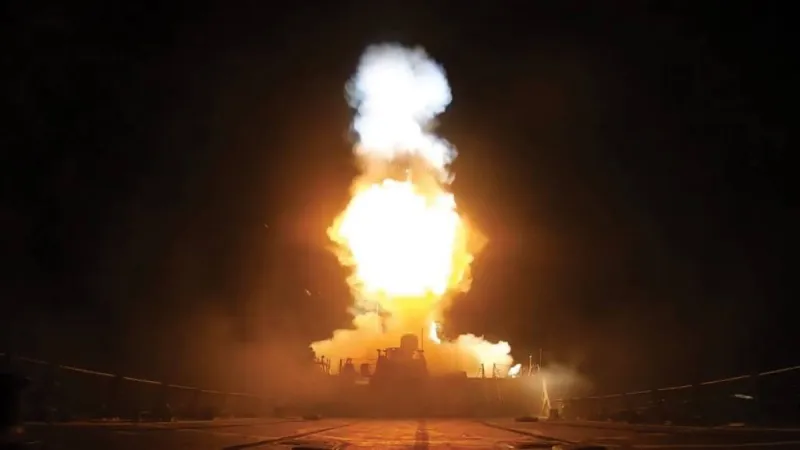
CENTCOM said the strikes were carried out using precision-guided munitions launched by combat aircraft based on land and at sea, along with US drones and naval vessels.
The targets included, according to the US statement, missile and drone launch and storage sites, naval facilities and capabilities, ammunition depots, communications networks, and coastal surveillance sites linked to Iranian operations in the Strait of Hormuz.
Axios reported, citing a senior US official, that the United States launched several strikes on Iranian missile systems and air defence systems, and targeted small fast boats belonging to the Revolutionary Guard at scattered locations around the Strait of Hormuz.
CENTCOM reported that its forces struck more than 300 targets in Iran over three nights of operations this week, on the orders of the US president, with the aim of undermining Tehran's ability to attack civilian mariners and commercial vessels transiting the strait.
US Defense Secretary Pete Hegseth said Iran had "made a bad choice and is now paying the price." Iranian media reported explosions in Bandar Abbas, Sirik, Jask, Qeshm Island, and Khuzestan Province — areas that contain military and naval installations and sites along the Iranian coastline overlooking the strait.
Iranian media also reported the death of a military personnel member at the port of Jask. Mohammad Allahdad, head of the state-run Iranian electricity company Tavanir, said the latest strikes caused "severe damage" to the power grid and, by his estimates, resulted in the loss of approximately 4,200 megawatts of grid capacity and damage to more than 2,000 grid points.
CENTCOM said US forces are deployed and on full alert to ensure continued freedom of navigation, despite what it described as "Iranian aggression, harassment, threats, and unwarranted arbitrary declarations." It added that "Iran does not control the strait," affirming that shipping traffic is proceeding normally.
CENTCOM stated that US forces have, since the beginning of May, helped secure the transit of more than 800 commercial vessels and the transport of 400 million barrels of crude oil through the Strait of Hormuz.
The Joint Maritime Information Centre announced that the southern route through the strait, running along the coasts of the Sultanate of Oman, remains open and available for vessel transit, despite Iran's declaration that the passage is closed.
However, the centre maintained the maritime threat level at "critical" and urged vessels to exercise maximum caution, to expect radio communications from naval forces deployed in the area, and to be alert to potential risks associated with naval mines.
Following the US strikes, Bahrain, Kuwait, and Qatar announced that their air defences had intercepted Iranian missile and drone attacks, while the Sultanate of Oman confirmed that sites in the governorates of Musandam and Al Wusta had been targeted, and Jordan announced that 3 missiles launched from Iranian territory had landed inside the kingdom.
In Bahrain, the General Command of the Bahrain Defence Force announced that its air defence systems had engaged, intercepted, and destroyed a number of Iranian aerial attacks. The General Command said Iran is continuing its "systematic hostile approach" through missile and drone attacks targeting civilians in the kingdom.
It confirmed that all weapons and units of the Bahrain Defence Force are at the highest levels of readiness and on full defensive alert to protect the kingdom, calling on citizens and residents not to approach any foreign objects or remnants of interception operations and to report them to the relevant authorities.
It stressed that the deliberate use of missiles and drones to target civilians and private property constitutes a flagrant violation of international humanitarian law.
In Kuwait, the General Staff of the Army announced that the armed forces had intercepted hostile aerial targets within the country's airspace, explaining that the sounds of explosions heard were the result of interception operations carried out by air defence systems.
The General Staff called on citizens and residents to adhere to the security and safety instructions issued by official authorities.
Kuwait's Ministry of Foreign Affairs said the Iranian attacks reflect "insistence on a repeated hostile approach" and constitute a grave violation of Kuwait's sovereignty and territorial integrity, and a direct threat to its security, stability, and the safety of its citizens and residents.
It affirmed that the continuation of these attacks constitutes a dangerously serious escalation that exacerbates tension and instability in the region, threatens regional peace and security, and undermines diplomatic efforts aimed at de-escalation.
Kuwait reaffirmed that its security, sovereignty, and territorial integrity are inviolable, and that it reserves all its rights to take whatever is necessary to protect its security and preserve its sovereignty in accordance with international law and the UN Charter.
In Qatar, the Ministry of Defence announced that the armed forces had intercepted a missile attack targeting the country. The Qatari Ministry of Interior said 3 people, including a child, were injured as a result of shrapnel from interception operations, and that those injured are receiving the necessary medical care.
The ministry confirmed that security agencies and civil defence teams responded to developments in accordance with approved response plans and that services continued to operate normally.
Qatar's Ministry of Foreign Affairs condemned in "the strongest terms" the renewed Iranian attacks on its territory and on a number of Arab states, describing them as a flagrant violation of sovereignty, a breach of international law, the UN Charter, and the principles of good neighbourliness.
Qatar held Iran fully legally responsible for the attacks and their consequences, and affirmed that it retains its full right to respond in accordance with international law and Article 51 of the UN Charter, and to take the necessary measures to protect its sovereignty, security, territorial integrity, and citizens.
It also warned that the continuation of the attacks constitutes a "dangerous escalation" that complicates efforts to contain tensions and undermines political and diplomatic endeavours, calling for an immediate cessation of military operations and a genuine return to dialogue and negotiations.
In the Sultanate of Oman, an Omani security source confirmed that sites in the Governorate of Musandam had been targeted by drones.
The Sultanate of Oman expressed its condemnation and denunciation of the targeting, and stated that it is taking all necessary measures to address these developments in order to safeguard the country and those residing within it.
Oman's Ministry of Foreign Affairs summoned the Iranian ambassador in Muscat to deliver a protest note in connection with the targeting of sites in the governorates of Musandam and Al Wusta by drones.
The Ministry of Foreign Affairs said in a statement carried by the Oman News Agency that the ministry's Undersecretary for Administrative and Financial Affairs delivered the protest note to the Iranian ambassador during a meeting in Muscat.
The undersecretary expressed Oman's displeasure at these irresponsible actions, calling for adherence to the principles of state sovereignty, good neighbourliness, non-interference in internal affairs, and respect for the customs and moral values that bind the two neighbouring countries and peoples.
Iran's Ministry of Foreign Affairs had previously announced that talks hosted in Muscat between Iran and Oman on the Strait of Hormuz — in which a Qatari delegation also participated — concluded without tangible progress, with both sides agreeing to continue discussions at the political and technical levels.
In Jordan, the General Command of the Jordanian Armed Forces announced that 3 missiles launched from Iranian territory had landed at sites inside the kingdom with no human casualties recorded, while damage was limited to minor material losses.
It said Royal Engineering Corps teams moved to the sites and worked to secure them and handle the missiles and their remnants in accordance with approved technical procedures.
The Jordanian Armed Forces affirmed that they will not allow the kingdom's airspace or territory to be used as an arena for conflict or to threaten its security and stability, and that they will respond firmly to any threat to state sovereignty, territorial integrity, and the security of its citizens.
The United Arab Emirates condemned in the strongest terms the renewed Iranian aggressive attacks targeting the Kingdom of Bahrain, the State of Kuwait, the State of Qatar, the Hashemite Kingdom of Jordan, and the Sultanate of Oman with missiles and drones.
The Ministry of Foreign Affairs affirmed in a statement that these aggressive attacks constitute a flagrant violation of the sovereignty of the sisterly states and a threat to their security and stability. The ministry renewed the UAE's full solidarity with the Kingdom of Bahrain, the State of Kuwait, the State of Qatar, the Hashemite Kingdom of Jordan, and the Sultanate of Oman, and its support for all measures that serve to preserve their security and stability.
Saudi Arabia expressed its condemnation and denunciation in the strongest terms of Iran's continued behaviour destabilising the region's security and stability, and its violation of the principles of international law, the UN Charter, the Charter of the Organisation of Islamic Cooperation, and the rules of good neighbourliness.
The Saudi foreign ministry condemned the repeated Iranian attacks on commercial vessels, threatening the security and freedom of navigation, as well as the attacks on Gulf and Arab states, reaffirming the kingdom's complete rejection of violations of state sovereignty and threats to the region's security and stability.
Egypt also condemned in the strongest terms the Iranian attacks on Kuwait, Bahrain, Qatar, the Sultanate of Oman, and Jordan, describing them as a flagrant violation of their sovereignty and a dangerous escalation threatening the security and stability of the Gulf region and undermining de-escalation efforts.
Cairo renewed its full solidarity with the Gulf states and its support for them in confronting all that threatens their security and territorial integrity, affirming that no pretexts or justifications for these attacks can be accepted, and calling for an immediate halt to escalatory actions.
Arab League Secretary-General Nabil Fahmy condemned the Iranian attacks on commercial vessels and on Kuwait, Bahrain, Qatar, the Sultanate of Oman, and Jordan, affirming that Arab national security is indivisible.
He said that any infringement on the sovereignty of an Arab state constitutes an unacceptable violation requiring a unified and firm Arab stance, rejecting any justifications for the attacks and considering them to be in violation of international law, the UN Charter, and the rules of good neighbourliness.