
Days after the US-Iranian memorandum of understanding came into effect, the Strait of Hormuz has returned to the centre of tensions.
US President Donald Trump accused Iran of a "foolish violation" of the ceasefire agreement by launching attack drones towards ships transiting the strait, while the International Maritime Organization suspended the evacuation of stranded vessels and sailors pending additional safety guarantees for navigation.
Trump said in a post on Truth Social that Iran launched at least 4 attack drones towards ships transiting the Strait of Hormuz, adding that one of the drones struck the deck of a cargo vessel and caused damage, though the ship continued its voyage.
He said US forces shot down the other 3 drones, describing what had happened as a "foolish violation of the ceasefire agreement."
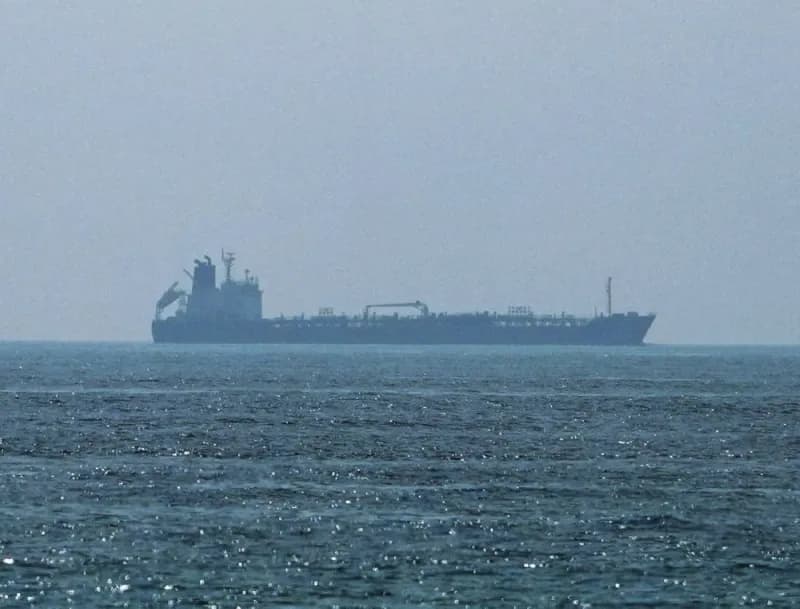
Trump's statement came after an incident targeting a cargo ship near the Omani coast. Taiwanese company Evergreen Marine announced that its vessel Ever Lovely, registered in Singapore, was struck by an "unidentified object" while exiting the Strait of Hormuz.
The company said damage was confined to the bridge area and that the main engine and other equipment were functioning normally, with no injuries reported among crew members.
The United Kingdom Maritime Trade Operations reported that a ship was struck by an unidentified projectile off the coast of Oman, causing damage to the command bridge with no injuries or environmental pollution. US media outlets, citing officials, attributed the attack to Iran.
In the wake of the attack, the International Maritime Organization, a United Nations body, announced the suspension of its operation to evacuate vessels stranded in the area.
Secretary-General Arsenio Dominguez said the organization had, since the operation began, successfully evacuated 115 ships and around 2,500 sailors through the Strait of Hormuz, as part of a plan targeting the evacuation of more than 11,000 sailors aboard around 600 vessels.
He added that some ships were still passing through the southern part of the strait, and that the evacuation operation would resume after obtaining additional assurances regarding navigational safety. The organization had begun the evacuation operation following the signing of the US-Iranian memorandum of understanding, via two corridors — one close to the Iranian coast and another close to the Omani coast — in coordination with local authorities.
Dominguez clarified that the vessel that came under attack was not part of the evacuation programme and had used the corridor close to the Omani coast without communicating with Omani authorities, according to Agence France-Presse. Iran, for its part, reaffirmed its insistence on a direct role in managing navigation in the strait.
Iranian Deputy Foreign Minister Kazem Gharibabadi said that safe passage could not be guaranteed through "vague arrangements" or alternative corridors that disregarded Iran's role as a state bordering the strait.
Iranian state television also reported that 3 foreign tankers attempted what it described as an "unauthorised transit" before turning back after receiving a warning from the Revolutionary Guard, without providing further details.
This came after a joint US-Gulf position underscoring freedom of navigation in the strait. US Secretary of State Marco Rubio, during a meeting with Gulf Cooperation Council foreign ministers the day before yesterday, affirmed that Washington rejects any attempt to impose fees or restrictions on international waterways, stating that these waterways "belong to no country" and that accepting fees for their use could open the door to "utter chaos."
The joint statement issued by the United States and the Gulf Cooperation Council affirmed "unconditional and unrestricted freedom of navigation" in the Strait of Hormuz, and rejected any fees, taxes, or attempts to impose control over transit traffic.
The statement also stressed that achieving lasting regional security requires addressing what it described as Iranian threats, including ballistic missiles, drones, and support for proxies in the region.
Gulf Cooperation Council Secretary-General Jasem Mohamed Al-Budaiwi welcomed yesterday Oman's announcement of the provision of a temporary maritime corridor in the Strait of Hormuz, in coordination with the International Maritime Organization, to assist in evacuating stranded sailors. He condemned, in a statement, what he described as Iranian threats to freedom of navigation in the strait.
Despite the security tensions, shipping data showed a limited recovery in traffic through Hormuz, particularly in fertiliser shipments. According to an analysis by specialist agency Argus, around 640,000 tonnes of sulphur have departed the strait since the temporary agreement was announced, compared with around 80,000 tonnes during the war.
Data from consultancy CRU also showed approximately 427,000 tonnes of urea transiting after the agreement, compared with around 275,000 tonnes during the war.
These shipments are of particular importance because around one-third of globally traded urea and around half of seaborne sulphur had typically passed through the strait before the war broke out. The near-total closure of the corridor during most of the conflict led to a sharp decline in shipments and a rise in fertiliser prices, raising concerns about potential repercussions for agricultural production and food prices.
Sarah Marlow, head of fertiliser pricing at Argus, said the flow of shipments through the strait "is reassuring," but noted that most current shipments are tied to existing contracts and will not supply new volumes to the market.
She added that bulk carriers are leaving the strait slowly, while empty tankers are not returning to load new shipments.
Willis Thomas, senior fertiliser analyst at CRU, said fertiliser volumes transiting the strait would not return quickly to pre-conflict levels, adding that August would be, in the best-case scenario, the earliest point at which a notable recovery in traffic could be expected.
CRU data indicate that around 600,000 tonnes of urea remain stranded inside the strait, while Argus estimates that between 300,000 and 400,000 tonnes of sulphur are awaiting departure.
On a separate matter linked to the US-Iranian negotiations, International Atomic Energy Agency Director General Rafael Grossi said any final agreement with Iran must include an "extremely in-depth" verification regime to ensure that nuclear weapons are not developed.
He added that the agency had begun preliminary talks with Iran regarding the fate of its enriched uranium stockpile, noting that diluting the enrichment level or transferring the stockpile outside Iran remain among the options on the table.
The memorandum of understanding between Washington and Tehran stipulates the opening of negotiations within 60 days — extendable — to reach a broader settlement encompassing Iran's nuclear programme, sanctions, and navigation arrangements in the Strait of Hormuz. It also stipulates, according to reports, the reopening of the strait and a prohibition on imposing fees on traffic during the negotiating period.