
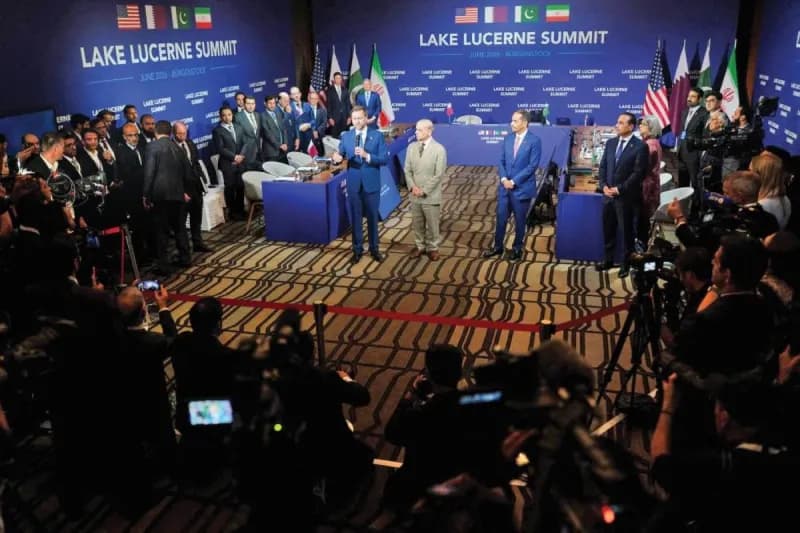
US-Iranian negotiations held at the Bürgenstock mountain resort on the shores of Lake Lucerne in Switzerland on Saturday became intertwined with discussions on a ceasefire in Lebanon. The first high-level meeting included representatives from the United States and Iran, alongside delegations from Pakistan and Qatar.
Switzerland imposed a no-fly zone over the resort hosting the talks, which caused a technical disruption due to interference with radar display systems.
12 arriving flights and 14 departing flights were cancelled, and at least 60 departing flights were delayed. The Swiss aviation authority said the decision to establish the no-fly zone was made at the last minute.
US Vice President JD Vance spoke of "significant progress" already achieved in the talks, which aim to reach a long-term peace agreement. Speaking as direct talks began between the two countries and mediators from Qatar and Pakistan at the Bürgenstock mountain resort, he said:
"What the President has asked us to do is to turn over a new leaf and transform our relationship with the Iranian people." He added: "We have already made significant progress, and I expect we will make further progress."
Vance described the talks with Iran as "historic." He said: "This is a historic meeting… What the President asked us to do is to turn over a new leaf in order to change our relationship with the Iranian people, and to reach out to the Iranians to tell them that if their leaders are willing to give up their role as a driver of regional instability, and if they are willing to permanently abandon any ambition to possess nuclear weapons, then the United States is ready for a fundamental change in its relationship with this country."
Pakistani Prime Minister Shehbaz Sharif, speaking alongside Vance, said he hoped the negotiations would conclude with "a wonderful agreement that will enhance peace, progress and prosperity throughout the world."
Vance, who is accompanied in Switzerland by envoys Steve Witkoff and Jared Kushner, continued: "Can we make a fresh start? Can we bring about a lasting change in relations in the Middle East? Or will we revert to the old ways, which is not something we prefer, but it certainly remains a very real possibility?"
He affirmed that the talks aim to address outstanding issues peacefully, noting that Washington hopes these tracks will lead to a fundamental shift in Iranian policies that ensures security and stability in the Middle East.
He stressed that diplomatic work continues alongside political pressure, explaining that the ultimate goal is to reach comprehensive understandings that end existing tensions and spare the region the ravages of wars and armed conflicts in the near future.
After bilateral morning meetings between the US and Iranian delegations with their Qatari and Pakistani mediators and Swiss hosts, all four delegations convened around the negotiating table in the afternoon.
For its part, the Iranian delegation made no statements to journalists and did not join the other three delegations in the hall while media representatives and photographers were present.
The early stages of the Switzerland talks were dominated by clashes in recent days in southern Lebanon between the Israeli army and Hezbollah. Alongside the diplomacy, US President Donald Trump struck a different tone.
On his Truth Social platform, Trump issued an explicit threat to Iran, demanding it immediately halt the activities of its "proxies" in Lebanon, warning that failure to comply would lead Washington to strike Iran militarily with greater force than it did last week.
Trump said, in reference to the confrontations between Israel and Hezbollah: "Iran must immediately stop its lavishly funded proxies in Lebanon from causing trouble. And if they don't, we will hit Iran hard again, just like we did last week, but harder!"
Trump added that the American administration would not tolerate any threats targeting regional stability, stressing that American patience has limits and that military options remain on the table should these warnings be ignored.
He said Washington is monitoring developments in the field with extreme precision, noting that any new escalation by Iran-backed parties would be met with a swift and powerful response aimed at ending destabilising influence in the Lebanese and regional arena.
Trump stressed that he is moving closer to handing the Hezbollah file to Syria. He told Fox News that he will give "Syrian President Ahmed al-Sharaa a greater role in dealing with Hezbollah," indicating that he is "on the verge of giving the order for Ahmed al-Sharaa to enter southern Lebanon because he will do a more precise job."
Trump expressed his frustration with Israel's performance against the group, saying he feels exasperated because Tel Aviv "cannot eliminate Hezbollah," contending that the Israeli army "cannot do anything without demolishing buildings" — a direct criticism of Israel's approach in Lebanon.
Tel Aviv maintains core conditions for any potential withdrawal from southern Lebanon, with the fate of the final formula for any agreement tied to ending the war on all fronts.
The Israeli newspaper Israel Hayom revealed on Saturday that Israel's conditions represent the "minimum" it will accept before withdrawing its forces: Hezbollah's withdrawal north of the Litani River, the dismantling of Hezbollah's infrastructure south of the river, and guarantees of full freedom of military action for the Israeli army.
Israeli Defence Minister Israel Katz stated that the Israeli army is not prepared to accept any restrictions on its operations in southern Lebanon, following reports of renewed airstrikes on targets in the area.
A statement issued by Katz said it remains possible to take measures to "eliminate threats." He added that the Israeli army had responded forcefully to attacks that killed soldiers in its ranks and had succeeded in eliminating a large number of Hezbollah fighters.