
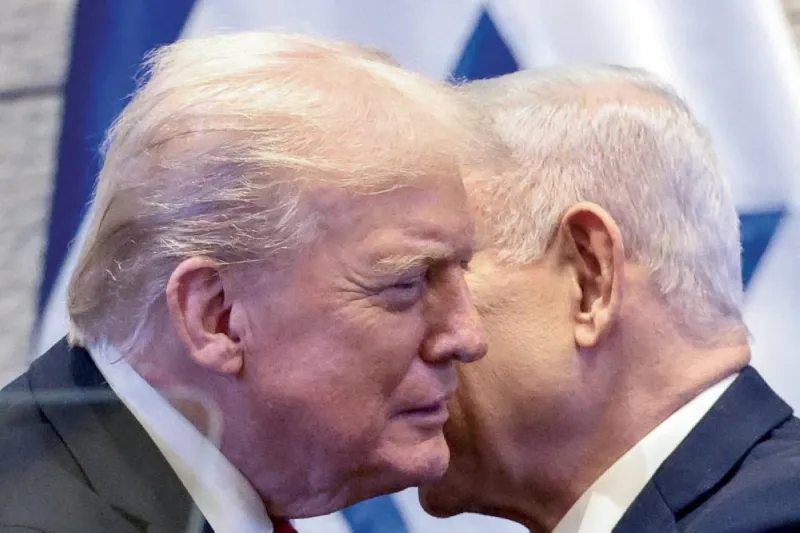
A report by Israel's Channel 12, indicating that the United States had rejected an Israeli request to view the memorandum of understanding taking shape with Iran, has triggered a wave of questions within Israeli political and security circles.
The development concerns more than a disagreement over a negotiating document; it touches on the foundation of the special and exceptional relationship that has bound the two sides for decades — one that has typically granted Israel the position of an informed partner privy to the finest details of American policy in the Middle East, and particularly on the Iranian file.
Amihai Stein, diplomatic correspondent for i24 News, wrote on X yesterday: "Israel requested access to the Iranian-American memorandum of understanding, and the request was rejected."
Earlier yesterday, a report in the American newspaper The Wall Street Journal revealed Israeli concerns about Washington's agreement with Tehran. The newspaper, citing a knowledgeable source, reported that Israeli Prime Minister Benjamin Netanyahu is urgently seeking a meeting with US President Donald Trump to resolve what he described as "conflicting matters" in the agreement.
Since 1979, the Iranian file has been one of the most important areas of strategic coordination between Washington and Tel Aviv. Despite recurring disagreements over methods of dealing with Tehran, Israel had typically enjoyed access to essential information regarding American negotiations and communications with the Iranians. Israeli circles therefore regard the refusal to share the details of the current memorandum of understanding as a political signal that goes beyond the content of the document itself.
The sensitivity of the issue stems from a fundamental difference in the two parties' visions of the Iranian question. Israel views Iran as the primary strategic threat to its national security, and believes that any agreement that does not lead to the complete dismantlement of Iran's nuclear infrastructure and a reduction in its missile capabilities and network of regional allies amounts to no more than a deferred danger.
The United States, for its part, approaches the file from a broader perspective that encompasses regional stability, the security of maritime corridors, global energy markets, and the prevention of a slide into an open regional war that could drain Washington and its allies.
This is not the first disagreement between the two sides over Iran. Tensions reached their peak during the nuclear deal negotiations in 2015, when Prime Minister Benjamin Netanyahu led a public campaign against President Barack Obama's administration, culminating in his delivery of a controversial address before the US Congress without prior coordination with the White House.
Yet the current development carries a different significance. In 2015, Israel was opposing an agreement whose details it knew and was seeking to torpedo; today, it is complaining of not having access to the details in the first place.
Observers interpret this distinction as an expression of an American desire to limit Tel Aviv's ability to directly influence the course of negotiations, leak information, or exert early political pressure to obstruct them.
This comes at a time when relations between the two countries are witnessing a series of accumulated divergences, the latest of which concerns the Lebanese file.
Whatever the nature of the memorandum of understanding being prepared, the manner in which the file has been managed may be more significant than its actual clauses. Washington's refusal to brief Israel on the document suggests that the relationship is passing through an unannounced phase of redefinition — one in which Israel is gradually shifting from the position of a partner participating in shaping American policy toward Iran to that of an ally informed of outcomes after decisions have been taken.