
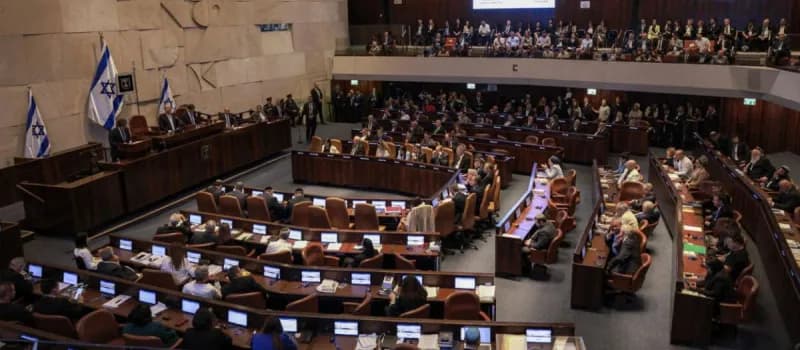
The Israeli parliament announced on Sunday that legislative elections will be held on 27 October, the latest date permitted by law, in a vote widely seen as a referendum on Prime Minister Benjamin Netanyahu's leadership since the outbreak of the Gaza war.
A statement from the parliament said: "Since it is expected that the current Knesset will complete its full term, and since the next general election is already set by law for 27 October, with no intention of shortening the legislative term, there is no need to issue a Knesset dissolution law in the usual sense."
The central question in the election remains whether Benjamin Netanyahu, Israel's longest-serving prime minister, will retain his position.
Below are the main features of Israel's electoral system.
Single constituency
The Israeli Knesset (parliament) is a unicameral body comprising 120 members elected to four-year terms.
The law stipulates that elections must be "general, national, direct, equal, secret, and proportional."
The Knesset can be dissolved before the end of its term by a simple majority vote, which is common in Israel.
In exceptional circumstances, the Knesset can extend its term beyond four years with a vote of 80 members.
The entire country, with approximately 7 million voters, constitutes a single electoral constituency.
In the most recent elections in November 2022, voter turnout reached 70.6 per cent.
Voters cast their ballots directly for Knesset members through party candidate lists.
The system is based on full proportional representation, with seats distributed in proportion to the share of votes each list receives.
Any list that exceeds the electoral threshold of 3.25 per cent of valid votes — equivalent to 4 seats — enters the Knesset.
Electoral threshold
The electoral threshold significantly influences final results, as votes cast for lists that fail to reach it are considered "void" and are effectively redistributed to lists that surpassed the required percentage.
This mechanism played a decisive role in the most recent elections, when 300,000 ballots — representing 6 per cent of votes — were redistributed.
Despite near-parity between the two competing blocs in terms of votes received, Netanyahu's camp ultimately secured a comfortable majority of 64 seats thanks to the redistribution of votes.
Electoral mosaic
Israel's electoral base is divided among multiple parties; 29 lists competed in the 2022 elections.
In addition to the historic parties such as the right-wing Likud and the left-wing Labour, there are parties representing ultra-Orthodox Jews, citizens from former Soviet republics, the Religious Zionist movement, as well as Druze and Arab voters.
Coalitions
The large number of parties makes it near-impossible to achieve the absolute majority of 61 seats required to form a government.
Once votes are counted, negotiations to form a coalition begin.
The president — currently Isaac Herzog — bears legal responsibility for tasking the leader most likely to succeed with forming a governing coalition, based on recommendations submitted by the parties.
In 2021, following four elections in less than two years, Netanyahu failed to form a government.
By contrast, Naftali Bennett succeeded in becoming prime minister at the head of a diverse coalition, despite his party winning only 6 Knesset seats.