
The successive political and field developments in south Lebanon, since the announcement of the framework agreement under American auspices on 26 June, reveal that the implementation of understandings is proceeding in parallel with continuing military operations and an exchange of political messages between Beirut and Tel Aviv.
While Israel insists on continuing its military operations and maintaining its forces in the areas under its control, the Lebanese state is escalating its demands for an Israeli withdrawal as a precondition for army deployment and the completion of the agreement's implementation — even as the dispute has extended to mutual statements about border villages and the future of the south.
In this context, Lebanese President Joseph Aoun, in a video call with the American Task Force for Lebanon, affirmed that the continued presence of Israeli forces on Lebanese soil "undermines the legitimacy of the state and prevents the deployment of the army and the foundations for achieving a just and lasting peace." He called on the American administration to pressure Israel to achieve withdrawal, saying — according to the Lebanese presidency and the National News Agency — that withdrawal represents "the key to any real, tangible, and practical progress" on the path to peace and stability in the south.
Aoun added that the Lebanese army and security forces constitute "the cornerstone of stability and security" in the south and of residents' return to their towns, stating that the option of negotiation has become the only remaining path after the war failed to achieve its declared objectives.
He warned that what he described as continued "Israeli intransigence" in remaining on Lebanese territory would not serve the goals sought by the United States and Lebanon in restoring state sovereignty and strengthening its institutions.
He also stressed that a return to civil war "is not on the table, despite all the attempts by some to reawaken strife," praising the role of Parliament Speaker Nabih Berri in supporting de-escalation and warning against sedition.
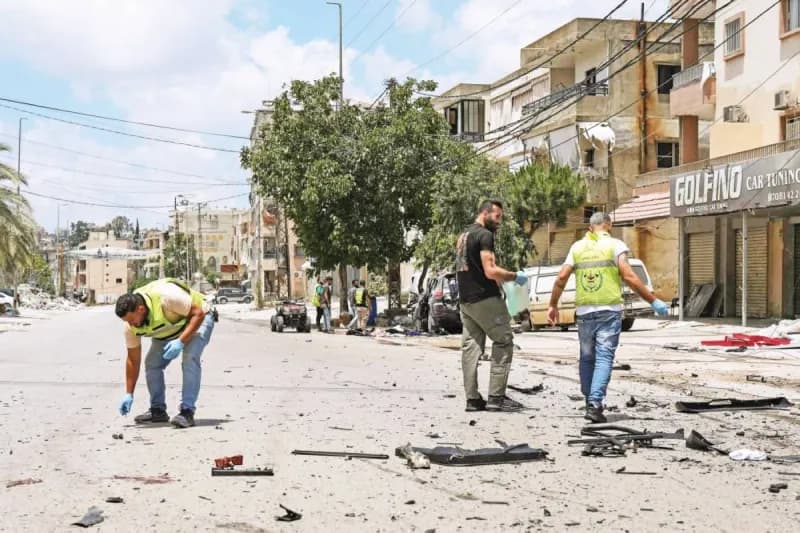
These positions came as Israeli military operations in south Lebanon continued. Following large-scale demolition operations carried out by the Israeli army the day before yesterday in the city of Bint Jbeil — which drew Arab condemnation — the Lebanese Ministry of Health announced, according to the National News Agency, the killing of 4 people, including 3 women, in an Israeli airstrike targeting a vehicle in the town of Al-Nabatiyeh Al-Fawqa.
Israel, for its part, says its operations target Hezbollah personnel and military infrastructure. Alongside the field developments, the political dispute widened following statements by Israeli Prime Minister Benjamin Netanyahu in an interview with Fox News, in which he claimed that some Christian villages in south Lebanon had requested to join Israel in order to be protected from Hezbollah fighters.
These statements were met with Lebanese rejection. The mayor of Rmeish, Hanna Al-Amil, denied the veracity of those claims in statements carried by the National News Agency, affirming that none of the southern towns had requested to join Israel.
Parliament Speaker Nabih Berri also praised, in a statement, the positions of municipal mayors and local figures — particularly in the border towns — saying they confirm the southerners' attachment to their land and national identity, and warning against "lies and fabrications" which he said were aimed at sowing strife among the inhabitants of the border areas.
Berri called on the Lebanese state and the Arab and international communities to act to halt what he described as the "systematic destruction" being inflicted on southern towns, saying that the continued demolition operations in Bint Jbeil, Marjayoun, Nabatiyeh, and Tyre reflect Israel's "true intentions" toward those areas.