
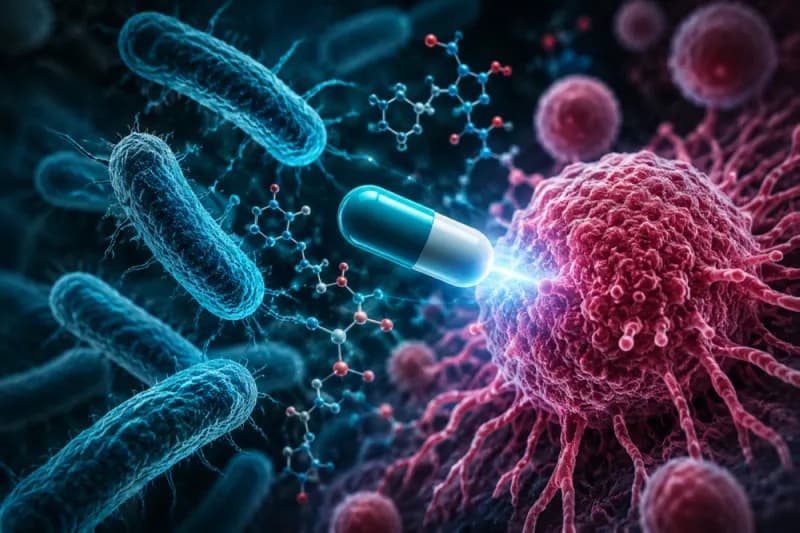
A team of researchers has succeeded in unravelling one of the most complex scientific mysteries in the world of microbiology, after determining the method by which certain species of bacteria naturally produce multiple copies of potent anti-cancer compounds. Scientists believe the discovery could pave the way for developing a new generation of treatments that are more effective and have fewer side effects, particularly for cancers that continue to resist current therapies.
According to the study, published in the journal Nature Communications, researchers from the University of Warwick in the United Kingdom and Monash University in Australia managed to decode a mechanism that had puzzled scientists for decades — namely, how bacterial enzymes cooperate to produce a diverse range of pharmaceutical compounds using a single biological system.
For many years, researchers had attempted to exploit this natural mechanism to produce new drugs through what is known as "combinatorial biosynthesis" — a technique that relies on employing bacterial enzymes to manufacture innovative pharmaceutical compounds. However, a limited understanding of how these enzymes communicate with one another had prevented significant progress in the field.
The researchers explained that the new breakthrough revealed how enzymes inside bacteria cooperate in a precise manner resembling industrial production lines, exchanging components among themselves to produce an entire family of anti-cancer molecules, rather than a single compound.
Among these compounds is the drug romidepsin, known commercially as Istodax, which is an approved treatment for certain types of blood cancers. Scientists hope that understanding this mechanism will enable the production of more advanced versions of this drug, with greater efficacy and fewer side effects.
The lead researcher on the study, Dr Monroe Passmore of the University of Warwick, noted that scientists had known for years that bacteria are capable of synthesising several versions of anti-cancer drugs, but did not know how this occurred in practice. He added that the study revealed for the first time how enzymes "communicate" and cooperate to produce these compounds — something that opens the door to designing new drugs that mimic what nature does.
The research team found that the secret lies in small protein structures known as "docking domains," which act as molecular connectors linking different enzymes within the bacterial cell. These connectors allow chemical compounds to move between enzymes smoothly and precisely, giving bacteria the ability to produce a large number of different therapeutic molecules using the same biological system.
The study also found that these systems evolved over millions of years as a result of gene duplication and rearrangement processes, which granted bacteria considerable flexibility in synthesising new compounds while preserving their therapeutic efficiency.
The study also focused on a compound known as FR-901375, which had puzzled scientists for years due to their inability to determine how it was produced inside bacteria. The new research succeeded in revealing its complete production pathway, showing that it belongs to a family of complex compounds that target enzymes responsible for regulating gene activity within cancer cells.
To reach these findings, the researchers used a combination of the latest techniques, including genetic analysis, biochemistry, artificial intelligence-based computational modelling, and protein analysis using mass spectrometry, in addition to gene-deletion experiments to verify the role of each component in the drug synthesis process, according to the website SciTechDaily.
Scientists believe that understanding this "natural factory" inside bacteria will give them the ability to engineer new biological pathways to produce anti-cancer drugs with improved properties, such as increased efficacy, enhanced precision in targeting cancer cells, and reduced side effects that accompany many current treatments.
The researchers affirm that their next goal is to build an extensive library of new pharmaceutical compounds inspired by this natural mechanism, in order to accelerate the development of innovative treatments for types of cancer that still require more efficient therapeutic options — a step that could represent a qualitative leap in the future of medicine and oncology.