
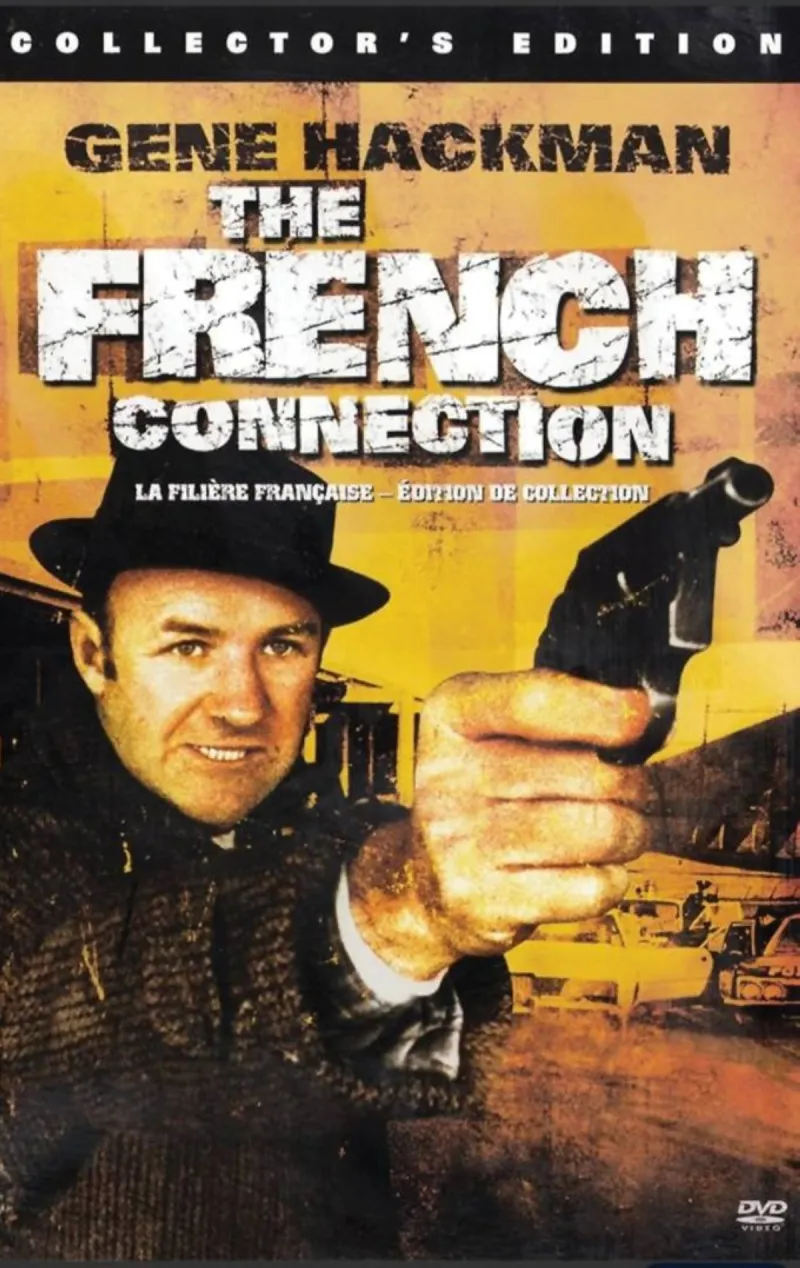
There is a shot in The French Connection that announces itself without fanfare: a camera bolted to the hood of a car hurtling at 90 miles per hour beneath the elevated rail tracks of Brooklyn, chasing a train passing overhead.
There is no score, no slow-motion cuts — only a terrifying, dispassionate rendering of the physics of speed. When director William Friedkin released the film in 1971, he was not making a conventional police procedural. He was detonating a charge beneath Hollywood's storytelling machinery.
The film reached screens at a moment of historic fracture: the old studio system was crumbling, the Vietnam War was raging, and audiences were exhausted by the lies that had defined the previous decade.
Friedkin absorbed all of this. He stripped The French Connection of sentimentality and idealism, offering audiences a central protagonist — Detective Jimmy "Popeye" Doyle, played by Gene Hackman in what may be the most defining American screen performance of the era — who was not a hero in any traditional sense, but a man driven by ferocious obsession. Doyle is prejudiced, reckless and frequently wrong. He prevails in the end, yet the film refuses to grant that victory any sense of moral integrity.
What Friedkin invented was a visual language that subsequent filmmakers adopted as a kind of artistic doctrine: handheld cameras that register the wobble and stumble of human movement; location shooting that transforms the city into a character in its own right rather than a backdrop; editing rhythms that reflect anxiety and tension rather than comfort.
This aesthetic planted the seeds of the decade that immediately followed. Sidney Lumet absorbed that same dry, documentary style into Serpico in 1973 and Dog Day Afternoon in 1975. Michael Mann, who would later build his entire career on the grammar of procedural tension and contemporary nocturnal urban lighting, has repeatedly cited the film's influence on his directorial style in masterworks such as Heat and Collateral.
Even Martin Scorsese, whose Mean Streets appeared two years after Friedkin's film, acknowledged the permission and audacity that The French Connection granted filmmakers to present New York as a lived reality, stripped of any glamour or embellishment.
The elevated train chase — a full 12 minutes with no dialogue, relying almost entirely on practical effects and physical realism — became the definitive benchmark against which the craft of action filmmaking has been measured ever since.
What made those shots radical was not the speed itself, but the consequences and genuine danger. Friedkin takes care to capture bystanders caught in the orbit of the event: a woman pushing a pram, a man stepping off a kerb.
The stakes feel real because the laws of physics feel real — and they are, because they were executed practically. Stunt coordinator Bill Hickman drove that car at those speeds through live, everyday traffic on the streets of Brooklyn.
That artistic legacy is pervasive today: from the Bourne series' commitment to shaky, close-quarters cinematography, to Christopher Nolan's insistence on practical effects and real locations in The Dark Knight, to the rigorous procedural restraint of Denis Villeneuve's Sicario.
The film granted permission and boldness to works such as Chinatown, No Country for Old Men and Zodiac — films that understood that reality never bends to serve narrative comfort.
Friedkin made only one French Connection, yet cinema has been remaking it ever since. We see it in every crime thriller that has the audacity to trust its audience's intelligence and confront them with doubt and discomfort; in every action sequence whose adrenaline derives its value from weight and realism; in every film courageous enough to end without easy answers. That is an immense, enduring and far-reaching legacy for a film that was, at its simplest, about two detectives, a drug shipment and a single car.