
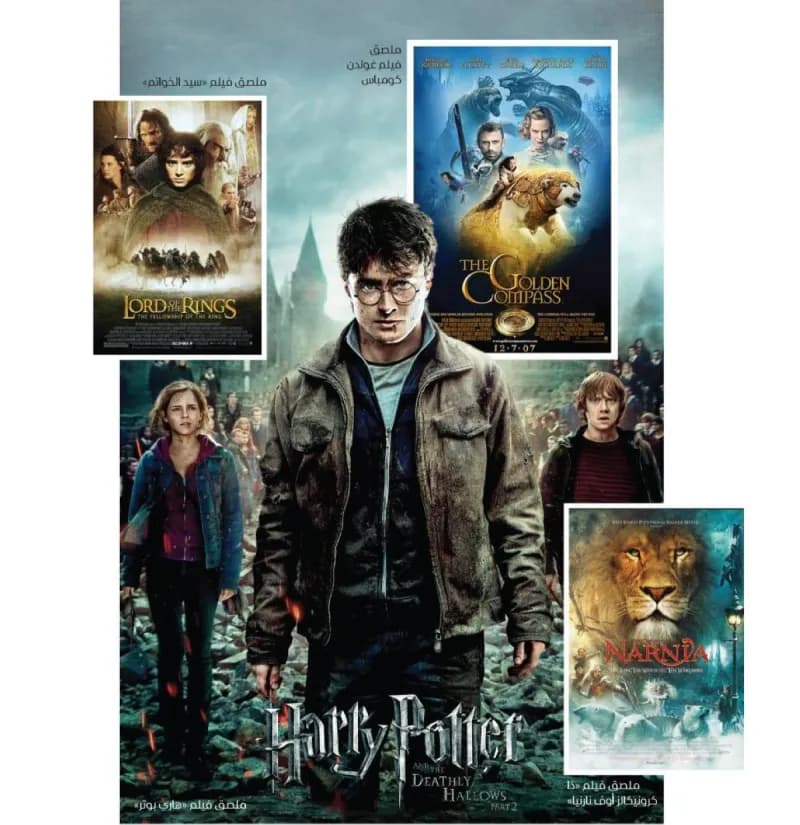
The simultaneous arrival of Peter Jackson's The Lord of the Rings and Chris Columbus's Harry Potter did not merely challenge the prevailing convictions and assumptions of the industry at the time — it detonated and shook the entire global box-office structure.
The historic success of The Lord of the Rings trilogy rested on a radical revolution in tone and artistic style. Director Peter Jackson did not treat J.R.R. Tolkien's epic as a fairy tale for children; instead, he forged it into a realistic, brutal historical epic teeming with vivid detail.
Middle-earth was not a place awash in glittering, ethereal magic, but a world of mud, blood, time-worn stone, and rust-eaten armour.
By applying rigorous and uncompromising levels of realism, Jackson succeeded in stripping the genre of the "geek stigma" that had long shadowed it, drawing in broad audiences of adults and mature viewers — the very demographics that had previously preferred historical war films or elite prestige dramas.
This creative vision was fully supported by a decisive technological leap and turning point: artists and programmers at Weta Digital developed advanced software for digital simulation and crowd animation — including the MASSIVE programme — which made fantasy worlds look genuinely real and breathtakingly convincing for the first time in cinematic history.
The spectacular digital rendering of characters such as Gollum, and the imposing, terrifying embodiment of the fire-demon Balrog, meant that audiences were no longer forced to look past clumsy puppets or poor, unconvincing animation to engage with the story. The world on screen felt as tangible and real as our own.
Yet the seismic impact of The Lord of the Rings cannot be separated from the critical historical moment it inhabited. With the premiere of The Fellowship of the Ring just a few months after the tragedy of 11 September 2001, the film met a global audience living through deep collective trauma and a sudden sense of political instability.
The film's narrative — centring on a small, disparate band from differing cultures uniting to confront a profound evil lurking in the shadows — spoke directly to deep societal and psychological needs.
The story offered profound consolation to the human spirit, carrying an unambiguous reassurance that ordinary, simple people who appear powerless are capable of changing the course and fate of a terrifying world, simply by holding fast to their moral convictions and their absolute loyalty to one another.
In the wake of the twin successes of Middle-earth and Hogwarts, fantasy literature and cinema entered a quarter-century of continuous and turbulent evolution, tracking sweeping shifts in audience taste, corporate financing strategies, and global politics across three prominent historical phases.
In the period immediately following 2001, Hollywood studios drew a lesson that was far too reductive. Executives assumed — with disarming simplicity — that audiences now possessed an insatiable appetite for any intellectual property involving magic and ancient prophecy, and they raced frantically to acquire the adaptation rights to every young-adult fantasy book series available on the market.
The result was the dawn of an era of blind commercial and institutional imitation, as audiences were inundated with a flood of adaptations: The Chronicles of Narnia in 2005, Eragon in 2006, The Golden Compass in 2007, and The Spiderwick Chronicles in 2008.
With rare exceptions, this first wave ultimately collapsed under the weight of its own limitations and narrow horizons.
Stripped of the artistic commitment and thematic depth that had distinguished Peter Jackson's work, most of these films appeared to be consumer products manufactured in corporate corridors rather than organically crafted worlds pulsing with living detail.
By the end of that decade, a clear and palpable sense of exhaustion and boredom had settled over the box office. The classic "chosen boy who saves the magical kingdom" motif had been utterly drained, leaving audiences yearning for a more mature and sophisticated mode of storytelling.
The magic mirror: How 'pop spirituality', political anxiety and the 'prestige production' boom reshaped fantasy literature (1-3)