
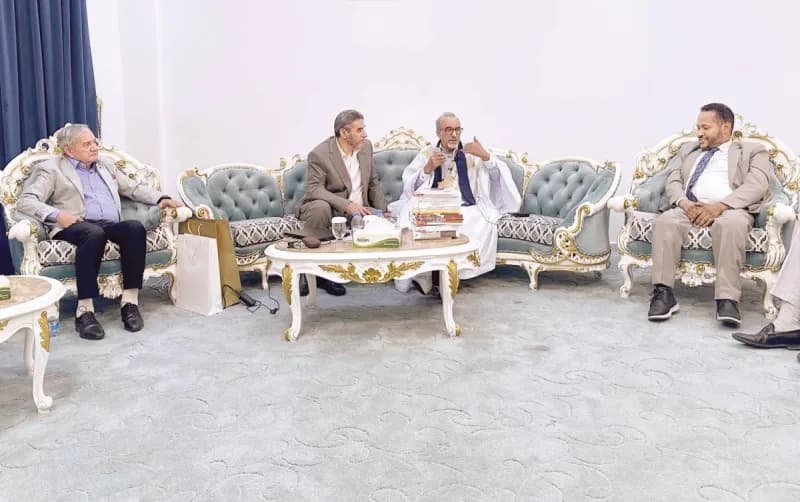
The Arab Cultural Club in Sharjah recently hosted Mauritanian poet Dr Addi Wuld Adabb in a dialogue session titled 'Between Biography and Poem', which explored highlights of his journey in literary criticism and linguistic studies as well as his poetic works, in the presence of a number of intellectuals and cultural enthusiasts.
The session was presented by journalist and writer Mohammed Wuld Mohammed Salem, chairman of the cultural committee at the Arab Cultural Club in Sharjah, who affirmed the club's commitment to hosting Arab writers visiting the United Arab Emirates in order to enrich the cultural scene.
Dr Omar Abdulaziz, chairman of the club's board of directors, joined with a remote address from London, in which he said that 'Dr Addi Wuld Adabb is a comprehensive Arab intellectual with a special relationship with poetry, criticism, vision, and overarching concepts, and this is an exceptional symposium because it addresses a personality that has made a genuine contribution to Arab culture.'
Dr Addi Wuld Adabb began by paying tribute to the role of the Arab Cultural Club, which had hosted his first poetry evening in Sharjah in 2008, and to the Sharjah Department of Culture, which published his first book in 2006, affirming that Sharjah holds a special place in his soul.
On the ongoing debate between classical metre poetry and free verse, Dr Addi Wuld Adabb presented a thesis he termed 'hot poetry', saying: 'Poetry is not served by being free if it lacks warmth, nor is it served by being classical in form unless it pulsates with that warmth. When poetry loses its heat, free verse becomes mere prose and classical verse turns into nothing but cold versification. This warmth is a spirit that flows through the text — it is not found in the word alone, or the sentence alone, or the image alone, or the rhythm alone, or the feeling alone, but is formed from all of these together, in which everything dissolves to become another creative composition, a burning one that ignites its listener and reader with the flame of poetry.'
The lecturer also addressed the complexities of classical poetic structure and reviewed the views of early scholars on the definition of the poem.