
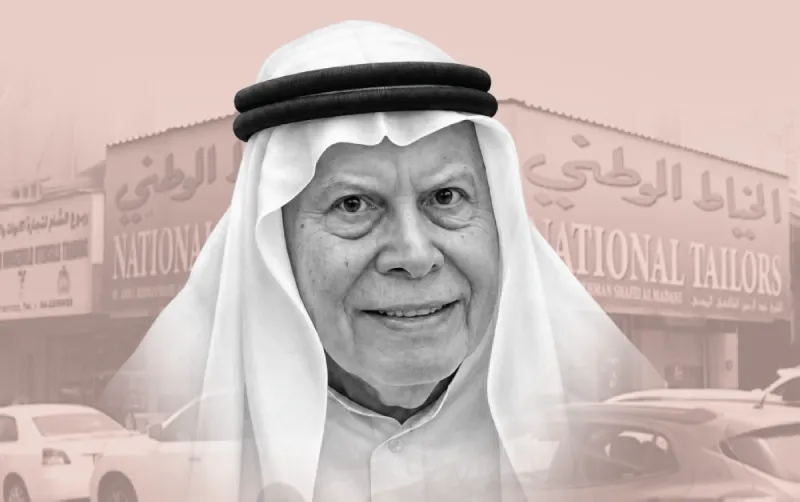
Sheikh Abdulrahman Al Shafi'i Al Madani was not merely a tailor celebrated for his mastery of the craft; he was a witness to Dubai's history and one of the men who preserved the details of Emirati identity with thread and needle. He earned the title of "Dubai's first tailor in history" after his name became synonymous with the Emirati kandura for many decades, and he became one of the emirate's most prominent symbols of heritage craftsmanship.
With his passing at the age of approximately 97, Dubai closed one of its cherished chapters. The man had lived nearly a full century, during which he witnessed the emirate's transformation from a small city dependent on trade and the sea into one of the world's most important cities. Throughout all those years, he remained devoted to the profession he loved, convinced that the kandura is not merely a garment but a statement of identity and authenticity.
Abdulrahman Al Madani began his journey with tailoring at around the age of 14, at a time when the trade relied entirely on manual work and modern sewing machines had yet to enter most shops. He learned the fundamentals of the craft through patience and practice until his name echoed across the various neighbourhoods of Dubai, where he would cut and sew fabric with extraordinary precision, earning the trust of ordinary residents and prominent figures in the emirate alike.
As Dubai flourished and grew economically, Sheikh Abdulrahman Al Madani never abandoned his professional principles. He established his own shops, which became among the oldest and most renowned men's tailoring establishments in Dubai. Over the course of decades, they welcomed successive generations of UAE nationals and residents, eventually becoming a landmark associated with Emirati elegance and local heritage.
He believed that a tailor does not merely make a garment — he creates an impression and an identity. He was therefore known for the precision of his measurements and his insistence that every kandura fit its owner perfectly, while preserving the traditional Emirati cut, despite the evolution of fabrics, fashions, and tailoring techniques.
For him, tailoring was not merely a livelihood but a mission through which he safeguarded one of the most important aspects of national identity. At a time when modern fashions flooded the markets, Al Madani held fast to the Emirati kandura, preserving its details that reflect the history and culture of society.
Over the course of nearly 8 decades, thousands of kanduras passed through his hands, leaving his imprint on countless official, national, and social occasions. His name remained linked to the early craftsmen who contributed to building modern Dubai, each in their own field.
Abdulrahman Al Madani represented not merely individual success but a model for an entire generation of pioneers who built Dubai's economy before the construction boom, when traditional crafts rested on trust, mastery, and human relationships — values that still live in the memory of Emirati society.
The condolence messages that followed his death reflected the magnitude of the place he occupied in the hearts of UAE nationals. Many described him on social media as "the sheikh of tailors" and "one of Dubai's earliest pioneers," affirming that his passing represents the loss not only of a tailor but of a part of the city's memory and human heritage.
The name of Sheikh Abdulrahman Al Shafi'i Al Madani endures in Dubai's history — not only because he was the first to make a profession of tailoring the Emirati kandura, but because he was able to transform a simple trade into a cultural legacy, and to make the needle and thread a means of preserving identity, just as books preserve the history of cities. His life story remains a testament to an era in which devoted hands shaped the Dubai the world knows today.