
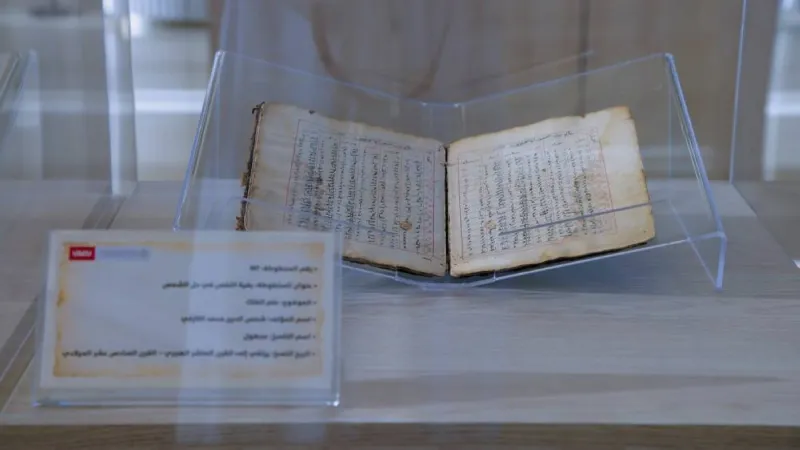
Manuscripts in the United Arab Emirates form a fundamental pillar in safeguarding national memory, representing the intellectual vessel that documents Arab and Islamic heritage and preserves the features of cultural identity from distortion or oblivion.
Through the knowledge and human experience they carry, these manuscripts remain a bridge of knowledge connecting generations to their roots and civilisation, and a source that reinforces belonging and entrenches awareness of cultural heritage.
In this context, UAE University opens a window for the public onto rare manuscripts that stand as living testament to an enduring civilisational glory, where the secrets of astronomy and applied sciences blend with the magic of the Arabic language, weaving together a story of identity and sustainable memory that has resisted forgetting, and come to recount for generations the details of Arab genius.
At the exhibition "Manuscripts: Identity and Sustainable Development", held in cooperation between UAE University and Bait Al Hikma, letters breathe the fragrance of history and knowledge awakens from centuries of slumber, proclaiming that the ink inscribed by early scholars still pulses with life.
Mahra Al Qaseer, spokesperson for Bait Al Hikma in Sharjah, confirmed to Al Bayan that the exhibition "Manuscripts: Identity and Sustainable Development" serves as the final stop of an expansive cultural tour that encompassed a number of destinations across the country's various emirates, launched by UAE University to celebrate its academic and intellectual legacy spanning 5 decades since its founding.
She explained that the exhibition opens its doors to the public for 10 days, offering them an exceptional opportunity to view and discover rare and precious scientific manuscripts from the university's own collection.
She noted that the event aims principally to shed light on the great scientific and civilisational value contained within these manuscripts, as an authentic and inspiring source of human knowledge, a living witness to the momentous contributions made by scholars throughout history, and a bridge connecting authenticity with contemporaneity, and the past with the present across various fields of knowledge.
Aisha Ali Al Safdani, a UAE University student majoring in Political Science, confirmed that the exhibition is broadly divided into 3 main sections covering: applied sciences, astronomy, and Arabic language and literature, with each section housing a varied collection of historical manuscripts.
She noted that the applied sciences section showcases manuscripts specialising in medicine, engineering, mathematics, agriculture, and chemistry, while the Arabic language section addresses multiple themes including grammar, rhetoric, poetry, literature and criticism, and that these works were composed by the hands of Arab scholars dating back to ancient eras.
Al Safdani pointed out that the exhibition represents a wonderful opportunity for researchers and those interested in scientific and research fields, as the manuscripts on display offer the chance to examine the earliest beginnings of research and applied sciences, as well as to become acquainted with historical methods of medical diagnosis and treatment.
She also highlighted the development of mathematical models, methods of enumeration, measurement, and ancient techniques, noting that the exhibition clearly reflects the diversity of scientific and literary fields that contributed to advancing paths of learning, discovery, and the exchange of knowledge across the ages.
Khalifa Saeed Al Zaabi, a UAE University student majoring in Aerospace Engineering, emphasised the scientific and cultural importance contained in the first section of the exhibition, which illuminates the linguistic and historical identity of the Arab heritage.
He explained that this section presents a unique and distinguished collection of historical manuscripts that accurately document the stages of development of the Arabic language and its literature across the ages, and that the exhibits are not limited to literary texts alone, but also encompass the vital sciences associated with the language such as expression, writing, and poetry, in addition to rhetoric and literary criticism.
Al Zaabi noted that the manuscripts also cover important foundational and grammatical aspects in the fields of syntax and morphology, alongside numerous other sciences and branches that delve into the details of the Arabic language.
He drew attention to the strategic value of these fields of knowledge, which throughout history have formed essential and fundamental tools for human communication and the transfer of knowledge between generations, as well as playing a principal role in preserving the intellectual and cultural heritage of the nation.
For her part, Aisha Al Kutbi, a UAE University student majoring in Management and Economics, explained that the prominent academic richness and knowledge diversity evident in the applied sciences section represents a fundamental pillar in preparing students and equipping them with the necessary knowledge and skills.
Al Kutbi outlined that the fields of scientific and applied knowledge in the section are characterised by broad plurality encompassing various vital sectors, such as medicine, engineering, mathematics, and chemistry, in addition to agricultural sciences.
She noted that the curricula and courses on offer clearly illuminate the historical and methodological development of scholars' approaches, focusing on how scientific research progressed from stages of precise observation and practical experimentation through to the development of comprehensive scientific knowledge and its real-world applications, keeping pace with the global scientific leap.