
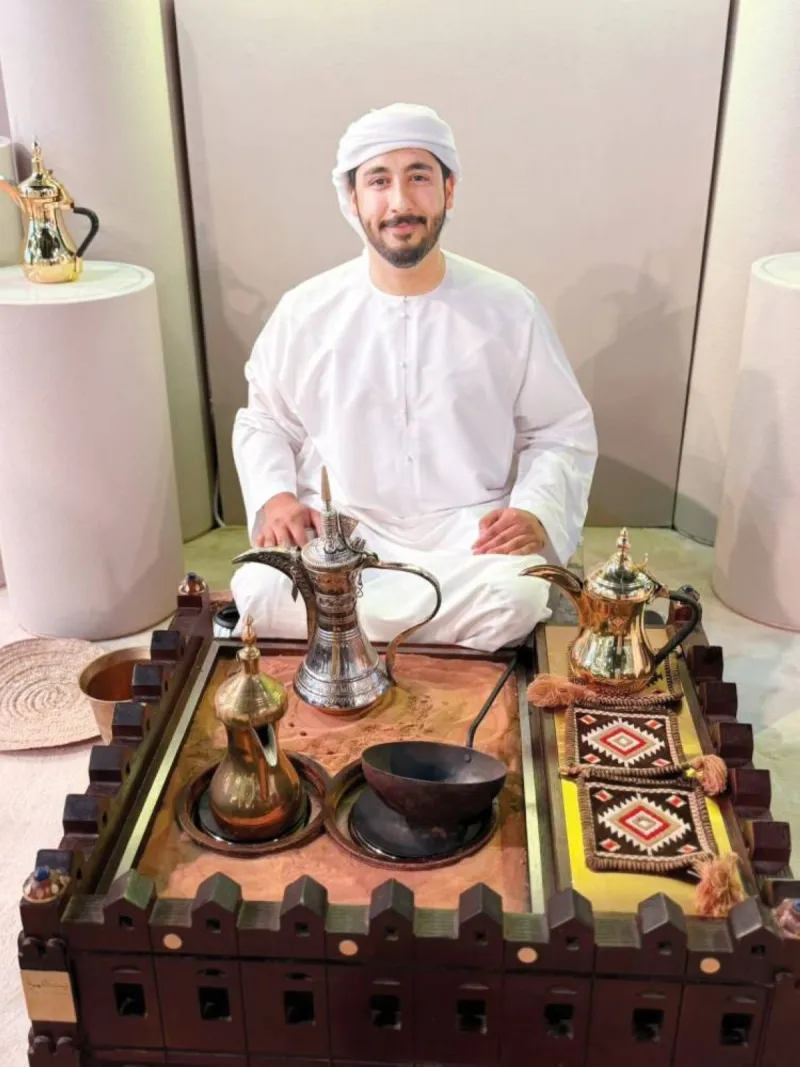
Emirati coffee has become far more than a drink served to guests. It is a complete story, carrying details from memory, identity, and ancient gathering halls. Between the aroma of roasted coffee beans, the sound of the mortar and pestle, and the dallah pots passed from hand to hand, the preparation of coffee transforms into a cultural experience through which visitors discover a facet of the Emirati heritage — its language, its tools, and its rituals, which remain alive to this day.
In this context, Saif Al Maamari, winner of the coffee-maker championship held by the Department of Culture and Tourism – Abu Dhabi and supervisor of the visitor experience at the department, said that his participation in cultural events and exhibitions aims to introduce audiences to the method of preparing Emirati coffee and to convey its heritage details to visitors of various nationalities.
He explained that coffee is not merely a preparation method but a complete culture tied to its own tools and vocabulary, noting that there are 3 types of dallah pots: the khamra, used for boiling water; the malaqqama, in which the coffee is placed; and the mazalla, used for pouring and serving coffee to the guest.
He added that coffee also has rituals associated with the cups themselves, including the finjaan al-hayf — drunk by the owner of the dallah to reassure the guest — the finjaan al-dayf (the guest's cup), and the finjaan al-kayf, which reflects a mood of comfort and ease in the gathering. There is also the finjaan al-sayf, historically associated with important occasions and fateful decisions.
Al Maamari noted that cultural participations are not limited to serving coffee alone, but include explaining the heritage tools used in its preparation, such as the tawa, the mihmas, the minhaz, and the dallal pots, as well as introducing visitors to the method of roasting, grinding, and pouring coffee in accordance with inherited Emirati customs.
He confirmed that the strong engagement from the public — especially foreign visitors — reflects a growing interest in learning about Emirati culture and experiencing it first-hand, pointing out that some events allow visitors to personally participate in grinding, roasting, and serving the coffee.
"Even visitors from nationalities that can sometimes be difficult to engage with — such as some Korean and Chinese visitors — were very interactive with the experience, because heritage reaches people through experience more than through words."
He explained that the team aspires in the future to establish a specialised academy and coffee shop that presents the Emirati coffee experience in a way that combines heritage with contemporary cultural engagement, alongside continuing to participate in festivals and events that help introduce the public to the Emirati legacy.