
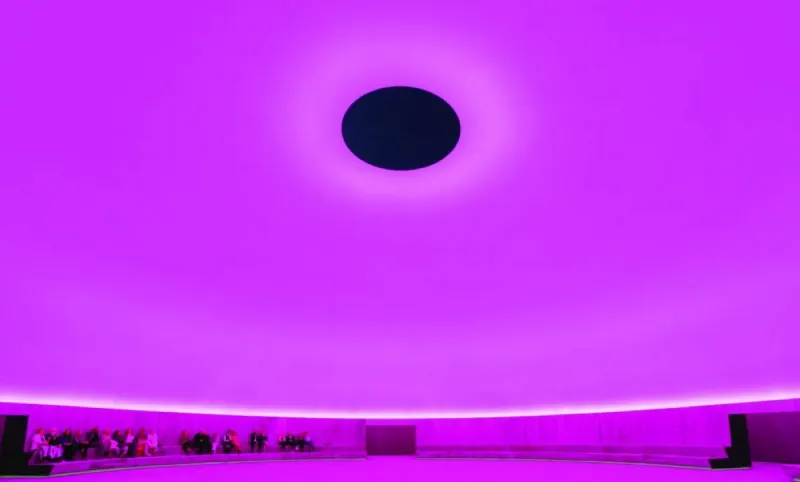
When a visitor enters an exhibition of works by American artist James Turrell, they find themselves inside an illuminated space. At first it seems simple — a room bathed in a single colour, or an opening in the ceiling that reveals the sky. But the longer one remains inside the work, the more the eye begins to doubt what it sees, as colours and light engulf the senses and the feeling of distance and depth gradually dissolves.
What is striking about Turrell's practice is that the work is incomplete without the viewer. Yet for those of us who have browsed his pieces through a Google search, the works are difficult to explain through images alone. Likewise, a visitor who passes through his installations quickly will be left with nothing but question marks — except for the connoisseur of contemporary art, who meditates within the piece, as is the habit of the discerning viewer, because their eye gradually begins to detect variations in light and colour until visual silence transforms into a state of contemplation.
This is why his works are sometimes difficult to explain through photographs alone, particularly to art dealers and market-minded collectors. An image conveys the form, not the sensation — except to the contemplative connoisseur, who loses depth incrementally until a slow shift in perception occurs. Therein lies the singularity of this kind of art.
James Turrell has made composite image art a subject of perception rather than interpretation, keeping the experience genuinely sensory — compelling the viewer to question the very meaning of sight itself, in space, and in the heights where light dwells. In this context, light is transformed from a technical element into a fully realised artistic medium.
Among his most celebrated projects is Roden Crater, a massive volcanic crater in the Arizona desert that he has been converting since the 1970s into an enormous visual observatory for studying the sky, light, and astronomical phenomena.
Having treated the crater as an instrument for seeing the cosmos differently — where the shifting of light throughout the day becomes part of the artwork itself — he created a material capable of constructing emptiness, altering the sense of place, and revealing that what we see is not as fixed as we imagine, but an experience shaped jointly by the mind and the eye.
James Turrell is today 83 years old and is considered one of the foremost artists of the Light and Space movement. He has, by his very nature, given us visual tension in the present age, situated between natural and artificial light. His practice has been central to his art since his beginnings in the 1960s, when he titled his works "Light and Space" — all built upon elements directed by light, making light an autonomous artistic element in its own right and using luminance as a means of manifesting the artwork.
Turrell's works reshape the viewer's perception of place. At times the viewer feels as though they could touch the light, or walk through it, as if the space has shed its physical boundaries. In an interview with a newspaper, he remarked: "The human eye always needs edges and shadows to define depth and distance."