
There is a meticulous precision in heist cinema that captivates the mind. Unlike traditional crime drama, which focuses on the chaos that follows the breaking of the law, this sub-genre operates like a finely crafted Swiss watch.
It transforms organised crime into a form of systematic work, consummate craftsmanship, and logistical operations as disciplined as factory production lines. The narrative structure of these films follows an almost procedural course.
The constants: assembling specialist talent, drawing up the initial blueprint, a breathtaking execution, and then the inevitable tragic collapse at the end. While early cinema flirted with gang stories and bank robberies — most notably at the landmark of silent film, The Great Train Robbery in 1903 — the true cornerstone of contemporary heist cinema was laid in 1950.
John Huston's The Asphalt Jungle shifted the camera's gaze away from the virtuous detectives and trained it directly and entirely on the perpetrators.
Huston treated the safe-crackers, drivers, and planners not as hardened criminals but as hardworking "working-class" professionals whose field of work happened to be illegal.
If The Asphalt Jungle gave the genre its soul, a French production released five years later gave it its rigorous and definitive methodology.
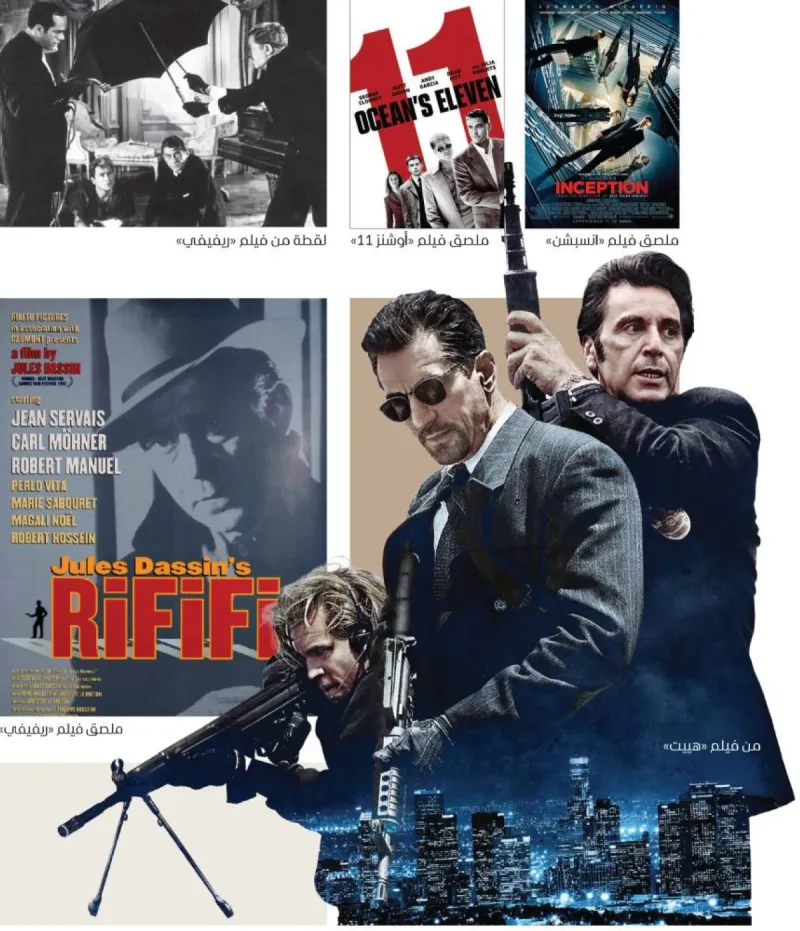
In 1955, expatriate American director Jules Dassin presented Rififi, a raw and unflinching cinematic adaptation of Auguste Le Breton's novel, which changed forever the mechanics of building tension on screen.
The jewellery store robbery sequence remains the crown jewel of the film and its most enduring legacy. The scene runs for nearly half an hour and unfolds in near-total silence — no dialogue, no score, not even a voiceover.
The only sounds are tangible, physical ones: the rhythmic scraping of umbrellas catching falling plaster, the muffled blows of chisels breaking through concrete, and the heavy breathing of men racing against an invisible clock.
The impact of Rififi cannot be overstated. It established the robbery sequence itself as an extended, obsessively detailed performance following precise procedural steps.
Suddenly, the heist was no longer merely a plot point to ignite a chase; it became the visual centrepiece and the very backbone of the entire film. The film was steeped in the details and methodology of safe-cracking.
By the late twentieth century, directors began fusing these cinematic traditions together. Michael Mann's Heat (1995) stands as the absolute pinnacle of hyper-realism in the genre.
It succeeded in balancing a complex armoured-truck robbery and a bank heist against a deep exploration of strict professionalism and the crushing loneliness weighing on its protagonists.
By contrast, Steven Soderbergh's Ocean's Eleven (2001) leaned heavily toward a dazzling, vibrant visual style, replacing anxiety and fear of the unknown with elegantly tailored suits, charismatic and sardonic dialogue, and a narrative structure built on surprises and multi-layered twists that keep the audience pleasantly in the dark about the plan's details until the final reveal.
Today, the heist film formula remains vital and dynamic, offering an ideal space for formal and stylistic experimentation. Christopher Nolan's Inception (2010) demonstrated brilliantly that the genre's structure is robust enough to be transposed onto the world of science fiction, substituting fortified bank vaults for the depths of the human subconscious.
Ultimately, we return again and again to heist films because they represent the eternal and supreme battle of human intelligence and cunning against an unforgiving, rigid system. They allow us to root for the underdog and to contemplate the beauty of a flawless plan.