
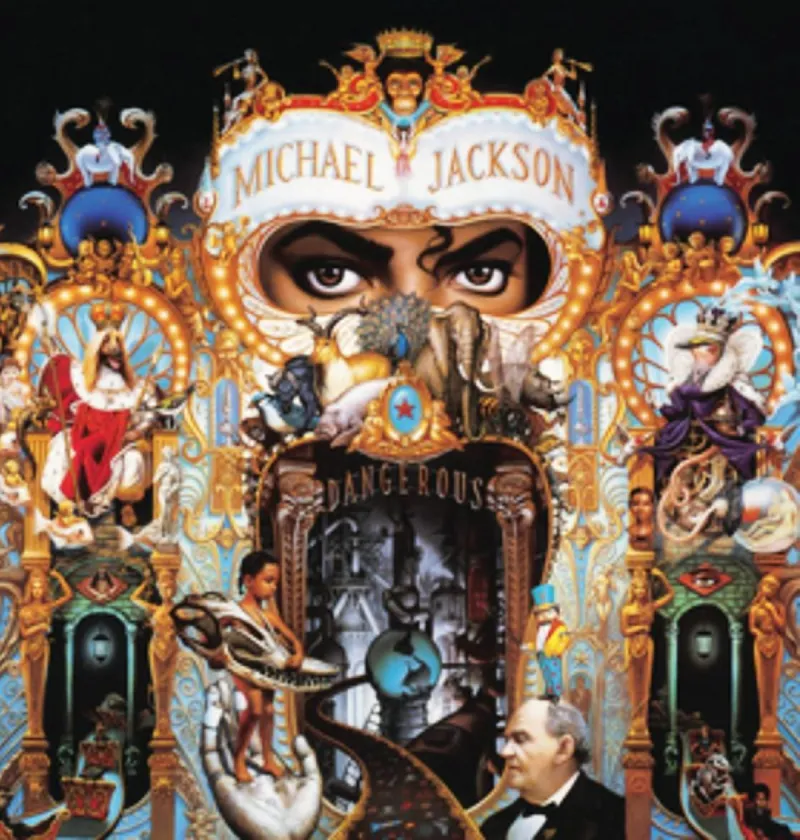
In the wake of the thunderous and unprecedented success of Thriller, Jackson found himself confronting a near-impossible task: competing with his own artistic legacy. During the five-year gap between the two albums, his isolation from the world deepened.
His public image became fertile material for tabloid sensationalism, while he tightened his creative grip on his work to an even greater degree. Although Quincy Jones co-produced Bad, Jackson wrote and composed 9 of the album's 11 tracks entirely on his own.
This evolution from Thriller to Bad marked a departure from the warm, traditional pop melodies, as Jackson moved toward a harsher and sharper visual and sonic identity — one that relied heavily on synthesisers and industrial-flavoured digital effects, embracing the aggressive and confrontational aesthetics of street culture.
Bad cemented Jackson's visual identity: black leather jackets, heavy-buckled belts, fedora hats, and a white armband.
The elaborate, precisely synchronised group performance sequences — as seen in "Bad" and "Smooth Criminal" — became the foundational template and primary reference point for modern pop stage productions.
The Bad World Tour was Jackson's first solo concert tour, through which he entirely reimagined the concept of stadium entertainment by introducing cutting-edge lighting technology, visual and pyrotechnic effects, sound systems, and stage sets — laying the blueprint for the large-scale spectacular festivals of contemporary pop.
Bad became the first album in history to place 5 consecutive singles at the top of the Billboard Hot 100, proving that the sweeping chart dominance achieved by Thriller was not a fleeting anomaly or a stroke of unrepeatable luck, but a reproducible and replicable industry strategy.
The most striking and shocking change of all — and the driving force behind Dangerous — can be summed up in three words: the absence of Quincy Jones.
After three consecutive landmark works, Jackson made a decisive executive decision to part ways with his legendary producer, driven by ambition to prove to critics that his genius was entirely his own and dependent on no one.
He also felt that the classical orchestral arrangements for which Quincy was renowned had begun to seem too traditional and conservative, failing to keep pace with the aggressive sounds and street rhythms that were beginning to dominate radio airwaves at the time.
To capture those cutting-edge rhythms, Jackson enlisted producer Teddy Riley — the undisputed pioneer and architect of New Jack Swing, a genre that fuses sharp, fluid hip-hop drum patterns with smooth R&B melodies.
In doing so, Jackson succeeded in crafting a formula that allowed him to pull this urban artistic movement from its underground and marginal circles and elevate it to global reach on a broad pop scale.
By adopting Teddy Riley's production style, Jackson compelled international radio stations to embrace the interlocking, harmonising rhythms of hip-hop culture. This move proved that urban street-culture music was capable of selling more than 32 million copies worldwide and dominating charts from Tokyo to London.
If Thriller invented the concept of the music video, then Dangerous transformed the premiere of his visual works into an extraordinary event that commanded every screen on the planet.
The "Black or White" video was broadcast simultaneously in 27 countries to an estimated audience of 500 million viewers, in an unprecedented cultural event in the history of media.
Before 1993, the Super Bowl halftime show was a dull and colourless affair limited to university marching band performances.
But Jackson's legendary 1993 performance, coinciding with the Dangerous era, changed television history forever. The star stood motionless for a full 2 minutes amid the crowd's deafening roars before launching into high-energy performance sequences that drew television viewership figures surpassing those of the game itself. Single-handedly, Jackson transformed the Super Bowl into the premier and most spectacular entertainment event we know today.
The architecture of pop: How Michael Jackson built the modern album concept — then dismantled it (1/3)