
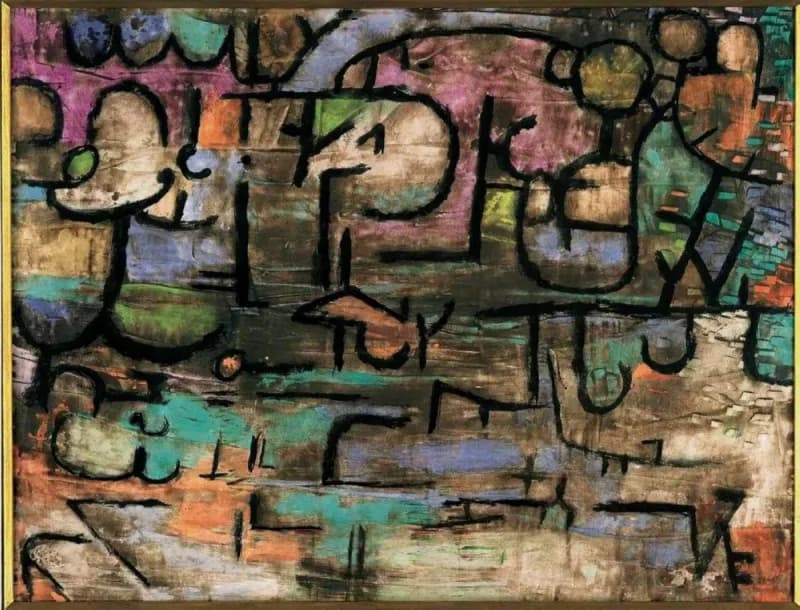
The paintings of German artist Paul Klee appear at first glance closer to a child's drawing: light lines, incomplete shapes, primitive symbols, and freely distributed colours. This initial impression leads to a common misunderstanding, as these works are read as spontaneous or unfinished. Yet pausing before them reveals a precise system operating behind their apparent simplicity, one in which details are distilled in order to capture the essence.
His paintings and drawings, as we see them, consist of a square and a roof and a triangle, a face rendered with two dots and a line, a tree suggested with a quick stroke. This economy of drawing is believed by some to be random, yet it is a free-form draughtsmanship that moves lightly, as if hovering between play and contemplation — every slight deviation carries a decision, every pause creates an internal rhythm. Paul Klee (1879–1940) has been described in many ways: as the father of abstract art.
He was also a professor at the celebrated German art school Bauhaus, a pioneer of Surrealism, and a figure who defies easy classification, according to many art historians and admirers — the latter of whom his devotees call "Klee's companions".
His paintings are linked to the leading artistic movements of the 20th century, as European newspapers have described him, from German Expressionism to Dadaism.
It is difficult to place Klee's work within a single category, and credit for that lies with the system of pulsating forms, mysterious hieroglyphic symbols, and strange creatures he invented to enrich his work. These symbols are considered among the earliest attempts in the 20th century to incorporate spiritual and subconscious content into abstract art.
His work in turn inspired both Surrealism and Abstract Expressionism, and was taken up by their most influential pioneers. Reviewing the work of figures ranging from Joan Miró and Salvador Dalí to Mark Rothko and Robert Motherwell, one finds Paul Klee as a guiding light for them all. Klee's enigmatic and influential works are celebrated annually, most notably at the Centre Pompidou in Paris, where his exhibitions continue.
But why is his work considered important, particularly in the early 20th century? Exploring this question, we find that Klee made a radical break with long-established artistic traditions and the familiar classics. He did so alongside Picasso and other avant-garde artists at the turn of the century, abandoning recognisable subject matter and contributing to the emergence of an artistic form that would later become known as "abstraction".
Klee was among the earliest adopters of this movement and a member of one of the regional factions of German Expressionism, alongside a group of artists united by the belief that art must express the metaphysical world — that which lies beyond nature.