
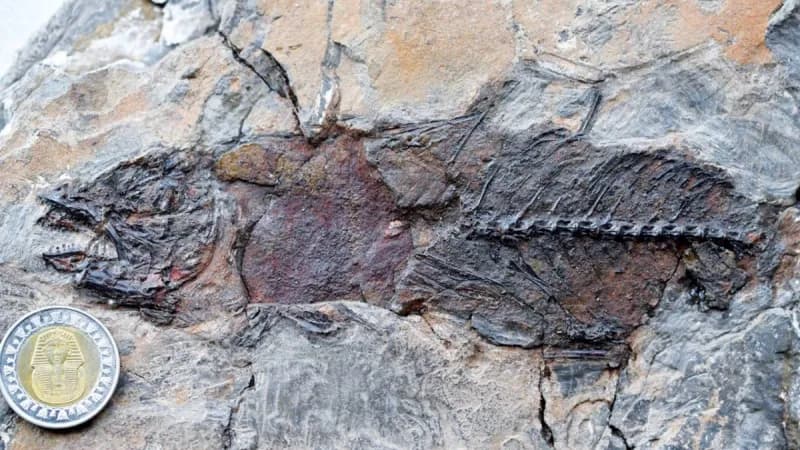
Dozens of international scientific websites have recently circulated a gripping story accompanied by a remarkable photograph, originating from the Mansoura Vertebrate Paleontology Center at Mansoura University in Egypt.
An international research team led by Egyptian paleontologist Hesham Sallam, in collaboration with researchers from the University of Michigan in the United States and the University of Leuven in Belgium, has uncovered a collection of fossils that open a rare window onto a decisive moment in the history of marine life — one in which the features of modern marine fish communities began to take shape just 4 million years after the catastrophic extinction that ended the age of the dinosaurs.
The study, published in the journal Science Advances, in Nature's science bulletin, and on other major international scientific platforms, has reshuffled scientists' understanding of how quickly the oceans recovered after the Chicxulub asteroid struck Earth 66 million years ago.
Scientists had believed that the rise of modern marine fish communities took longer following the extinction of the dinosaurs, and that the clear features of these communities did not appear strongly in the fossil record until later — particularly with the beginning of the Eocene epoch, some 10 million years after the impact.
But the Egyptian fossils revealed that a rich marine community, familiar in its general composition, already existed in the early Paleocene epoch.
The photograph accompanying this discovery — which has been widely published and shared — shows the fossilised skeleton of the oldest known tuna fish, discovered at a fossil site in Egypt's Eastern Desert. The image has become a symbol of the sudden shift in knowledge that has closed a gap long troubling to paleontologists, as it falls within one of the most sensitive periods in the history of modern life: the first years following the mass extinction that ended the Cretaceous period.
No remarkable scientific discovery is complete without a photograph that satisfies the curiosity of minds before eyes.
Hamdan bin Mohammed bin Rashid Al Maktoum International Photography Award
www.hipa.ae