
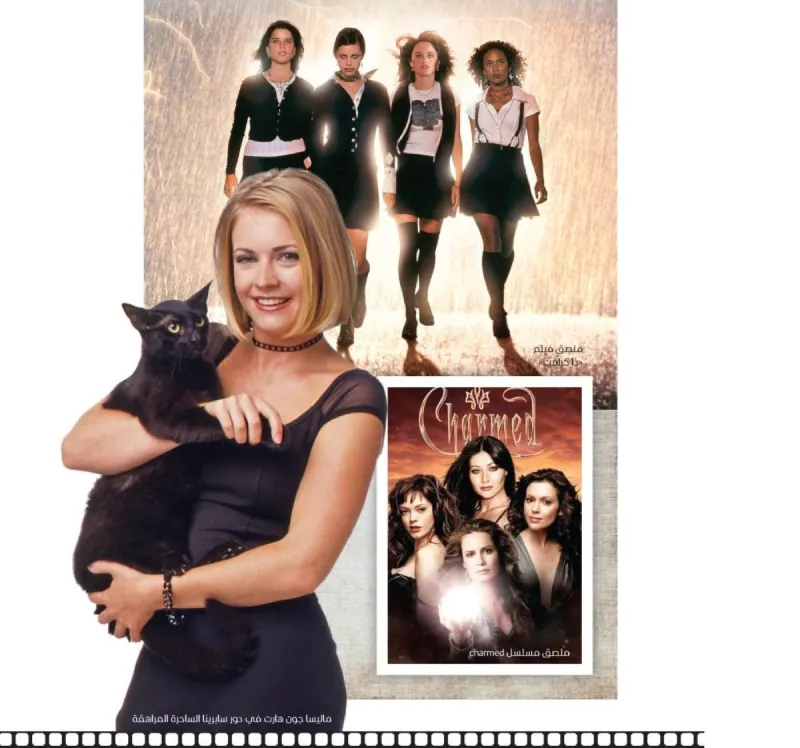
In the autumn of 1996, a modest, mid-budget film about four outcast girls at a Catholic high school in Los Angeles managed to reshape the entire cultural landscape. Andrew Fleming's The Craft was not built on vast kingdoms or ancient prophecies; it lived in heavy combat boots, smeared dark lipstick, and a group of teenage girls summoning the forces of nature in a woodland clearing.
That same year, the bright and lively sitcom Sabrina the Teenage Witch arrived on television screens, turning witchcraft into a light-hearted metaphor for the adolescent identity crisis.
By the time Charmed premiered in 1998 — cementing the concept of "the Power of Three" in the mainstream cultural lexicon — the image of the witch had already undergone a radical transformation and swept through mainstream cinema.
The gaunt, elderly, green-skinned villain who had long haunted old folklore vanished entirely, replaced by a wholly new cultural icon: young, stylish, fiercely independent, and possessed of unquestionable power and influence.
This sudden explosion of witch-centred content in the late 1990s was no passing creative coincidence; it was the tangible commercial expression of a profound cultural shift that had taken hold: the arrival and entrenchment of the Third Wave of feminism.
Unlike the structural and legislative focus of the Second Wave, the Third Wave placed absolute priority on individual agency, self-expression, and the subversion of prevailing patriarchal norms.
In this context, the witch — historically a symbol deployed by society to demonise women who dared to transgress the social boundaries set for them — became the preeminent icon of reclaimed rights and self-sovereignty.
To be a witch at that moment meant possessing a voice that was heard, seizing power at a time when society preferred women's silence, and finding strength in female solidarity and mutual support.
This intellectual and political awakening coincided perfectly with a radical shift in the media economy: emerging television networks — such as The WB and UPN — were targeting teenagers and young adults specifically.
Television executives recognised that young women represented a promising and highly lucrative market that had yet to be fully tapped, and they packaged the aesthetics of empowerment as a mass consumer product within what became known as the "girl power" economy.
As a result, magic became a lifestyle: shops filled with choker necklaces, long leather coats and crystal pendulums. The screen and the street fed one another in an inspiring feedback loop; the release of The Craft directly triggered a real and significant surge in Western youth interest in neo-paganism and Wicca, and books aimed at teenagers proliferated, promoting beliefs that linked magic, nature, and the latent power within the human self.
This cultural and commercial boom aimed at teenagers helped normalise the social idea of magic as a gateway to unlocking the latent forces within individuals — an image diametrically opposed to the one that prevailed in the 1960s and 1970s, when the practice of magic was considered sinful and socially condemned.
The most important distinction, however, was that the magic of the late 1990s was close and accessible. This was "urban fantasy": magical worlds flowing and operating within the familiar everyday geography of the real world.
This magic lived in suburban bedrooms, secondary school corridors, and the old Victorian houses of San Francisco. The implicit message, the promise the screen held out to the viewer, was: you do not need to travel to distant legendary realms to seek power — it is already within you, waiting only to be set free.
By the late 1990s, a clear dividing line governed the mechanics of Hollywood production. While "urban fantasy" flourished on the small screen, "epic fantasy" — stories set entirely within parallel imaginary worlds inhabited by dragons, dwarves and medieval-style great crusades — was classified by the major film studios as "toxic projects" and an inadvisable production risk.
A series of resounding failures with meagre returns in the 1980s and early 1990s — among them Krull, Legend and Willow — had convinced executives that audiences had come to regard world-building fantasy as hackneyed, childish fare that lacked the elements of attraction and realistic engagement.
Then December 2001 arrived and reshuffled every card on the table.