
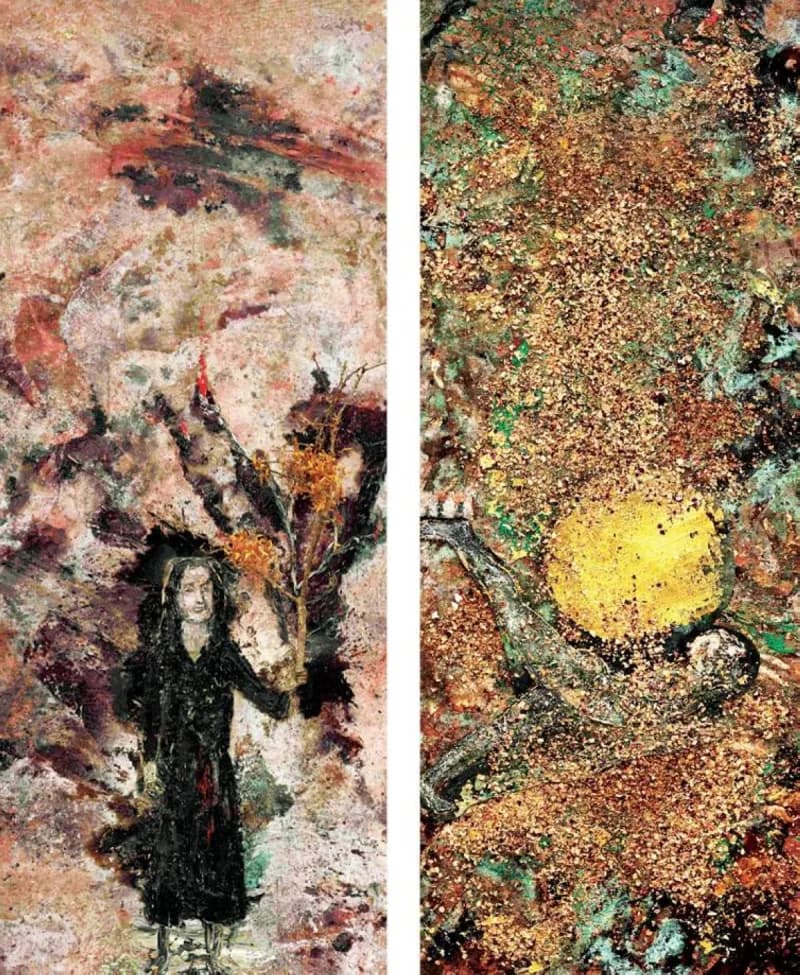
The works of German artist Anselm Kiefer are not easy on the eye. Perhaps this is because he belongs to the post-World War II generation — born in 1945 — a generation that came of age inside a complex German question: how can art grapple with the memory of European devastation, with the legacy of Nazism, the Holocaust, and the cultural destruction left behind by the war?
Carrying this ruinous historical weight in his soul, Kiefer set about building works that seem to bear the very mass of history itself. Their surfaces are heavy, dark, and cracked; his canvases appear to people as though they have emerged from an ancient fire or from the remains of an abandoned building. Dense layers of clay, lead, ash, straw, cement, and even dried plants accumulate across the surface, giving each work the appearance of an archaeological relic rather than a conventional painting.
A journalist once asked him why lead recurs so frequently in his work. Kiefer was puzzled by the question, as if the journalist had not noticed that lead is a metal historically bound to war — just as, in ancient alchemy, it was linked to the idea of transformation into ash, appearing as a trace of burning and annihilation, while straw evokes fragility and transience. Every material carries an implicit memory, even before it becomes part of the artwork.
Critics have written of his paintings that the closer you draw to the surface, the more you find it is not smooth but riddled with cracks and protrusions, as though time has literally passed over it. At times the works resemble destroyed maps, burnt fields, or libraries that have collapsed in on themselves. This rough texture prevents the eye from merely observing; the gaze is typically drawn toward a distant depth and an expanse that lends the work an epic quality, as if the scene is larger than humanity itself.
Contemplating most of his paintings, one notices signs pointing to Germanic mythology, poetry, philosophy, and ancient alchemy, making each canvas a complex cultural network. But does the power of his work reside solely in these intellectual references? He has succeeded in transforming ruin into a visual language — yet is destruction presented here merely as a historical event?
The truth, one must say, is that it represents a continuous human condition: a memory that accumulates, cracks, and leaves its marks on the material itself. This is why his works feel closer to archaeological sites of the modern European consciousness. Every layer conceals what lies beneath it, and every material bears the trace of what has passed through it, until the surface becomes a record of time and art becomes an act of excavation within history and memory.
This does not mean he was absorbed solely in his personal concerns and German identity, painting only for himself and his own memory. His paintings speak to vast spaces in the world, in the service of collective accountability. We must not turn our faces away from the past; fleeing catastrophes does not erase them, because they accumulate in the unconscious. It is better to confront destruction as part of human identity, to refuse passivity or self-absorption, and instead to participate in the experience with all our senses and feel it in full. Art is the act of being capable of recovery after confronting layers of history, myth, and ancient stories.
And bear in mind that our age is dominated by swift forgetting — a pattern that repeats itself across all cultures — leaving human suffering and the search for meaning as the threads that bind all of humanity together.