
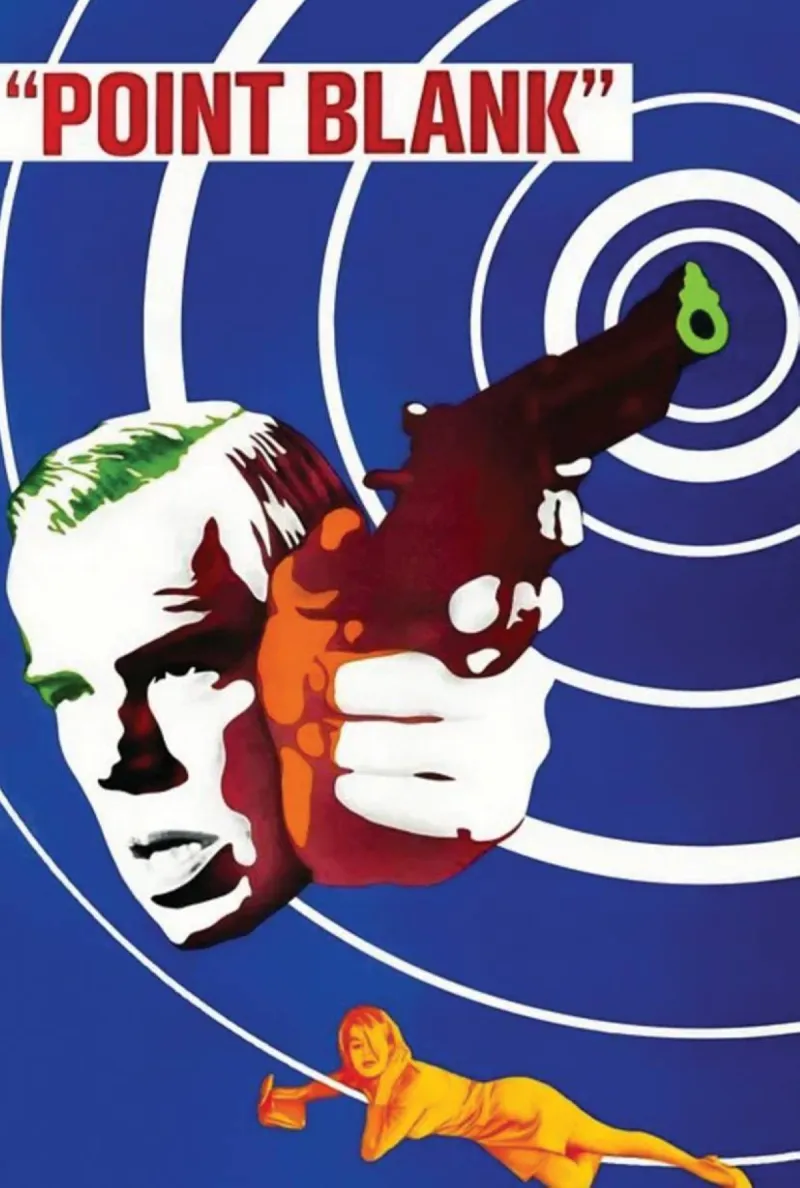
When John Boorman's Point Blank opened in cinemas in 1967, it shook the traditional structural foundations of American crime cinema. On the surface, the plot follows a familiar trajectory:
A cold, hardened criminal named Walker — played by Lee Marvin with a sharp edge and a chilling conviction that made his face look carved from stone — is betrayed by his partner and left for dead among the ruins of Alcatraz prison.
Yet he returns, burrowing into the back alleys and criminal underworld of Los Angeles, driven by a desperate determination to recover his stolen share of $93,000.
What makes Point Blank a cinematic masterpiece of the New Hollywood school, however, is not the sequence of its events but the radical, fragmented style of its execution. The film did not merely update the thriller genre — it reinvented and reformulated it from the ground up.
Before 1967, film noir was defined primarily through its shadows: those rain-soaked black-and-white alleyways of the 1940s and 1950s. Point Blank effectively launched the wave of colour noir, proving that feelings of bleakness, alienation, and dread could also live and flourish beneath the scorching California sun. Boorman, working alongside cinematographer Philip H. Lathrop, devised an expressive and exquisitely refined use of colour. Rather than mimicking reality, the film employs a strict, coded colour palette that shifts and transforms as Walker closes in on his targets.
Scenes move with deliberate intent through shades of washed-out grey, jarring yellow, deep blue, and finally an aggressive, strident red. This brilliant deployment of colour-coded environments laid the foundation for the loud colour-noir aesthetic that would later reshape the identity of iconic films such as Drive, The Long Goodbye, and Michael Mann's Thief.
For decades, film critics and scholars have been captivated by the film's strange and puzzling ability to blur the boundary between reality and dream. A prominent and well-established critical reading holds that Walker never actually survived the initial betrayal at Alcatraz; the entire film can be read as the hallucinations and final dying moments of a man bleeding out on the concrete floor of his cell, imagining a perfect, unstoppable revenge fantasy against the institutional Syndicate that double-crossed him.
Boorman deliberately fed this ambiguity through the use of disorienting montage and overlapping temporal jumps. Walker frequently seems less a man of flesh and blood than an unstoppable spectral force.
In one of the most celebrated scenes in cinema history, the rhythmic, reverberating echo of Walker's footsteps as he strides down a sterile, empty airport corridor crosses the boundaries of time and space, overlapping with shots of his estranged wife waking from sleep.
He moves through heavily guarded institutional fortresses like a ghost, never touching the money with his own hands, while his adversaries fall and plunge to their deaths one by one without Walker ever needing to pull a trigger. This sustained, methodical blurring leaves the audience in a constant state of uncertainty between what is real and what is the fantasy of a dying mind.
The impact of Point Blank on contemporary cinema is immense. By fusing the raw, pulp fiction wreckage of American crime writing with a style that echoed the French New Wave, Boorman succeeded in altering the DNA of action and thriller cinema entirely.
Walker is the precursor to the contemporary antihero — the direct ancestor of characters ranging from Steven Soderbergh's The Limey to the fierce, relentless drive of John Wick.
Soderbergh has been known to use Point Blank as a structural blueprint and guiding imprint for his own editing style, while Quentin Tarantino has repeatedly cited its fractured chronology as a primary source of inspiration for his work.
By transforming the immediate aftermath of a conventional heist into an existential and psychological journey, Point Blank demonstrated that the crime film can be deeply philosophical, radically visual, and breathlessly gripping all at once. Nearly six decades on, its cold, iron grip on the cinematic imagination remains unbroken.