
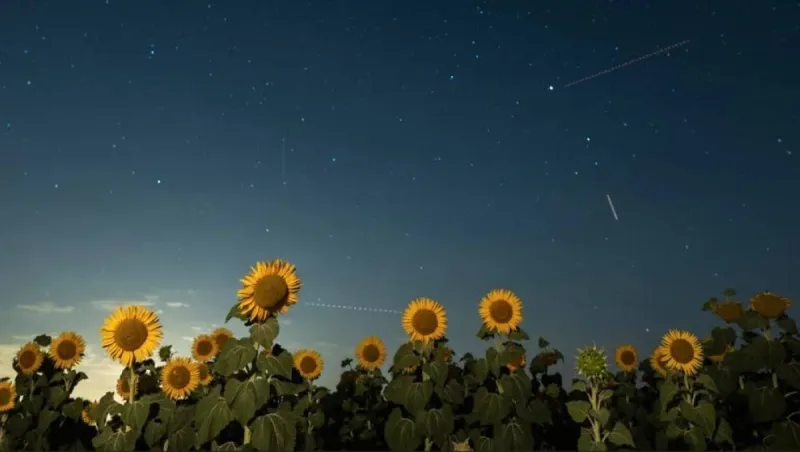
The summer solstice heralds the beginning of astronomical summer in the Northern Hemisphere and marks the day with the longest daylight hours of the year. This astronomical event occurs annually on 20 or 21 June, as a result of the tilt of Earth's axis relative to its orbit around the Sun.
The two solstices and two equinoxes are among the most significant phenomena that define the four seasons. They arise because Earth's axis is tilted 23.5 degrees from the plane of its orbit around the Sun, according to NASA, and this tilt causes different regions of the planet to receive varying amounts of sunlight throughout the year.
During the summer solstice, the Northern Hemisphere tilts toward the Sun, allowing it to receive the greatest amount of solar radiation, and thus recording the longest day and shortest night of the year. Conversely, the Southern Hemisphere experiences the winter solstice on the same day.
In 2026, the summer solstice occurred at 4:24 a.m. Eastern Time on 21 June, according to the website Time and Date.
The manifestations of this phenomenon differ depending on geographic location. At the North Pole, the Sun does not set at all on the day of the summer solstice, while the South Pole experiences the exact opposite, with the Sun not rising at all during this period.
Moving northward within the Northern Hemisphere, the hours of sunshine increase noticeably, and the Sun appears very high in the sky at noon. During the spring and autumn equinoxes, day and night hours are equal, and the Sun is directly above the equator.
During the Northern Hemisphere's summer solstice, the Sun's rays fall perpendicularly on the Tropic of Cancer, located at latitude 23.5 degrees north of the equator, which passes through a number of countries including the United Arab Emirates, Saudi Arabia, the Sultanate of Oman, Egypt, India, China, and Mexico.
The Tropic of Cancer is the northernmost latitude at which the Sun can appear directly overhead at noon, according to the Pacific Islands Ocean Observing System at the University of Hawaii.
Despite the summer solstice being associated with the beginning of summer, its date is not entirely fixed — it falls between 20 and 21 June in the Northern Hemisphere, and between 21 and 22 December in the Southern Hemisphere.
This variation is due to the fact that the calendar year consists of 365 days, with a leap day added every four years, while Earth takes approximately 365.25 days to complete a full orbit around the Sun, causing the date of the solstice to shift from year to year.
Contrary to popular belief, Earth is not closest to the Sun during summer in the Northern Hemisphere; in fact, it is at its farthest point from the Sun, a position known as aphelion.
The average distance between Earth and the Sun is approximately 150 million kilometres, but Earth will reach its farthest point from the Sun on 6 July 2026 — about two weeks after the summer solstice — according to Live Science.
By contrast, Earth was at its closest point to the Sun, known as perihelion, on 3 January 2026.
Astronomically, summer in the Northern Hemisphere begins with the summer solstice and ends with the autumnal equinox, which falls between 21 and 24 September. The average duration of summer in the Northern Hemisphere is approximately 93.6 days.
According to the meteorological classification, summer extends from 1 June to the end of August, with all meteorological seasons lasting exactly three months.
The origin of the term "solstice" comes from Latin and means "the Sun stands still," because during this period the Sun rises and sets at its most extreme northeastern and northwestern points before gradually beginning to return toward the east as the next equinox approaches.
Although the summer solstice grants the Northern Hemisphere the greatest number of daylight hours, it is not the hottest day of the year. Scientists explain this through a phenomenon known as "seasonal lag," whereby land and oceans require time to absorb and store heat.
For this reason, temperatures continue to rise in the weeks following the summer solstice, even as daylight hours begin to gradually decrease, while the Northern Hemisphere remains tilted toward the Sun, maintaining warm conditions throughout the summer months.