
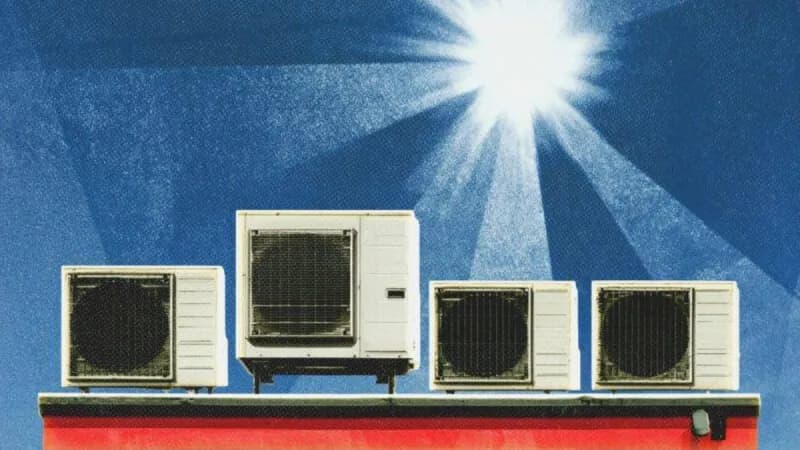
Europe used to pride itself on knowing how to live without air conditioning. Old houses with thick walls, windows open to the evening breeze, shaded cafés, and a small fan sufficient to get through a few hot days. In the European imagination, air conditioning was something excessively American: electrical noise, artificial cold, and an extravagance unbecoming of a continent that talks so much about the climate.
This year, summer changed. Heat is no longer a passing visitor that arrives in July and leaves; it has taken up residence. It enters houses built to retain warmth and climbs to the rooms of the elderly.
According to The Atlantic, Europe is going through what can be described as a belated reconciliation with air conditioning, after repeated heat waves have led many in the north and centre of the continent to reconsider an old idea that viewed cooling as a luxury rather than a necessity. The magazine notes that European buildings were generally not designed to cope with a long, hot summer, and that surging demand for cooling devices reveals a vast gap between yesterday's climate and today's.
A continent heating up
The issue does not begin with a device mounted on a wall; it begins with a continent warming faster than any other. According to the Copernicus Climate Change Service, Europe is the world's fastest-warming continent, with temperatures rising by approximately 2.5 degrees Celsius compared with pre-industrial levels — nearly twice the global average.
That figure does not remain confined to reports alone. It shows up on pavements, in bedrooms that do not cool at night, and in cities that nearly suffocate when the air stops moving. During the European heat wave in June 2026, press reports indicated that temperatures broke records in several countries, and that more than 1,300 excess deaths were recorded in Europe since 21 June, according to reports citing the World Health Organization.
In France alone, The Guardian reported that deaths rose by 29.1 per cent during the hottest weeks of the heat wave, equivalent to approximately 2,025 additional deaths compared with the previous week, with Paris among the hardest-hit areas, where deaths increased by 62 per cent.
A hot home
The problem is that Europe did not build itself for this kind of summer. Many houses were designed to resist winter, not to expel heat. Walls retain warmth, windows do not always allow sufficient airflow, and historic city centres do not easily accommodate external modifications to façades. What was an asset in January has become a burden in June.
According to Euronews, only around 20 per cent of European homes have air conditioning, and many dwellings were built to retain heat rather than shed it. According to the Boston Consulting Group, that figure compares with roughly 90 per cent of American homes that have air conditioning units, illustrating the depth of the cultural and practical divide between the two sides of the Atlantic.
A cold war
Air conditioning has consequently become something resembling a minor culture war. In the United States, air conditioning appears to be part of daily life, like water and electricity. In Europe, it long remained an object of suspicion: an ugly device on the façade, a source of energy consumption, and a sign of a city surrendering to heat rather than addressing the causes of warming.
According to Vox, air conditioning in Europe has become part of a transatlantic debate, between those who view it as a health necessity in the face of deadly heat waves and those who fear that its spread will increase electricity consumption and emissions if it does not come as part of efficiency and clean energy policies. Vox notes that around 90 per cent of American households have air conditioning, compared with around 20 per cent in Europe.
In truth, both sides hold part of the correct answer. Air conditioning can save lives, especially the lives of the elderly, the sick, and those working in enclosed spaces. But if it spreads without planning, and with inefficient devices and weak electricity grids, it may add a new burden to a system already groaning during hot days.
The energy figure
According to the International Energy Agency, the use of air conditioners and fans for cooling accounts for approximately 20 per cent of total electricity consumed in buildings worldwide. The Agency affirms that demand for cooling will continue to grow for decades if policies do not intervene to improve device efficiency and manage consumption.
According to a report published on the BUILD UP platform of the European Commission, the number of air conditioning units in Europe has more than doubled since 1990, with residential installations expected to multiply several times over by 2050, particularly among higher-income households. This means Europe will be buying air conditioners, whether it favours the environmental discourse or not.