
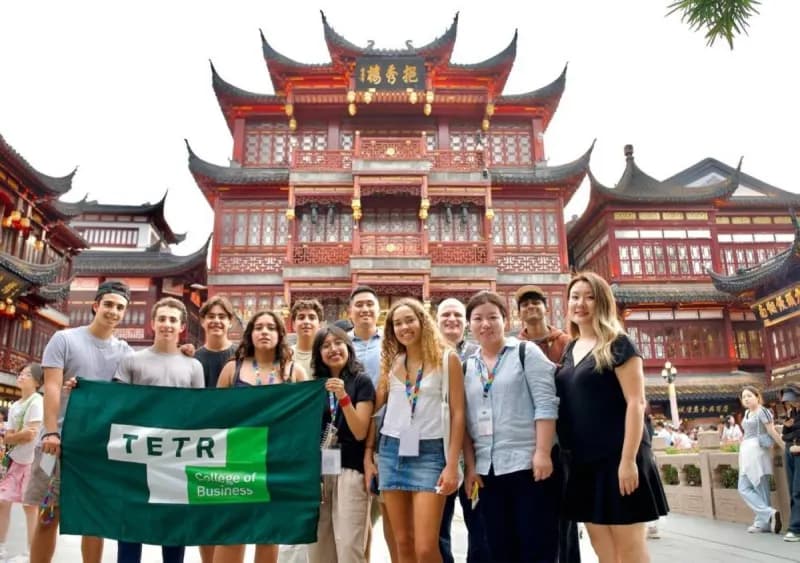
Tetr College of Business, the global educational institution specialising in redefining business education through applied learning and hands-on experience, has announced the launch of its Global Gap Year Program — a 40-week international programme aimed at transforming the traditional gap year into an integrated educational experience that combines academic study, entrepreneurship, cultural immersion, and fieldwork in global business environments.
The programme spans 9 countries, including China, Japan, several European countries, Argentina, India, Kenya, and Bali, giving participants the opportunity to gain practical entrepreneurship experience, explore diverse markets, and engage with varied communities and cultures through a curriculum built on learning by doing.
The programme blends academic, practical, and cultural experiences, enabling students to work and interact with entrepreneurs, cultural institutions, and local communities, while also gaining exposure to the business models of global companies such as Alibaba, Tesla, SoftBank, Mercari, LVMH, and FITT-IIT Delhi.
The programme focuses on translating theoretical knowledge into practical applications, with each learning destination designed around a specialised theme: in China, students explore supply chains and global consumer markets; in Japan, they examine innovation ecosystems and advanced technologies; Europe presents creator economy models; Argentina offers experiences in sustainability; India provides an environment for entrepreneurship and product development; and Bali centres on community-based tourism and wellness concepts.
Throughout the programme, students work on developing entrepreneurial ventures across multiple markets, with seed funding support to help them test their ideas and turn them into viable projects. The programme concludes with a hands-on internship period inside growth-stage startups, where participants work directly with founders to gain practical experience in building and scaling companies.
Tarun Janagwar, co-founding partner of Tetr College of Business, said the programme aims to redefine the concept of the gap year by transforming it from a transitional period between stages of education into an experience filled with building, experimentation, and discovery.
He added that the goal is for learning to come from active participation — whether through exploring new cultures, working with company founders, or testing ideas in different markets — rather than through theoretical study alone.
The launch of the programme builds on Tetr College's experience in entrepreneurship education, following the success of its undergraduate programme, which contributed to the founding of a number of student-led startups across sectors including artificial intelligence, software as a service (SaaS), consumer products, and food and beverage.
Among the most notable companies to emerge from the college's ecosystem are Fluma, BluSpru, ServeClub, Meridian, Jhatak, and Nothing But, which together have generated revenues exceeding $1 million and attracted more than $500,000 in seed investment from international investors and venture capital funds.
College students have also benefited from opportunities to present their projects to executive leaders from global companies and institutions, including Reebok, Y Combinator Startup School, The Network School, and Emirates airline — reflecting the college's emphasis on the practical and global dimensions of its educational model.
The programme is supported by a group of international academics and experts, including Dr Edward Rogers, former Chief Knowledge Officer at NASA; Dr Zal Phiroze from Harvard University; Stephane de la Faverie, Chief Executive Officer of the Estée Lauder Group; Nitin Gaur, former member of the advisory board at Stanford University; and Manoj Kohli, former head of SoftBank India.
Through its partnerships with global institutions, investors, and major corporations, Tetr College provides students with internship opportunities, applied project experiences, and field placements with companies such as Tesla, Alibaba, Google, and Emaar, as well as global cultural institutions including the Louvre Museum and the Prado Museum.
The first cohort of the Global Gap Year Program is scheduled to begin in September 2026, in a move aimed at building a new model of experience-based education and preparing a generation of entrepreneurs capable of operating in global markets.