
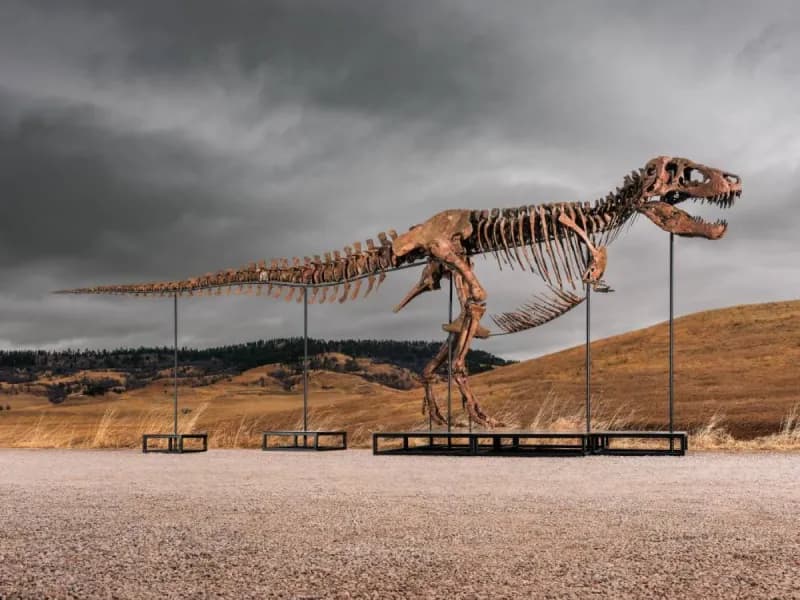
Billionaires have stormed the dinosaur excavation scene, transforming bones that were once the subject of research and study into luxury acquisitions adorning palaces — specimens that were formerly the exclusive domain of research teams spending months under the desert sun.
Dinosaurs have officially entered the "art economy". As astronomic figures at global auctions continue to rise, scientists find themselves confronting a troubling reality: do these sums help save history from erosion and loss, or are we witnessing a second extinction of these creatures — locked away from scientific scrutiny and reduced to figures in the accounts of the wealthy?
The phenomenon began in 1997 with the sale of "Sue" for $8 million, but over the past six years fossil prices have seen an unprecedented surge; the five most expensive specimens ever sold were all sold within this brief period.
Against this backdrop, an auction on Tuesday, 14 July 2026 stands out, in which the dinosaur "Gus" (T. rex) is being offered with a preliminary estimate of $30 million — a figure that clearly reflects the transformation of such specimens from mere "scientific data" into "investment assets" coveted by the wealthy as they compete in the world's leading auction houses.
Fossils are no longer simply artefacts; they have become a powerfully rising category within the "art economy" as alternative investment assets. The numbers tell the story of how this market has exploded: after the historic "Sue" deal in 1997 at $8.3 million was considered a fantastical figure, we have since witnessed staggering leaps — with the all-time record set in July 2024 when the dinosaur "Apex" (a Stegosaurus) sold for $44.6 million.
This enormous price differential depends on specimen size: while complete skeletons sell for tens of millions, partial pieces sell for less, with individual T. rex teeth, for example, ranging from $5,000 to $90,000 — confirming that this is an elite, tiered market.
Away from the spotlight, the extraction process is a battle against physics.
Dr. Smithwick explains that the moment a fossil leaves the ground it loses its chemical equilibrium and begins to deteriorate. For this reason, the "Gus" team spent three years in painstaking excavation, followed by another three years of laboratory documentation and reconstruction. This process is not mere digging; it is a "rescue" of remains that would have been destroyed by natural erosion had they been left in the ground.
Auction houses employ sophisticated marketing strategies: they do not sell bones, they sell a "story". "Gus" is marketed as a legendary champion who fought fierce battles, with bite marks on his skull used to reinforce his value as a "one-of-a-kind" piece.
This "emotional marketing" transforms the fossil into a cultural icon that transcends its scientific value, making it a symbol of power and distinction in a world where the wealthy possess everything — so that owning an "extinct monster" becomes the ultimate expression of social status.
Fossils are no longer mere collectibles; they are now classified as "alternative assets" within investment portfolios. Natural history is viewed as a long-term investment, with buyers betting on the scarcity of complete specimens worldwide. This shift towards "psychological pricing" triggers bidding frenzies in which billionaires compete not on the basis of scientific appreciation but driven by the fear of missing out (FOMO), turning the auction into a battle of wills that pushes prices to fantastical levels.
Here a philosophical question emerges: to whom does history belong? Professor Maidment argues that confining a fossil to a private collection amounts to "erasing" it from the scientific record. Prestigious scientific journals refuse to publish studies conducted on privately held specimens because they cannot be verified afterwards, and science demands "reproducibility" — something that individual ownership cannot guarantee, since a specimen may be sold or lost the moment an owner's interests change.
Cassandra Hatton of Sotheby's counters that billionaires play the role of "patron": excavators frequently require substantial funding that museum budgets cannot provide, and without this market, those excavators may find no incentive to invest years of their lives facing the hazards of nature to extract these treasures.
While some see these auctions as an opportunity to fund science, scientists view them as a "second extinction" of dinosaurs — seized from the public and converted into figures in the accounts of the wealthy.
Fossils remain in limbo: either they find their way to museums to inspire future generations, or they vanish into the corridors of palaces, far from the eyes of those who seek to understand our planet's future by studying its past.