
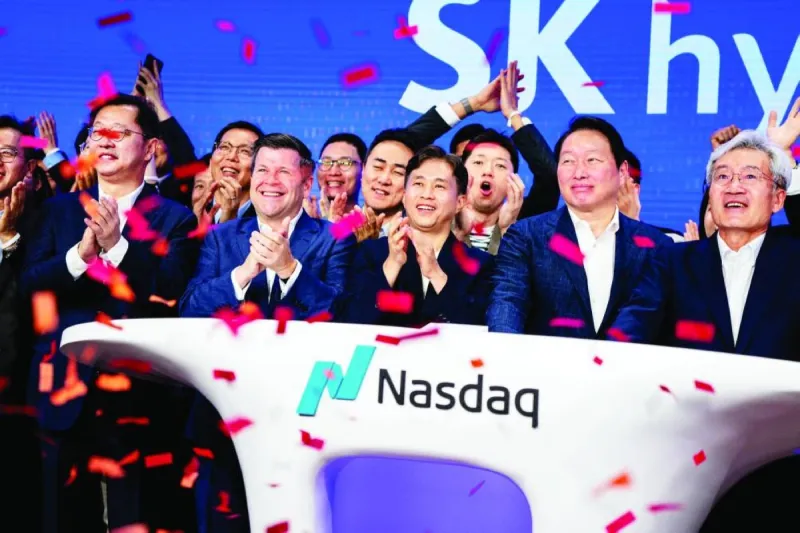
SK Hynix is no longer merely the world's second-largest memory chip producer. It has transformed into one of the most prominent beneficiaries of the global artificial intelligence boom, with its market capitalisation surging to approximately $1 trillion, driven by unprecedented demand for the advanced memory chips used to power AI models.
With the commencement of trading in the company's American Depositary Receipts (ADRs) on the Nasdaq stock exchange, the South Korean company is entering US capital markets for the first time, in a move aimed at broadening its investor base and raising billions of dollars to fund the largest expansion plan in its history.
A bet on the AI boom
The company's shares have risen by more than 700% over the past year, as High Bandwidth Memory (HBM) chips have become the most critical component in AI data centres.
These chips are the beating heart of the graphics processing units produced by Nvidia and AMD, providing the massive data transfer speeds required to run generative AI models.
Research firm estimates indicate that SK Hynix commands more than half of the global HBM chip market, giving it a clear advantage over its rivals, chief among them Samsung and Micron.
Why list on Nasdaq?
The company chose to list in the United States to tap the world's largest investor base and to narrow the valuation gap with American companies.
The company issued ADRs through which it raised approximately $29 billion, funds that will be directed towards factory expansion, increasing production capacity, and financing new technologies for AI chips.
Analysts believe the listing gives American investors a direct opportunity to invest in one of the largest suppliers of AI memory, rather than being limited to US-listed companies.
A strategic partner for Nvidia
The relationship with Nvidia is one of the company's most important strengths. Last June, Nvidia CEO Jensen Huang announced an expansion of the partnership with the Korean company for several years, given that most advanced AI processors rely on HBM chips that SK Hynix produces.
Giant technology companies depend on these chips to operate the massive data centres that host AI applications, a situation that has caused demand to outstrip the market's current production capacity.
Expansion worth hundreds of billions
The company is investing aggressively to meet anticipated demand over the coming years. It is building its first factory in the United States, in Indiana, with investments of $4 billion, specialising in advanced chip packaging technologies — an essential element in HBM chip manufacturing. The company also expects to receive US government incentives exceeding $1 billion in grants and loans under the CHIPS Act.
In South Korea, the company is executing a massive factory expansion project with investments of approximately $720 billion, encompassing a large industrial complex in Yongin and new facilities in Cheongju, alongside multi-billion-dollar investments in advanced lithography equipment from Dutch company ASML.
Record financial figures
The financial results reflect the scale of the transformation the company is experiencing. Revenue rose from approximately $22 billion in 2023 to around $65 billion in 2025, while analyst estimates project it could exceed $230 billion during 2026 if strong demand for AI chips continues.
More than three-quarters of the company's revenues come from DRAM memory products, led by HBM chips, in addition to its activity in NAND Flash chips used in storage units.
A long history of difficult cycles
The company was founded in 1983 under the name Hyundai Electronics before subsequently becoming Hynix and then SK Hynix following its acquisition by SK Group in 2012.
Over decades, the memory industry has faced recurring cycles of boom and contraction, with periods of supply shortages typically followed by production surpluses that cause prices to collapse.
But this time, many analysts believe the AI boom may extend the growth cycle, particularly as companies move towards signing long-term supply contracts rather than the short-term sales that prevailed in the past.
Will the boom last?
Despite the record performance, risks remain. The memory sector is known for its sharp volatility, and the continuation of elevated valuations depends on major technology companies maintaining their massive investments in AI infrastructure.
On the other hand, industry estimates suggest that the shortage of HBM chips could persist until at least 2027, giving SK Hynix an opportunity to maintain its leadership position and achieve strong growth in profits and revenues.
Accordingly, SK Hynix's Nasdaq listing represents more than mere financial expansion; it reflects the company's transformation into one of the most important global players in the AI race, at a time when advanced memory chips have become among the most strategically valuable assets in the global digital economy.