
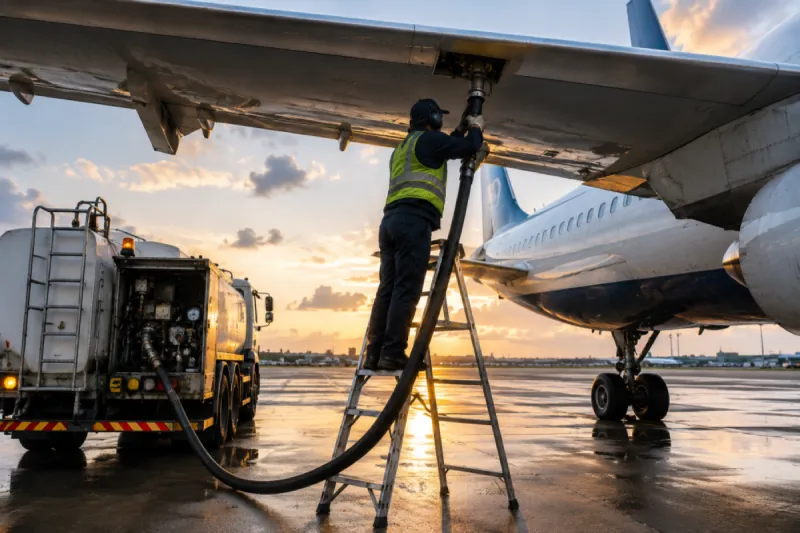
When you stop at a petrol station to fill your car, the quantity of petrol or diesel is measured in gallons or litres, because fuel is a liquid that is ordinarily traded by volume. In the world of aviation, however, pilots and engineers are not concerned with the number of gallons in an aircraft's tanks; they focus on something else entirely — the weight of the fuel.
For this reason, aviation fuel is measured in pounds or kilograms, not by volume as is the case with cars. This may seem strange at first glance, but it is in fact grounded in physical and engineering principles directly linked to aircraft safety and in-flight performance.
At ground level, most people do not notice any change in the volume of liquids, because temperatures and atmospheric pressure remain within relatively stable ranges. Measuring fuel by volume therefore seems perfectly natural.
Aircraft, however, do not remain at ground level. They climb to altitudes exceeding 10,000 metres, where temperatures drop sharply and atmospheric pressure changes significantly.
Under these conditions, fuel expands or contracts with temperature, meaning its volume can change during a flight. Its mass or weight, on the other hand, is unaffected by these changes — which makes weight the more accurate standard for calculating the quantity of fuel available to an aircraft.
Weight is the foundation of flight safety
The matter goes beyond measuring fuel alone; it concerns the total weight of the aircraft.
Weight is one of the most critical factors a pilot relies on before take-off, during the flight, and right up to the moment of landing. Any increase or decrease in weight affects the aircraft's performance, fuel consumption, take-off speed, and ability to manoeuvre and land safely.
For this reason, almost all aviation calculations are based on weight rather than volume, because weight determines the aircraft's ability to fly safely and efficiently, according to the website Slashgear.
This is clearly illustrated by military aircraft such as the F-15 Eagle fighter jet, which can carry up to 36,200 pounds of fuel distributed between its internal and external tanks.
Knowing how much fuel is in the tanks is not enough; it is also necessary to know its weight, how it is distributed among the various tanks, and the rate at which the engines are consuming it, because all of this directly affects the aircraft's balance and efficiency during a mission.
The same principle applies to civilian aircraft, which also rely on precise calculation of fuel weight before every flight.
Fuel consumption changes during a flight
An aircraft does not consume fuel at the same rate throughout a flight. During take-off and the climb to the required altitude, the engines operate at nearly full power, consuming a large quantity of fuel in a short time.
Once the cruising altitude is reached, however, air density decreases, the engines operate more efficiently, and the rate of fuel consumption gradually falls.
The pilot therefore needs to know the true remaining weight of fuel at every moment — not its volume — in order to manage the flight with the highest possible degree of efficiency and safety.
Why might an aircraft need to dump fuel?
One fact that may seem surprising is that many aircraft are not permitted to land carrying the same weight at which they took off.
For example, passenger aircraft such as the Airbus A320neo have a maximum take-off weight, while the maximum permitted landing weight is lower.
If an aircraft experiences an emergency shortly after take-off and must return to the airport, its weight may still exceed the safe landing limit because the fuel tanks are full.
In such cases, the pilot may be required to dump part of the fuel before landing, so that the aircraft reaches the permitted weight and avoids subjecting its airframe or landing gear to stress beyond design limits.
Why pounds and not gallons?
Aviation relies on pounds or kilograms because they provide a stable measurement that does not change with variations in temperature or altitude.
Measuring fuel by volume, on the other hand, can lead to discrepancies in calculations due to fuel expanding or contracting during a flight.
Relying on weight therefore makes all fuel and performance calculations more accurate, and facilitates the standardisation of criteria among airlines, manufacturers, and pilots around the world.
Using pounds instead of gallons may appear to be a mere difference in units of measurement, but it is in fact a fundamental part of the aviation safety system.
Every pound of fuel affects the aircraft's weight, range, energy consumption, and ability to take off and land safely. Weight therefore remains the primary language in which pilots and engineers speak when discussing aviation fuel, regardless of the type of aircraft or its destination.