
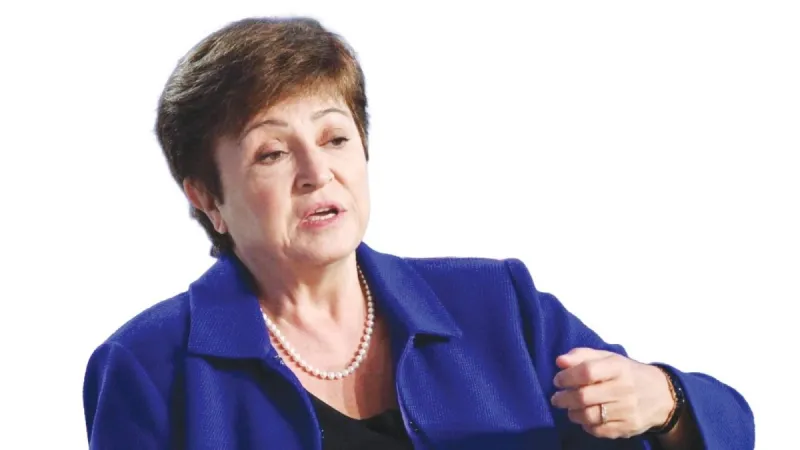
International Monetary Fund Managing Director Kristalina Georgieva has said the world needs to build stronger foundations capable of withstanding repeated shocks, after facing one crisis after another in recent years.
"I am concerned because we have not fully absorbed yet that this is the reality the world is heading towards... We will not reach a point where these shocks disappear," Georgieva said in a podcast broadcast on Bloomberg.
Georgieva has led the IMF since 2019, a period during which she has navigated the Covid-19 pandemic, the war in Ukraine, tariff disruptions, and most recently the conflict in the Middle East.
The Fund's lending capacity stands at approximately $1 trillion, and Georgieva describes her mission as keeping the Fund's 191 member countries focused on working together in the interest of the global economy. "The best weapon we have is objective analysis," she said.
The spread of artificial intelligence and its accompanying effects on labour markets and domestic economies represents one of the biggest transformations the world is witnessing. Georgieva acknowledged that international institutions, including the IMF, failed to track the inequalities generated by globalisation, and she is determined not to repeat the same mistake with artificial intelligence.
"None of us — including the Fund — grasped the full scale of the backlash from globalisation. The global economy improved overall, but many communities were hurt, having lost jobs without receiving adequate attention," she said. She added: "What I am very keen not to see repeated is the same scenario with artificial intelligence."
The IMF is scheduled to update its global economic outlook in July, after it lowered its growth estimates for this year in April in the wake of the fallout from the Middle East conflict.
The Fund also conducts annual reviews of member countries' economies, alongside other periodic reports and studies issued as part of its surveillance mandate to monitor global economic conditions.
In 2024, two years after Russia's invasion of Ukraine, the IMF announced its intention to resume its annual review of the Russian economy — known as the Article IV consultation — for the first time since the war began. The move was met with objections from several European Union countries, which criticised Georgieva over the decision.
"It was an extremely complex period, amid the mutual bombardment, so we decided to postpone the review," Georgieva said. "We needed to collect data on trade, imports and exports, but Russia was very reluctant to provide this information," she added. Georgieva said the Fund would resume its regular periodic review of the Russian economy "at some point", without specifying a timeline.
Georgieva had also warned that the global monetary system is unprepared to face the growing risks posed by artificial intelligence, amid the emerging cybersecurity threats raised by Anthropic's new model.
"We do not have the capacity — as a world — to protect the international monetary system from enormous cyber risks," Georgieva said. "We are very keen to devote more attention to the safeguards needed to protect financial stability in the age of artificial intelligence," she added, calling for global cooperation on the matter. "Yes, this is an issue that has been discussed here in the United States, but it is an issue that can easily arise in other parts of the world, and therefore we need everyone's cooperation," she said.
The IMF also said oil prices remain only about 3% above the levels on which it based its April baseline forecasts for global growth, but noted continued volatility in spot market prices and a decline in global reserves.
The Fund's 3.1% global economic growth forecast was based on an average oil price of $82.22 per barrel.