
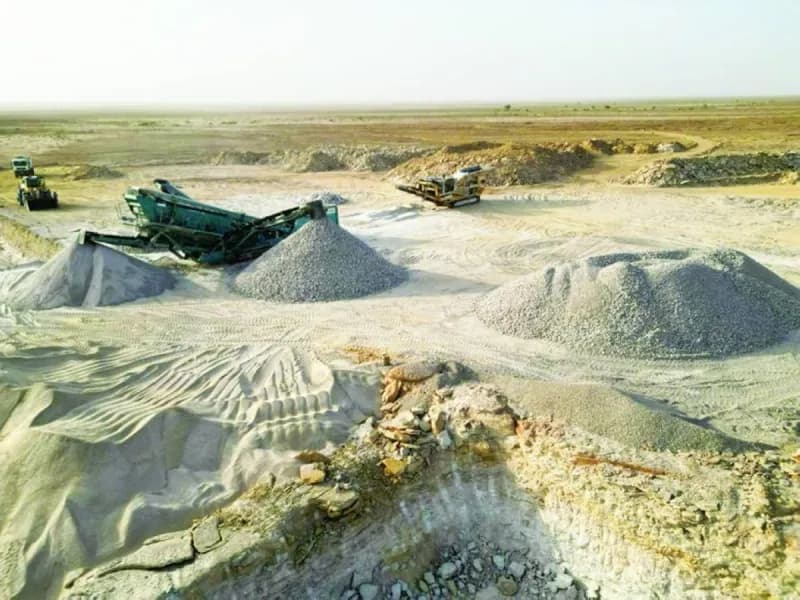
There is nothing more abundant on Earth than grains of sand, yet there exists a variety known as "white gold" — white in colour and entirely distinct from the ordinary sands used in construction. It is one of the most valuable natural resources in the countries where it is found. This is silica sand, or pure quartz — the primary raw material in silicon manufacturing and an indispensable input for precision technology industries and many others.
Silica sand is processed by melting white sand — composed principally of silicon dioxide — in high-temperature furnaces together with carbon sources to extract the element silicon. The process requires that the purity of the white sand used in smelting exceed 99% silica.
The sand must also be free of impurities, particularly iron oxide. Among the most prominent uses of the extracted silicon are electronic chips, semiconductors, integrated circuits, and the processors found in computers and smartphones.
Silicon is also used in the manufacture of solar panels, where it serves as the essential element in producing photovoltaic cells for electricity generation. It likewise features in chemical compounds — most notably silicone rubber — and in the production of sealants, lubricants, and synthetic rubber.
Silica sand is known as "quartz sand": pure white sandstone composed primarily of quartz mineral grains, containing less than 0.1% impurities and heavy minerals.
There is also "glass sand" — silica (quartz) sand whose physical and chemical specifications suit glass manufacturing in terms of grain size and an extremely low iron oxide content of less than 0.05%.
Silica sand is an input in a wide range of industries, including glassware, crystal glass, flat glass, fibreglass, and optical glass. It is also used in casting moulds, serves as a flux to lower the melting point of base oxides in smelting operations, and functions as a polishing material.
It is further used in the manufacture of ceramics, brick, and refractory materials, as well as in water filtration systems at wastewater treatment plants, swimming pools, and golf courses.
It can also serve as a filler and extender in the manufacture of rubber, plastics, paper, and paints, and in certain types of cement and concrete.
Silica sand is a widely available commercial and consumer product throughout North America. The United States, Australia, and China rank among the world's largest producers and exporters of silica (quartz) sand.
Each of these countries holds vast reserves directed towards various industries. The United States is the world's largest producer and manufacturer, with principal mines concentrated in the states of Minnesota, Wisconsin, California, and Nevada; it is used primarily in the oil and gas sector and in hydraulic fracturing operations for resource extraction.
Australia leads the Asia-Pacific region in production and export volumes. Areas such as Cape Flattery and Quiilbie are renowned for producing ultra-high-purity silica sand, with its most prominent domestic applications in advanced glass manufacturing, such as solar panels and display screens.
Large volumes are exported to meet global demand from the semiconductor sector. China ranks third in both production and consumption; it is the world's largest consumer of the silica sand market and also figures among the largest producers.
The Arab world's share of silica sand is modest compared with Europe and the Americas. At the regional level, the United Arab Emirates is among the most prominent countries in the area, with silica sand used intensively in construction, glass manufacturing, and oil and gas extraction operations.
Jordan possesses large deposits of high-quality silica-rich sandstone, concentrated in southern areas such as Ras Al Naqab, Al Quwayra, and Petra. Its ore is distinguished by ease of extraction and its strategic proximity to the port of Aqaba, facilitating export.
Egypt and Saudi Arabia, meanwhile, are counted among the countries that hold some of the world's purest and highest-quality silica sand. Egypt's deposits are found in areas such as Ain Sokhna and Al Zafarana on the Red Sea and Abu Zenima in southern Sinai. Both countries have in recent years adopted plans for intensive investment to localise solar energy and electronic chip industries based on silica with a purity exceeding 99%.