
The US Federal Reserve has turned a new page under the leadership of Kevin Warsh, who recently won Senate confirmation by a vote of 54 to 45 to become chairman of the Board, succeeding Jerome Powell, who had faced sharp criticism from President Donald Trump and sustained pressure to cut interest rates.
While Warsh — who has frequently criticised monetary policy and the management of the central bank — is widely seen as Trump's man, concerns about the Fed's independence are asserting themselves on the scene, despite Warsh's recent statements in which he sought to dispel those concerns by affirming that he had not promised the US president a rate cut.
Against this backdrop, the monetary policy meeting scheduled for 16 and 17 June is being viewed as "the first test of Warsh's leadership of the Fed and the nature of the internal understandings and balances within the Federal Open Market Committee."
The CME FedWatch service, which monitors the Federal Reserve's performance, showed that financial markets are pricing in a 99% probability that the Fed will leave its benchmark interest rate unchanged within the range of 3.50–3.75% at the mid-June meeting.
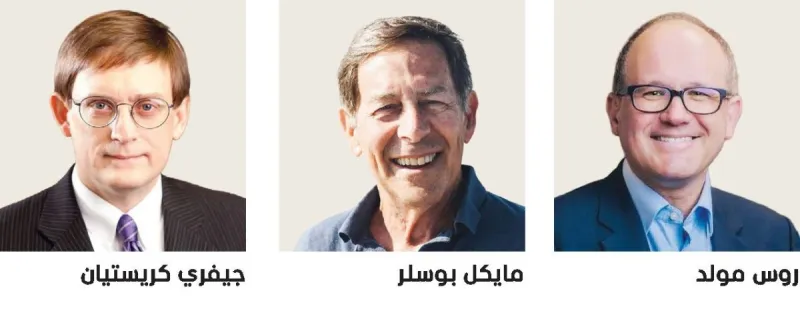
In exclusive comments to Al Bayan, Ross Mould, investment director at AJ Bell, said there would be considerable interest in any remarks issued by Warsh and the Fed governors in order to gauge how members of the Federal Open Market Committee are likely to vote.
The committee had been divided at its most recent meeting: the member appointed by President Trump, Stephen Miran, surprised no one by calling for a rate cut, while the real surprise came from three other members who demanded that the reference to a bias toward monetary easing be removed from the post-meeting statement.
Inflation continues to edge higher, while the labour market is relatively stable — even if the modest decline in the unemployment rate from its recent peak may owe more to a shrinking workforce and reduced immigration than to any genuine strength in job creation. Meanwhile, the housing market remains weak and consumer confidence has fallen to low levels.
Mould says that "despite these mixed signals from the real economy, Wall Street has continued to perform strongly, and the Fed may be reluctant to inject more cheap liquidity into a market environment already characterised by excessive optimism — bordering, perhaps, on euphoria.
The yield on the 10-year US Treasury bond will also remain at the back of committee members' minds, even if their official mandate is confined to inflation and employment."
He stresses that "there is a great deal for Warsh and his colleagues to discuss, especially since President Trump will undoubtedly push for a rate cut sooner rather than later."
Despite all of this, CME FedWatch data now show a one-in-three probability of a rate rise by year-end, versus a probability of barely 1% for a cut.
Jeffrey Christian, managing partner of the CPM Group, told Al Bayan that he and his team assume the Federal Open Market Committee will keep interest rates within the range of 3.5–3.75% at its meeting scheduled for next month.
He noted that this assessment is supported by several factors: rising inflation rates since March, and relatively stable employment conditions and economic output.
According to the latest data from the US Bureau of Labor Statistics, the Consumer Price Index rose 0.6% on a seasonally adjusted monthly basis, pushing the annual increase to 3.8%. The monthly rise was in line with expectations, but the annual rate exceeded Dow Jones estimates of 3.7% by 0.1 percentage point.
The core price index — which excludes food and energy and is the Federal Reserve's preferred measure — rose 0.4% month-on-month and 2.8% year-on-year, keeping inflation above the Fed's 2% target.
The monthly rate also hit its highest level since January 2025. The headline annual inflation rate reached its highest since May 2023, rising half a percentage point compared with March, while core inflation increased by 0.2 percentage points on an annual basis.
These developments represent a key starting point for a data-dependent Fed. Christian noted that "Kevin Warsh is expected to proceed with caution at his first meeting."
The US administration attributes the rise in inflation to the fallout from the war in the Middle East, which has contributed in particular to higher petrol prices. President Donald Trump holds an optimistic view of inflation in his country, saying it will fall to 1.5% — below the Federal Reserve's target rate — once the war ends.
He indicated that the current uptick in inflation is temporary. These remarks came before he departed the United States for Beijing to hold a summit with Chinese President Xi Jinping.
Professor Michael Busler, professor of finance at Stockton University in the United States, told Al Bayan: "I believe Kevin Warsh will lean toward cutting interest rates at the upcoming Federal Reserve meeting, but he will need to persuade a majority of board members to do so." He explained: "The war with Iran has constrained oil supplies, driving global crude prices up by roughly double.
As a result, inflation in the United States has risen significantly. Before the war broke out, inflation — which had peaked at 9.1% in July 2022 — had fallen to 2.4%.
Due to the war, March and April saw inflation climb to its current level, with the annual inflation rate now standing at 3.8%." Nevertheless, if the war in the Middle East ends in the coming days, energy prices will fall sharply.
By the time of the Federal Reserve meeting, oil prices may have declined enough to put inflation on a downward trajectory. The economist noted that "if this scenario materialises, a rate cut at the June meeting becomes possible. Such a cut would have a positive effect on the stock market, causing it to continue rising substantially."