
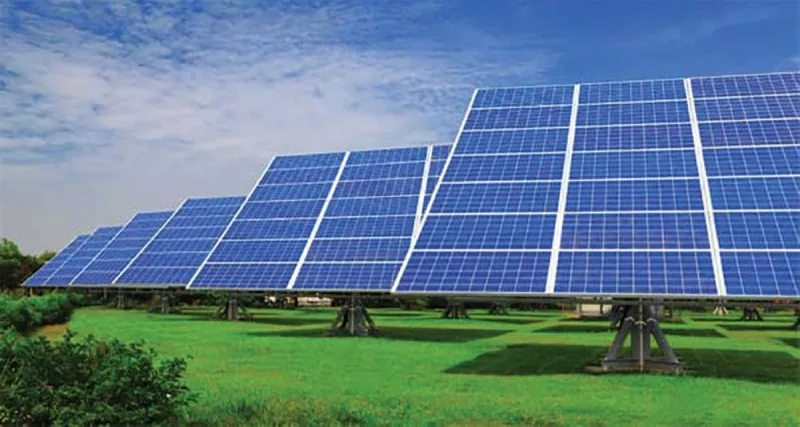
Fortunate are those countries that enjoy brilliant sunshine throughout the year — not only for producing good agricultural crops, but for obtaining a clean source of electricity through what is known as the solar, photovoltaic, or photoelectric cell, which in the early days of its manufacture was called a "solar battery".
That term now carries an entirely different meaning. The solar cell is a device that converts solar energy directly into electrical energy. It is composed of a silicon layer to which certain elements are added to give it electrical properties. Phosphorus is added to the upper layer facing the sun, giving it the property of pumping electrons when light falls upon it.
Boron is added to the lower layer to give it the property of absorbing electrons. When a sunbeam strikes the upper layer, it imparts energy to the electrons — an amount that depends on the intensity of solar radiation. Thanks to an electrical conductor between the two layers, electrons move from the upper layer to the lower layer, thus generating an electric current.
If a photovoltaic cell produces electrical energy on the ground, imagine what it can achieve in space — would it not be faster and more efficient in performing its function? The use of solar cells has extended to supplying spacecraft and satellites with the electrical energy they require, after previously serving merely as an alternative to conventional "terrestrial" energy sources such as petroleum, coal, gas, and their derivatives — resources that are finite in nature and susceptible to depletion due to massive exploitation.
These cells are distinguished by producing "clean electricity" without causing environmental pollution. The expected lifespan of a cell reaches 30 years, though the high cost of production remains the main obstacle to their widespread use.
The intensity of the electric current produced by solar cells depends on the duration and intensity of sunlight, as well as on the efficiency of the photovoltaic cell itself in converting solar energy into electrical energy. Connected in series, cells can produce hundreds of volts of direct current.
The energy produced can also be stored in lead-acid batteries or in alkaline batteries made from nickel and cadmium, and the direct current can be converted into alternating current to power ordinary household and industrial electrical appliances.
Among the advantages of solar cells is that they have no moving parts subject to breakdown. This is why they operate aboard satellites with high efficiency — they require no maintenance, no repairs, and no fuel. They work in silence. However, soiling caused by pollution or dust reduces their efficiency, necessitating regular cleaning.
The United Arab Emirates is leading the energy transition through giant solar cell projects, most notably the Mohammed bin Rashid Al Maktoum Solar Park, with a target capacity of 5,000 megawatts by 2030. These projects also include the Al Dhafra power station in Abu Dhabi with a capacity of 2,000 megawatts, the Shams 1 station with a capacity of 100 megawatts, and the Al Ajban project at 1,500 megawatts.
The term "photovoltaic" derives from a Greek word meaning "light," from the name of the Italian physicist Volta, and from the word "volt" — the unit of measurement for electrical force. The term was adopted in the English language in 1849.
In 1839, the French physicist Becquerel presented a new definition of light energy and how it could be converted into electricity. In 1883, American inventor Charles Fritts created the first working selenium cell.
The following year, he installed the world's first rooftop solar energy system on a building in New York City, United States, coating selenium and semiconductors with an extremely thin layer of gold. The efficiency of the device at that time, however, did not exceed 1%.
In 1888, Russian physicist Alexander Stoletov built the first photoelectric cell based on the effect of the "external photoelectric force" theory, which Heinrich Hertz had discovered earlier in 1887. The celebrated scientist Albert Einstein then explained the photoelectric effect in 1905.
That explanation was one of the reasons he was awarded the Nobel Prize in Physics in 1921. In 1946, American inventor Russell Ohl received a patent for semiconductors at the junction of modern solar cells, until the modern photovoltaic cell was developed in 1954 at Bell Laboratories.
Ohl was working there at the time. A high-efficiency solar energy cell was placed into use for the first time in 1954, but the problem lay in the cost of the electricity it produced: a cell generating 1 watt of electrical energy in bright sunlight cost approximately $250, compared with $2 or $3 in the case of coal.
The invention of solar cells might have fallen into oblivion had they not been employed in the Vanguard satellite, launched in 1958, which had previously been powered solely by battery. By adding the cells to the exterior of its body, the satellite gained a new power source.
There were doubts at the outset, but practical experience proved the cells to be a great success. In the end, solar cells remain a clean energy source — one that draws its very chance of survival from the existence of the sun.