
DP World Group has cemented its standing as a global economic force that transcends borders, going far beyond traditional port management to establish itself as an integrated system that controls and reshapes the flows of global trade across continents.
Numbers that reflect this weight: the group manages an annual trade ecosystem estimated at approximately AED 712 billion, alongside cumulative investments reaching AED 239 billion, reinforcing its position as one of the most prominent drivers in the modern global economy.
Starting from Dubai, DP World has established its presence in more than 80 countries spread across six continents, giving it access to roughly two-thirds of the world's population. The group employs more than 125,000 people and operates a global network of more than 300 cargo freight offices.
Thanks to this vast reach, the group has succeeded in developing an integrated logistics ecosystem that enables companies to access new markets with greater efficiency, while removing the regulatory and logistical obstacles facing international trade flows.
At the heart of this ecosystem, Jebel Ali Port and Jafza stand out as two principal hubs in cementing Dubai's status as a global centre for trade and re-export. Approximately 80% of the UAE's trade passes through Jebel Ali Port, making it one of the most vital arteries supporting import and export movements and linking regional and global markets.
The port is the largest in the Middle East and serves as the cornerstone of the region's largest free zone, Jafza, which hosts 12,000 companies operating across manufacturing, logistics, retail, healthcare, automotive, and food sectors.
Through its investments in digitalisation, automation, and the development of smart ports, the group has helped reduce shipping times, lower transport costs, and improve the efficiency of commercial operations — an impact that has benefited large corporations and extended to small and medium-sized enterprises, which are now able to access markets that were previously beyond their operational reach.
The economic impact of DP World Group in the countries where it operates encompasses developmental dimensions that go beyond port logistics infrastructure. The group has contributed to creating thousands of direct and indirect jobs through its operational activities and associated supply chains, including transport, storage, and support services.
It has also helped stimulate trade in these markets by raising cargo flow efficiency and reducing shipping times and costs, which has positively affected local commercial activity dynamics.
In addition, the group has played a pivotal role in attracting foreign investment by developing integrated economic ecosystems encompassing ports, free zones, logistics services, and related industries — contributing in turn to its share of gross domestic product in a number of the countries where it operates.
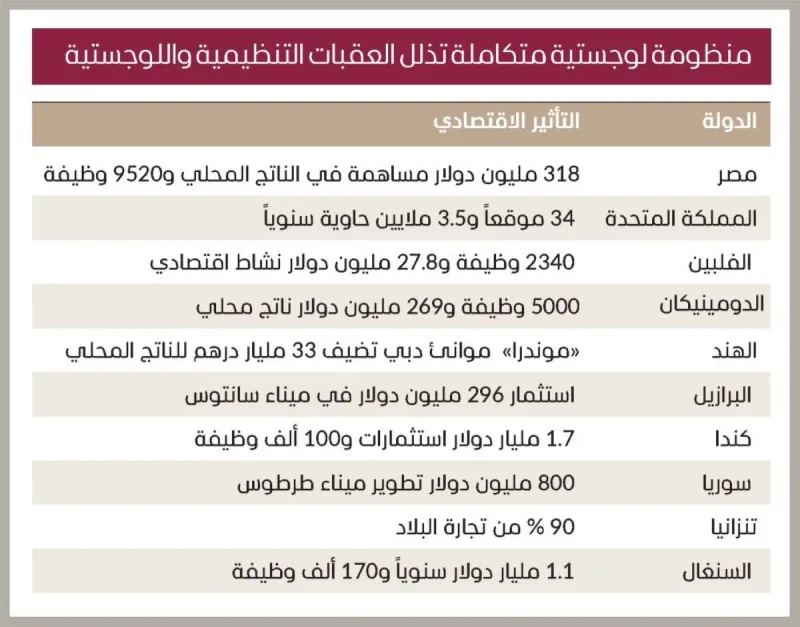
A survey conducted by Al Bayan, drawing on a range of specialised economic reports and official data, found that DP World's direct and indirect contribution to the economies of a sample of countries runs into tens of billions.
The survey covered a sample of countries in which the group operates, including India, the United Kingdom, the Philippines, the Dominican Republic, Canada, Egypt, Brazil, and others, while the economic impact extends to 80 countries across the group's operations on six continents.
At the heart of the Suez Canal Economic Zone, Sokhna Port continues to play a pivotal role in supporting trade flows and economic growth, driven by DP World's operational and investment activities, which, according to an independent economic analysis, reflect a wide-ranging impact extending to GDP, employment, and exports within Egypt.
A report issued by Oxford Economics revealed the growing economic role of Sokhna Port in supporting the Egyptian economy. The port's operations during 2024 contributed approximately $318 million to Egypt's GDP, while directly and indirectly supporting and generating close to 9,520 direct, indirect, and induced jobs nationwide.
The report noted that Sokhna Port's contribution to Suez Governorate alone amounted to $239 million in total added value, equivalent to approximately 6.92% of the governorate's economy, with these activities also supporting 3,030 jobs within Suez.
The report indicated that the port provided 910 direct jobs within the terminal, while its associated supply chains supported around 4,410 indirect jobs, in addition to 4,200 further jobs generated by the consumer spending of workers and their families — reflecting the broad impact of the port's operational activities across various economic sectors.
The report also showed that the productivity of workers at Sokhna Port far exceeds the sector average, with each port employee linked to generating total added value of approximately $230,000, compared with around $37,000 per worker in the transport and storage sector at the regional level.
On the public revenue side, port activities generated $12.3 million in tax revenues for the state during 2024, of which $5.6 million was paid directly by Sokhna Port and DP World in the form of taxes and social contributions.
Economic estimates indicate that DP World's presence at Sokhna is expected to help raise Egyptian exports over the long term by approximately 2.1%, with a projected increase in national productivity of around 0.2% by 2035.
According to future scenarios, this impact could result in approximately $1.0 billion in additional Egyptian merchandise exports by 2035 and roughly $1.1 billion in additional GDP.
Mohamed Shahab, CEO of DP World – Egypt and North Africa, said: