
The United Arab Emirates has achieved significant leaps in the space sector in recent years, from sending the first Emirati astronaut to space to the successful arrival of the Hope Probe in Mars orbit. Today, the country is moving into a new phase focused on developing and manufacturing commercial satellites locally, at a time when nations are racing to strengthen their space sovereignty amid shifting global geopolitical dynamics.
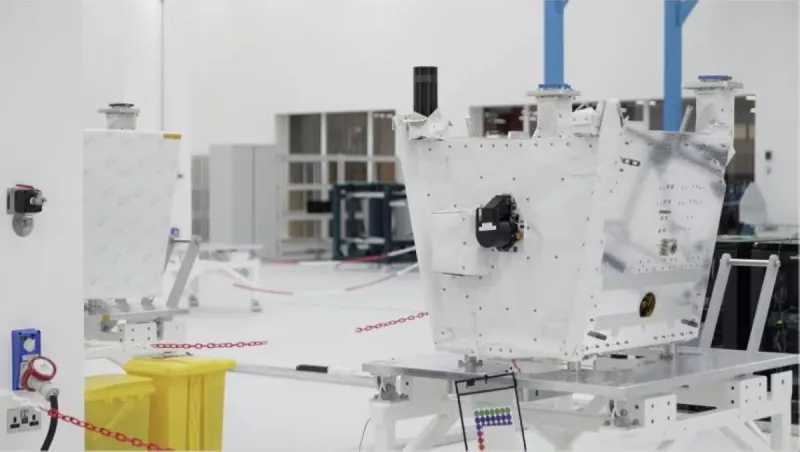
In this context, Abu Dhabi-based company Orbit Works is developing AI-powered satellites as part of a constellation called Altair, comprising 10 Earth-observation satellites with applications ranging from environmental monitoring and resource management to security and surveillance.
The company — a joint venture between UAE-based Marlan Space and US-based Loft Orbital — plans to launch its first satellite in October, a step that reinforces the UAE's standing as a regional hub for space technology development.
Data processing in space
Orbit Works satellites rely on artificial intelligence to process data onboard the satellite itself, rather than transmitting raw data to ground stations, enabling near-real-time delivery of analytics and insights to users and giving the company a competitive edge in the global satellite market.
Dr. Hamdallah Mohaib, CEO of both Orbit Works and Marlan Space, told CNN through correspondent Paula Hancocks that the company offers a "constellation-as-a-service" model, allowing governments, companies, and research institutions to lease satellite capabilities without needing to own them, amid growing interest from nations in building sovereign space assets.
The company's Abu Dhabi factory, spanning 50,000 square feet, has a production capacity of up to 50 satellites per year, with each satellite weighing up to 500 kilograms, while an expansion plan valued at up to $1 billion to launch an additional 40 satellites is under consideration.
Leadership in the space economy
Data from the Boston Consulting Group indicates that the global space market reached $224 billion in 2024, while the Middle East and Africa space market is estimated at approximately $18 billion, of which the UAE accounts for 40 to 45%.
The country aims to double space economy revenues and join the list of the world's top 10 space economies by 2031, underpinned by major investments in infrastructure, legislation, and national talent, including the 3-billion-dirham National Space Fund.
The UAE also has an ambitious programme of future space missions, most notably a mission to the asteroid belt scheduled for launch in 2028, alongside a focus on building a sovereign space ecosystem and developing AI-powered commercial applications covering infrastructure monitoring, port management, disaster response, and climate change tracking.
In a sign of growing international confidence in Emirati capabilities, Orbit Works announced that the French space agency has joined its client roster — a development that reflects the UAE's transition from an importer of space technologies to a provider of advanced space solutions and services.