
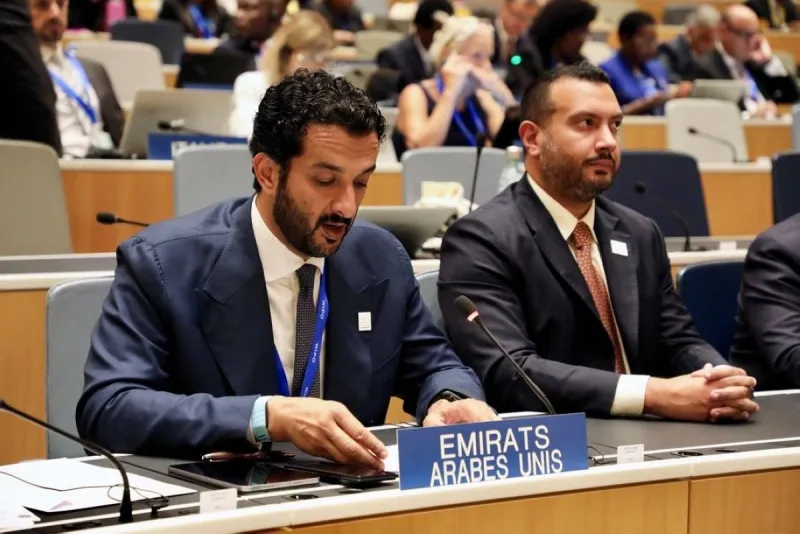
His Excellency Abdullah bin Touq Al Marri, Minister of Economy and Tourism, led the UAE delegation participating in the meetings of the 68th session of the Assemblies of Member States of the World Intellectual Property Organization (WIPO), held at the organization's headquarters in Geneva, Switzerland from 7 to 15 July, in the presence of Dr. Abdulrahman Hassan Al Maeeni, Assistant Undersecretary for the Intellectual Property Sector at the Ministry.
The UAE formally acceded during its participation in this session to the Locarno Agreement on the International Classification of Industrial Designs. The agreement is an international treaty concluded in the Swiss city of Locarno on 8 October 1968, administered by WIPO, and aimed at establishing a unified international classification system for industrial designs.
In this context, H.E. Abdullah bin Touq Al Marri said: "The UAE's accession to the Locarno Agreement represents an important milestone in strengthening the country's industrial design protection system and supporting the development of the national intellectual property framework in line with the best international standards. This step also reflects the UAE's vision of enhancing international cooperation in the field of intellectual property, particularly with regard to protecting industrial designs, facilitating the procedures for their registration, search, and comparison among member states, as well as unifying their classification procedures at intellectual property offices."
In his address delivered during the organization's meeting, he affirmed that the UAE, guided by the vision of its wise leadership, believes that the new economy constitutes a pillar for achieving sustainable economic development. On this basis, the country has attached great importance to creating a pioneering institutional environment that supports creators and inventors through the protection of intellectual property rights and the enablement of individual and institutional innovation, in alignment with the targets of the We the UAE 2031 vision, and contributing to cementing the country's position as a global hub for a knowledge- and innovation-based economy.
He added: "The UAE has developed advanced and proactive intellectual property laws, including the Law on the Regulation and Protection of Industrial Property Rights, the Trademarks Law, and the Copyright and Neighbouring Rights Law, which together have provided a comprehensive legislative framework for protecting intellectual property rights and supporting emerging entrepreneurial ventures and cultural and creative industries, thereby contributing to the diversification of the national economy and enhancing its competitiveness and sustainable growth."
He continued: "The Ministry of Economy and Tourism has launched more than 60 qualitative initiatives to enhance the intellectual property, innovation, and creativity environment over the past three years, at a rate exceeding 20 initiatives annually. Among these initiatives is the launch of the Trademark Market, the first innovative digital platform of its kind in the UAE and the region, dedicated to the sale and trading of trademarks."
He noted that these exceptional efforts have contributed to enhancing the UAE's position as a regional and global hub for innovation and competitiveness, particularly as it has maintained first place in the Arab world for the sixth consecutive year in the Global Innovation Index and advanced to 30th place globally.
He stressed the importance of keeping pace with rapid developments in the fields of artificial intelligence and emerging technologies within balanced frameworks that stimulate innovation and protect rights, noting in particular that the UAE led the world in the rates of adoption and deployment of artificial intelligence technologies during the first quarter of 2026.
Growing expansion of the UAE's intellectual property sector
The UAE's intellectual property sector continues its growing expansion, recording a series of positive results that reflect the success of the economic legislation, initiatives, and projects launched in recent years to develop and grow this vital sector. The Ministry of Economy and Tourism registered 17,217 national and international trademarks during the first half of 2026, while the total for 2025 reached approximately 39,113 trademarks.
Registered intellectual works in the country also recorded growth of 35.4% during the first half of 2026 compared to the same period in 2025, with the total number of intellectual works registered during 2025 reaching approximately 2,082 works.
With regard to patents, the Ministry achieved an increase of approximately 12% in the number of applications submitted during the first half of 2026 compared to the same period in 2025, while the total number of patent applications during last year reached 4,353. Utility certificate applications also recorded growth of 7.14% during the first half of the current year compared to the same period in 2025.
The UAE continued its efforts to protect intellectual works, particularly those related to broadcast rights and combating digital piracy, with the total number of violating websites blocked by the Ministry's "InstaBlock" centre reaching 31,852 during 2026, alongside a 26% growth in the number of websites blocked during the first half of the current year compared to the same period in 2025.
On another front, the Ministry of Economy and Tourism organised a pavilion at the exhibition accompanying the WIPO Assemblies meetings, in which a number of national entities concerned with intellectual property participated: the UAE Intellectual Property Association, the UAE Copyright Management Association, the Emirates Publishers Association, the Emirates Science Club, the Brand Owners Council, and the Sharjah Institute for Heritage.
The Ministry showcased the most prominent services and initiatives related to intellectual property activities in the country, as well as a collection of UAE handicrafts and heritage performances, in addition to highlighting a range of UAE innovations and inventions. The pavilion served as a platform to promote cultural exchange with the organization's member states, support the UAE's cultural diplomacy, and present the country as a leader in both creativity and cultural heritage protection. It also contributed to strengthening the country's cultural identity at the international level and cementing its pioneering role in building a comprehensive intellectual property ecosystem.