
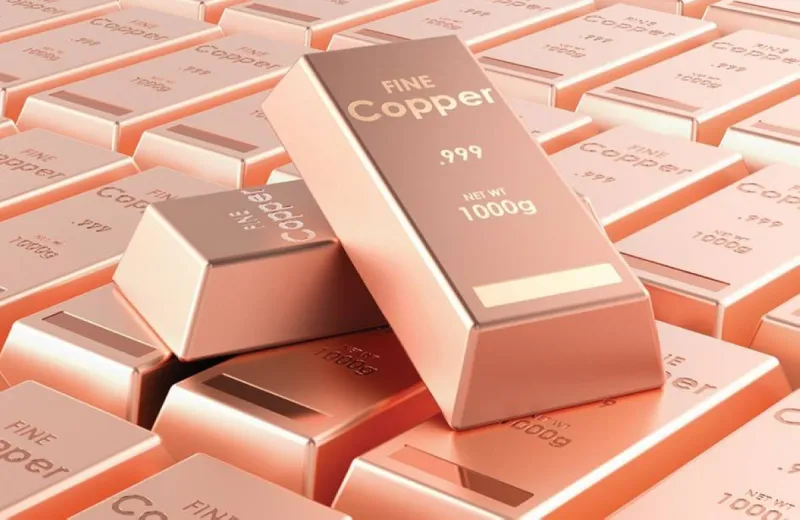
Humans have known it for more than thousands of years before Christ, fashioning from it primitive tools such as knives and daggers, then smelting it with other materials like tin to produce bronze. They adorned domes with it, crafted statues and works of art from it, minted coins from it, and used it as an excellent conductor of heat and electricity — it is copper, "the father of metals".
Copper is known as one of the few metals that can exist in nature in its free form, yet it also enters into the composition of a number of minerals in the Earth's crust. Humans have known and worked with it since ancient history in many parts of the world.
It was the first metal that humans were able to smelt and cast into moulds — this occurred in the historical period between 5000 and 4000 BC, known as the "Copper Age". Humans then discovered how to alloy it with tin to produce bronze around 3500 BC, giving rise to the "Bronze Age".
Copper is used in numerous applications, including the manufacture of electrical wires and measuring instruments, the production of alloys, the minting of coins, the crafting of jewellery and ornaments, and in the decorative arts.
It is also used as a building material. Copper sheets were widely used to clad the roofs and domes of buildings; when they oxidise, they turn green — a mark of architectural grandeur.
The historical phase in which humans mastered the smelting of copper was a pivotal moment in human history. Several archaeological sites around the world — in addition to the Middle East — point to this, including sites in China, Central America, West Africa, and Southeast Asia, where copper artefacts produced using precision casting methods dating to between 4000 and 4500 BC have been found.
A mummy was also discovered in the Alps belonging to Ötzi the Iceman, who lived during the Copper Age between 3300 and 3200 BC. He carried a copper axe blade with a purity of 99.7%, and elevated levels of arsenic found in his hair suggest he may have worked as a copper smelter.
The ancient Greeks also knew copper, calling it "chalkos". Scholars of the Islamic Golden Age likewise studied and classified copper and succeeded in preparing its compounds.
Sites and commercial markets renowned for copper craftsmanship and trade spread widely — among them the city of Alexandria in Egypt. To this day, the craft of the "coppersmith" remains one of the traditional trades of the Arab world, with dedicated markets in a number of capitals, such as the copper souk in Tunis and the coppersmiths' souks in Damascus, Cairo, and other capitals.
In the Americas, indigenous peoples extracted copper, and archaeological finds dating to between 800 and 1600 AD show they were able to alloy copper and gold into an alloy known as "tumbaga". Later, the Falun mine in Sweden became the principal source of copper extraction for all of Europe — supplying more than two-thirds — with mining beginning in the 10th century until it ceased operations in 1992.
Among the earliest modern applications of copper was its use in early forms of photography known as copperplate engraving, as well as in coin minting. Its use in constructing statues also became widespread, the most famous being the Statue of Liberty in the United States, in addition to its use in cladding rooftops and domes of buildings and in construction more broadly.
In the age of electricity — in the late 19th century — demand for copper rose dramatically due to its use in electrical wiring, with the United States among the leading nations in its production.
Sources indicate that the largest known mass of native copper weighed 420 tonnes and was found in 1857 in the state of Michigan. Among the most famous copper-rich sites are the Bingham Canyon mine in Utah and the Chino mine in New Mexico.
Copper is commonly alloyed with silver and gold, particularly in jewellery making, where it helps control the karat, colour tone, and melting point of the alloy. The "shakudo" alloy is widely used in Japan.
Copper can sometimes serve as a substitute for gold. One example is what is known as the "Nordic gold" alloy, which contains no gold whatsoever — it is composed of 89% copper, plus 5% aluminium, 5% zinc, and 1% tin — and is used primarily for minting coins, most notably the 50-euro-cent piece.
The copper reserves in the Earth's crust to a depth of one kilometre are estimated at approximately 1014 tonnes. Some estimates suggest that, given current consumption and growth rates, copper reserves could be depleted within no more than 60 years. This has prompted the adoption of the concept of "copper recycling" and has contributed to price instability: in June 1999, copper recorded a low not seen in sixty years, and in April 2007 it hit a record high, before falling again in the immediate wake of the global financial crisis the following year, 2008.